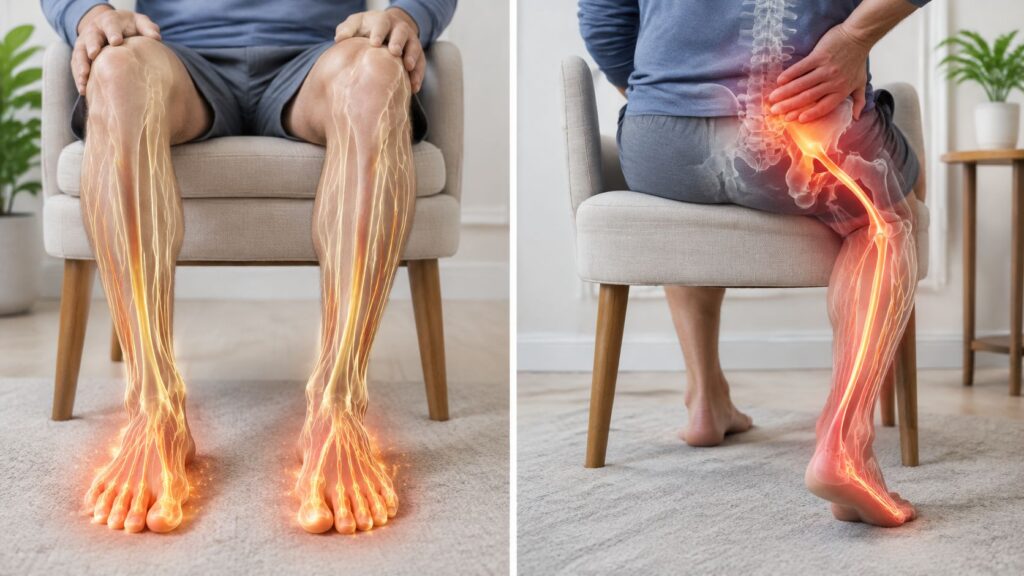
A lot of people start in the same place. A strange jolt down the arm when they turn their neck. Tingling in two fingers that won't go away. A leg that feels heavy on the stairs. Or low back pain that seems ordinary until the foot starts slapping the floor.
Those symptoms are unsettling because they don't always look dramatic. They can be vague, intermittent, or easy to explain away. But your spine and nerves are your body's communication system. When that system is irritated, compressed, or injured, the message often shows up as pain, numbness, weakness, poor balance, or changes in bladder, bowel, and other automatic body functions.
For people around Chicago Ridge, Oak Lawn, Palos Heights, Orland Park, Palos Hills, Worth, Bridgeview, Hickory Hills, Alsip, Burbank, and Evergreen Park, the most important first step is simple. Take new neurologic symptoms seriously, even if they seem mild at first.
That Unexplained Pain Numbness or Weakness
It often starts with a moment that doesn't seem big enough to matter. You lift a grocery bag, twist getting out of the car, sleep awkwardly, or stumble without fully falling. Later that day, your shoulder blade burns, your hand tingles, or your calf feels oddly weak. By the next morning, you're asking yourself whether this is just a pulled muscle or something more.
That uncertainty is one of the hardest parts for patients. Pain can be familiar. Nerve symptoms are different. They feel electrical, patchy, hot, cold, buzzing, or “off” in a way that's hard to describe. Many people worry they're overreacting. Others do the opposite and wait too long because they assume a true spinal injury would have to mean instant paralysis.
That's not how it always looks. The Mayo Clinic notes that symptoms can appear immediately or gradually as bleeding or swelling develops. It also notes that incomplete injuries may leave some sensation or movement intact, which is one reason early symptoms like tingling, one-sided weakness, or worsening pain can be easy to dismiss.
What patients often notice first
- Radiating pain: Pain that travels from the neck into the shoulder or arm, or from the low back into the buttock or leg.
- Sensory changes: Tingling, pins and needles, numb patches, or altered sensitivity to touch.
- Subtle weakness: Trouble opening jars, gripping objects, lifting the front of the foot, or climbing stairs.
- Coordination changes: Feeling off balance, clumsy, or less steady than usual.
New numbness, weakness, gait change, or bowel and bladder change is not “just pain.” It deserves medical attention.
If you live in Oak Lawn, Palos Heights, or Orland Park and you're trying to decide whether your symptoms matter, the practical answer is yes. They may turn out to be treatable nerve irritation, a disc problem, spinal narrowing, or another condition that benefits from early evaluation. Waiting doesn't make the pattern clearer. It often just gives the problem more time to declare itself.
Decoding Your Spinal Nerve Injury Symptoms
A useful way to think about spinal nerves is to picture the wiring in a house. When one wire is irritated, you don't always get a total power outage. Sometimes you get flickering lights, a buzzing outlet, or one room that keeps cutting out. Nerve problems work the same way. The signal may be painful, distorted, weak, or intermittent.
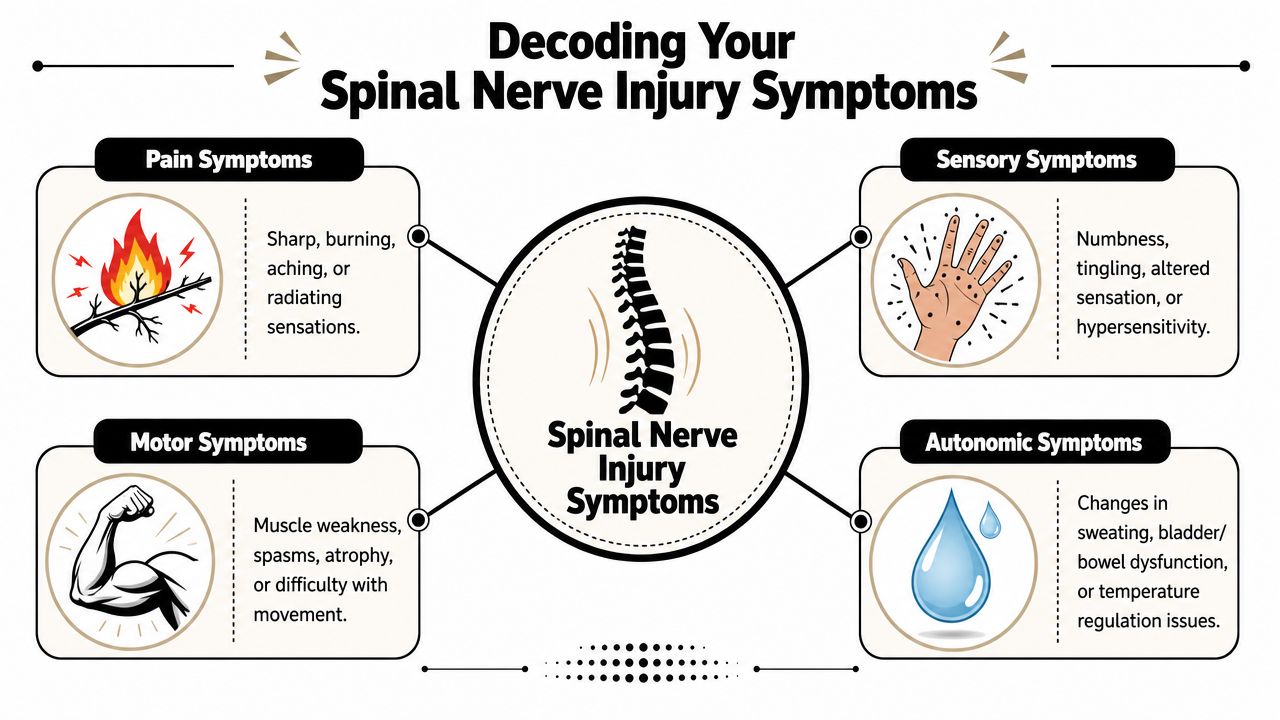
Pain symptoms
Nerve pain often has a distinct quality. Patients describe it as shooting, burning, stabbing, searing, or electric. It may start in the neck or low back and travel along a narrow path into an arm or leg. That pattern matters because nerves follow specific routes.
Some pain is constant. Some shows up only with certain positions, coughing, standing, or walking. If your pain has that electric or radiating character, it's often more informative than a general ache. For a deeper look at treatment approaches, this guide on how to manage neuropathic pain explains why nerve pain behaves differently from muscle soreness.
Sensory symptoms
When the signal gets noisy, sensation changes. You may notice:
- Numbness: A deadened or reduced ability to feel touch.
- Tingling: Pins and needles, buzzing, crawling, or vibrating sensations.
- Altered temperature sense: Trouble telling hot from cold in the affected area.
- Hypersensitivity: Clothing, sheets, or light touch feel unusually irritating.
Motor symptoms
Motor deficits are often more important than pain, even when they hurt less. A compressed or injured nerve can make a muscle weaker, slower to respond, or harder to control.
Common examples include dropping objects, difficulty lifting the arm overhead, reduced grip strength, trouble rising onto the toes, or the front of the foot catching the ground.
Autonomic symptoms
This is the category people miss most often. According to the World Health Organization, spinal cord injury symptoms can include partial or complete loss of sensory and motor function, along with bowel, bladder, sexual, blood pressure, heart rate, and body temperature dysregulation, and an estimated 15.4 million people were living with SCI worldwide in 2021.
Clinical takeaway: Pain gets attention, but weakness, numbness, balance change, and autonomic symptoms often tell us more about how much the nerve is struggling.
Mapping Symptoms to Your Spine
One of the most reassuring parts of a proper evaluation is realizing that symptoms usually follow a map. Doctors use dermatomes to track sensory symptoms and myotomes to track muscle weakness. In plain English, that means each spinal nerve tends to serve a predictable skin region and a predictable group of muscles.
So if numbness shows up in one part of the hand, and weakness shows up in a matching movement, that pattern points us toward a likely nerve root. It doesn't replace an exam or imaging, but it explains why a neck problem can cause hand symptoms, or why a low back issue can affect the foot.
A simple way to use the symptom map
Notice three things:
- Where the symptom starts
- Where it travels
- Which movement feels weaker
Pain alone can be noisy. A pattern of pain plus numbness plus weakness is usually much more useful.
Common spinal nerve symptom map
| Spinal Level | Common Area for Numbness Tingling (Sensory) | Common Area for Weakness (Motor) |
|---|---|---|
| C5 | Outer shoulder and upper arm | Shoulder lifting |
| C6 | Thumb and index finger | Wrist extension, elbow flexion |
| C7 | Middle finger | Elbow extension, pushing movements |
| C8 | Ring and little finger | Grip strength, finger flexion |
| L4 | Front of thigh, inner lower leg | Knee extension |
| L5 | Outer leg, top of foot, big toe | Lifting the foot or big toe |
| S1 | Outer foot, sole, back of calf | Pushing off the toes |
These are common patterns, not a home diagnosis chart. Bodies vary. More than one level can be involved, and swelling or inflammation can blur the picture.
If symptoms cross several areas, come and go, or don't fit a neat pattern, that doesn't mean nothing is wrong. It usually means the evaluation has to be more careful.
Patients with buttock pain shooting down the leg often assume they only have “sciatica,” but that word describes a symptom pattern, not a final diagnosis. Causes can differ, and treatment should match the cause. This overview of how to manage sciatica gives a useful framework for understanding that distinction.
Common Causes of Spinal Nerve Injuries
Not every nerve injury comes from a dramatic accident. Some do. Many don't. In practice, nerve symptoms often come from compression, inflammation, instability, or a combination of all three.
A herniated disc is one common example. Patients often understand it best when it's compared to a jelly-filled cushion that develops a weak spot and bulges outward, pressing on a nearby nerve. That pressure can create pain, numbness, or weakness depending on the level involved.
Structural problems that often irritate nerves
- Spinal stenosis: The central spinal canal narrows, reducing room for nerves.
- Foraminal stenosis: The side opening where the nerve exits becomes tighter.
- Spondylolisthesis: One vertebra shifts relative to another, which can irritate nerves and change mechanics.
- Bone spurs and arthritic change: Wear-and-tear changes can crowd nerve pathways.
Age matters here, but not in a simplistic way. According to Cleveland Clinic, between 250,000 and 500,000 spinal cord injuries occur every year worldwide, the average age at injury is 43 years, and the average age has risen from 29 years in the 1970s to 43 years today; the same source notes about two-thirds of new spinal cord injuries are incomplete. Clinically, that helps explain why some people don't experience total loss of function. They may still have mixed symptoms such as weakness, tingling, gait change, pain, or patchy sensory loss.
Trauma is one cause, not the only cause
Falls, car crashes, sports injuries, and work injuries can clearly injure the spine or nerves. But I'd urge patients not to anchor only on trauma. Degenerative narrowing, disc changes, prior surgery, scar tissue, and longstanding posture or load issues can also create very real spinal nerve injury symptoms.
What doesn't work is treating every radiating pain problem as “just inflammation” for weeks on end without asking whether strength, reflexes, sensation, or walking ability have changed. Once weakness enters the picture, the conversation changes.
How We Diagnose Nerve Injuries in Chicago Ridge
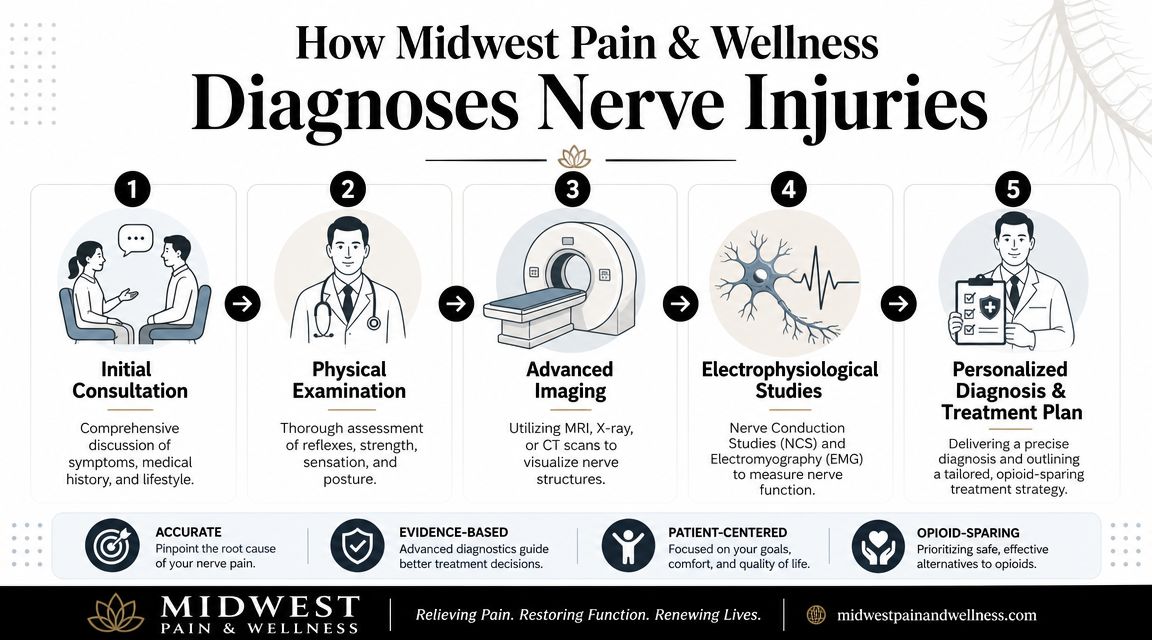
Patients often feel better once they know what the diagnostic process looks like. A careful evaluation isn't a rush to a procedure. It's a stepwise process designed to answer three practical questions. Which nerve is involved, what is irritating it, and how urgent is the problem?
The exam still matters
A strong neurologic and musculoskeletal exam does a lot of work. We look at strength, reflexes, sensation, balance, gait, and the specific positions that aggravate or relieve symptoms. That helps separate nerve root irritation from joint pain, muscle injury, or peripheral nerve entrapment.
Patients are often surprised by how much information comes from simple movements. Walking on heels, walking on toes, extending the knee, lifting the big toe, turning the neck, or checking reflexes can narrow the diagnosis quickly.
Imaging and electrodiagnostic testing
Imaging shows structure. MRI is often the study that best reveals disc problems, stenosis, and nerve compression. X-rays can help assess alignment and instability. CT may help in selected situations when bone detail matters.
EMG and nerve conduction studies answer a different question. They help assess nerve function, not just anatomy. That distinction matters when symptoms are confusing, when more than one problem may be present, or when we need to know whether a nerve is actively irritated versus showing older damage.
- Clinical history: When it started, what triggered it, and whether symptoms are progressing
- Focused examination: Strength, reflexes, sensation, coordination, and provocative testing
- Imaging when indicated: To confirm where compression or structural change exists
- EMG and nerve conduction studies when needed: To clarify the health of the nerve itself
For patients who want a clearer sense of how clinicians sort through overlapping spine complaints, this article on how to diagnose back pain is a useful companion.
Your Path to Relief with Advanced Treatment Options
You finally have an answer for the pain, numbness, or weakness. The next step is choosing treatment that matches the problem, protects function, and gives you a realistic path back to daily life.

For many patients, treatment starts conservatively. That usually means adjusting activity without shutting life down, using physical therapy that targets the irritated structure, and considering anti-inflammatory treatment when it fits the medical picture. The goal is to calm the nerve while keeping the rest of the body from getting weaker or stiffer.
Prolonged bed rest rarely helps. Repeated short-term fixes without a clear diagnosis rarely help either. Opioids also have a limited role in most spinal nerve problems because they do not correct compression, instability, or persistent inflammation, and they can make long-term recovery harder.
When pain keeps blocking sleep, walking, work, or rehab, a procedure may be the right next step. In practice, the trade-off is simple. The more precisely treatment matches the pain generator, the better the chance of meaningful relief.
Opioid-sparing interventional options
- Epidural steroid injections: These can reduce inflammation around an irritated nerve root and create a better window for movement and therapy.
- Medial branch blocks and radiofrequency ablation: These are useful when joint-related spine pain is part of the overall symptom picture, especially if nerve symptoms and mechanical back pain are overlapping.
- Minimally invasive lumbar decompression: In selected patients with lumbar stenosis, this can relieve pressure in a focused way without a larger surgery.
- Vertiflex Superion: In selected cases of lumbar spinal narrowing, this may help maintain space and reduce leg symptoms brought on by standing or walking.
- Peripheral nerve stimulation or spinal cord stimulation: These options may help some patients with persistent nerve-related pain when simpler measures have not provided enough relief.
Dr. Yaw Donkoh is a double board-certified interventional pain specialist, and Midwest Pain & Wellness offers these opioid-sparing approaches as part of a broader treatment plan. That plan may also include rehabilitation, regenerative treatments in selected cases, and coordination with surgical teams when surgery is the right next step.
Red flag symptoms
New loss of bowel or bladder control, numbness in the saddle area, rapidly worsening leg weakness, severe balance decline, or major breathing difficulty needs emergency evaluation right away. Those symptoms are not routine pain-clinic problems.
Good care should leave you knowing why a treatment is being recommended, what improvement to expect, what limits still exist, and how progress will be measured. That clarity matters. It helps patients in Chicago Ridge, Hickory Hills, Worth, Alsip, and nearby communities move from confusing symptoms and stopgap treatment to a plan that is specific, opioid-sparing, and built around function.
FAQs About Spinal Nerve Injury Recovery
Can spinal nerve damage be permanent
Sometimes, yes. Sometimes, no. The answer depends on how severe the injury is, how long the nerve has been compressed or inflamed, and whether there's ongoing instability. Some nerves recover well. Others recover partially. The main goal is to identify the problem early enough to protect function and improve the odds of recovery.
Is major surgery my only option
No. Many patients improve with a combination of precise diagnosis, rehabilitation, activity changes, medications chosen carefully, and minimally invasive interventional treatment. Surgery becomes part of the conversation when there is significant structural compression, progressive neurologic loss, instability, or when less invasive care hasn't been enough.
How long will recovery take
Recovery isn't one timeline. Irritated nerves can calm down faster than compressed or injured nerves. Muscle weakness often takes longer to improve than pain. The important thing is steady progress in the right direction, not expecting every symptom to disappear at once.
When should I stop waiting and get checked
Get checked promptly if symptoms are new, worsening, or paired with weakness, balance trouble, or numbness that spreads. If bowel, bladder, saddle numbness, or fast progression is involved, seek emergency care.
If you're dealing with spinal nerve injury symptoms and want a clear diagnosis with an opioid-sparing treatment plan, Midwest Pain & Wellness serves patients in Chicago Ridge and surrounding Illinois communities, including Oak Lawn, Palos Hills, Palos Heights, Worth, Bridgeview, Hickory Hills, Alsip, Burbank, Evergreen Park, and Orland Park. A focused evaluation can help identify what's causing your symptoms and what practical next step makes sense.