Is Botox Actually Worth It for Chronic Migraines? Here’s What the Evidence Says
How effective is botox for chronic migraine is one of the most important questions anyone suffering from frequent, debilitating headaches can ask — and the short answer is: quite effective, especially compared to many oral options.
Here’s a quick summary of what the evidence shows:
| Outcome | What Research Shows |
|---|---|
| Headache days reduced | ~10.6 fewer days/month at 24 weeks (real-world data) |
| Patients with ≥50% fewer migraines | ~47% of patients at 24 weeks |
| Quality of life (HIT-6) | ~11.7-point improvement at 24 weeks |
| Acute medication use | ~7.4 fewer medication days/month |
| FDA approval | Yes — approved since 2010 for chronic migraine |
| Treatment frequency | Every 12 weeks (31 injection sites) |
Chronic migraine is more than just a bad headache. It means living with head pain on 15 or more days every month — and for millions of people, standard oral medications simply stop working over time. Botox (onabotulinumtoxinA) was specifically FDA-approved in 2010 as a preventive treatment for this condition, backed by large clinical trials and over a decade of real-world use.
This guide walks you through everything you need to know — from the clinical evidence and treatment protocol to side effects, costs, and whether you’re a good candidate.
I’m Dr. Yaw Donkoh, a double board-certified physician in anesthesiology and interventional pain management, and evaluating how effective is botox for chronic migraine is something I work through with patients regularly as part of personalized, minimally invasive pain care. Let’s get into the details so you can make a truly informed decision.
Understanding Chronic Migraine vs. Episodic Migraine
To understand if Botox is right for you, we first have to look at the “15-day rule.” In neurology, there is a massive divide between episodic migraine and chronic migraine.
According to the ICHD-3 criteria (the gold standard for headache diagnosis), chronic migraine is defined as having a headache on 15 or more days per month for at least three months, where at least eight of those days have clear migraine features. If you have fewer than 15 days, it’s considered episodic.
Why does this matter? Because Botox is only FDA-approved for the chronic variety. Research has shown that Botox isn’t particularly effective for episodic migraines, but for those in the “chronic” category, it can be life-changing.
The disability impact of chronic migraine is staggering. Patients often deal with “transformation,” where their headaches slowly increase in frequency over years until they are rarely pain-free. This often leads to medication overuse—taking triptans or NSAIDs so often that the body develops “rebound” headaches. At Midwest Pain And Wellness, we focus on breaking this cycle through our Migraine Pain Management Ultimate Guide strategies, which prioritize long-term relief over daily pill-popping.
How Effective is Botox for Chronic Migraine? The Clinical Evidence
When we talk about how effective is botox for chronic migraine, we have to start with the PREEMPT trials. These were the massive Phase III studies that led to the FDA’s green light in 2010.
In the PREEMPT 2 trial, Botox was shown to reduce headache days by 9.0 days per month, compared to only 6.7 days for the placebo group. While that might seem like a small gap, for someone living with 20+ days of pain, those extra pain-free days represent a significant return to normalcy.
According to OnabotulinumtoxinA in the treatment of patients with chronic migraine: clinical evidence and experience, the clinical significance goes beyond just the number of days. It also reduces the intensity of the attacks and the total number of hours a patient spends in pain.
Real-World Success Rates and Long-Term Durability
Clinical trials are great, but what happens in the “real world” where patients have jobs, stress, and other health issues? A massive 10-year meta-analysis of real-world data (2010–2021) provides a clearer picture.
The data shows that at the 24-week mark (after about two treatment cycles), patients saw an average reduction of 10.64 headache days per month. Even better, this effectiveness is durable. At the 52-week mark, the reduction remained steady at about 10.32 days.
According to Effectiveness of onabotulinumtoxinA (BOTOX®) for the preventive treatment of chronic migraine: A meta-analysis on 10 years of real-world data, approximately 46.57% of patients achieve a 50% or greater reduction in their migraine days. In the medical world, a 50% reduction is considered a massive success, but many of our patients in Chicago Ridge see even better results as they continue treatment.
How Effective is Botox for Chronic Migraine in Improving Quality of Life?
We don’t just measure success by numbers on a calendar; we measure it by how you feel. Doctors use tools like the HIT-6 (Headache Impact Test), MSQ (Migraine-Specific Quality of Life), and MIDAS (Migraine Disability Assessment) to track this.
- HIT-6 Scores: Real-world data shows an average improvement of -11.7 points. Since a change of just 2.3 points is considered clinically important, this is a huge win.
- MSQ Scores: Patients reported an improvement of 23.6 points at 24 weeks, which jumped to 30.9 points at one year.

These functional gains mean fewer missed days of work, more time with family, and less “migraine hangover” between attacks.
The Science: How Botox Works to Stop Migraines Before They Start
A common misconception is that Botox works by “paralyzing” the muscles in your forehead. While Botox does relax muscles, that’s not actually how it stops migraines.
The real magic happens at the sensory nerve endings. Botox is taken up by the pain receptors in your nerves. Once inside, it blocks the release of neurotransmitters that carry pain signals to the brain. Specifically, it inhibits:
- CGRP (Calcitonin Gene-Related Peptide): A key protein involved in generating migraine pain.
- Substance P: A neurotransmitter that signals intense pain and inflammation.
- Glutamate: An excitatory neurotransmitter that helps “ramp up” pain signals.
By blocking these chemicals, Botox prevents “peripheral sensitization”—essentially keeping your nerves from becoming “hyper-irritable.” It calms down the trigeminal system, which is the major pain pathway in the head and neck.
What to Expect: The Botox Treatment Protocol and Safety
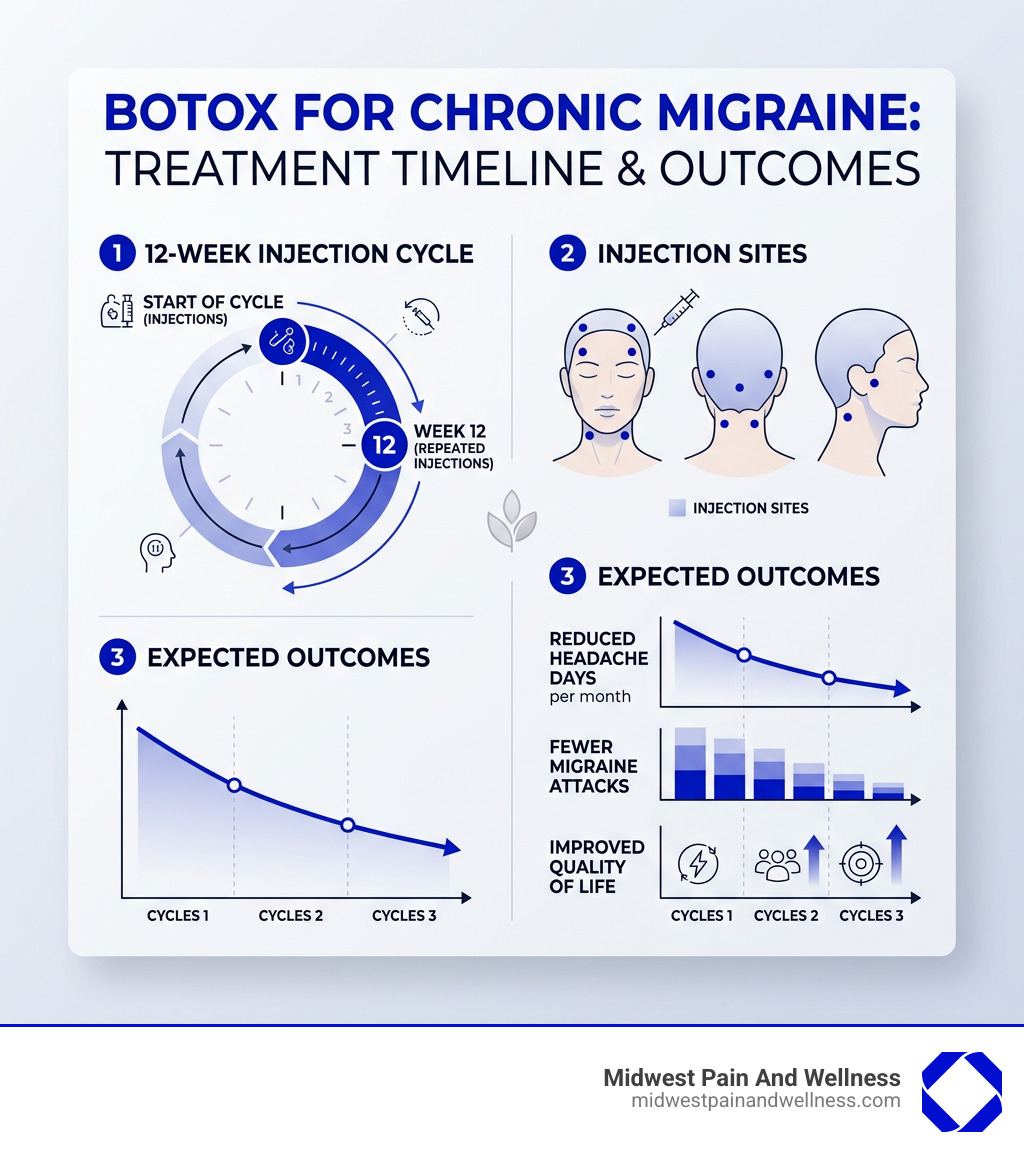
If we decide that Botox is the right path for you at Midwest Pain And Wellness, the procedure itself is surprisingly quick. We follow the FDA-approved PREEMPT protocol, which is standardized across the country.
- The Dose: 155 to 195 units of Botox.
- The Sites: 31 specific injection sites across the forehead, temples, back of the head, neck, and tops of the shoulders.
- The Schedule: Injections are given every 12 weeks (about every 3 months).
- The Session: The whole process takes about 10 to 15 minutes.
Our team in Chicago Ridge is highly trained in this specific injection map. We use tiny “insulin-style” needles, so most patients describe the feeling as a small pinprick or a tiny sting. You can read more about our specific approach to Botox for Chronic Migraine & Cervical Dystonia in Chicago Ridge on our service page.
Safety Profile and Common Side Effects
Botox has a very strong safety profile, especially since it stays largely local to where it is injected. However, like any medication, there are risks.
The most common side effects reported in clinical trials include:
- Neck pain (9%)
- Headache (5%)
- Eyelid drooping (ptosis) (4%)
- Muscular weakness (4%)
There is a “boxed warning” regarding the potential for the toxin to spread beyond the injection site, but this is extremely rare when used at the doses labeled for chronic migraine. Most side effects, like minor bruising or neck stiffness, resolve within a few days. For a full list of risks, you should always review the BOTOX full Prescribing Information.
Comparing Botox to Other Preventive Treatments
How does Botox stack up against the pills you might already be taking? The FORWARD study compared Botox directly to topiramate (a common oral preventive). The result? Botox had similar efficacy but much better “persistence” rates. This is because oral meds often cause “brain fog,” tingling, or fatigue, leading patients to quit.
| Feature | Botox | Oral Preventives (e.g., Topiramate) | CGRP Inhibitors (e.g., Aimovig) |
|---|---|---|---|
| Administration | Injection (Every 12 weeks) | Daily Pill | Monthly Injection |
| Common Side Effects | Neck pain, site bruising | Brain fog, weight loss, fatigue | Injection site reaction, constipation |
| Adherence | High (In-office) | Low (Easy to forget/quit) | High |
| Mechanism | Blocks neurotransmitter release | Calms overactive nerves | Blocks CGRP protein/receptor |
Determining if You Are a Candidate: How Effective is Botox for Chronic Migraine for You?
Not everyone with a headache is a candidate for Botox. To qualify, you generally need to meet these criteria:
- Age 18 or older.
- Diagnosis of Chronic Migraine (15+ days/month).
- Failed oral trials: Most insurance companies require that you have tried and failed at least 2–3 different classes of oral preventive medications (like beta-blockers, antidepressants, or anti-seizure meds).
We also look at your clinical goals. Are you looking to eliminate headaches entirely? While some patients achieve “permanent resolution” (about 22.7% in one study), the more realistic goal is to move you from “chronic” back to “episodic,” giving you your life back.
Frequently Asked Questions about Botox for Migraines
How long does it take for Botox to start working for migraines?
Don’t expect a miracle on day one! Most patients start to notice a reduction in headache frequency about 10 to 14 days after their first set of injections. However, the effect is cumulative. Many patients don’t see the full benefit until their second or even third treatment cycle (6–9 months in). Patience is key here.
Does Botox for migraines cause cosmetic changes?
Because we use a specific 31-site map, the “cosmetic” effect is minimal. We aren’t targeting the same areas or using the same doses as a plastic surgeon would for deep wrinkles. While you might notice some smoothing of the forehead, our goal is therapeutic. In rare cases, if the Botox migrates, you could have a temporary drooping eyelid, but with specialist precision, this is uncommon.
Is Botox covered by insurance for chronic migraine?
Yes, most major insurance plans, including Medicare and Medicaid, cover Botox for chronic migraine—but they have “hoops” you have to jump through. This usually involves “prior authorization,” where we provide documentation of your headache frequency and the other medications you’ve tried. There are also savings programs available from the manufacturer that can help cover out-of-pocket costs.
Conclusion
At Midwest Pain And Wellness, we believe that no one should have to spend half their life in a dark room waiting for a migraine to pass. Evaluating how effective is botox for chronic migraine is just one part of our multi-modal, opioid-free approach to pain management.
Our double board-certified doctors in Chicago Ridge, Illinois, specialize in creating custom care plans that combine current therapies like Botox with other interventional techniques for long-term relief. If you’re ready to break the cycle of chronic pain, we invite you to explore our Migraine Pain Management Ultimate Guide or schedule a consultation to see if you’re a candidate for Botox. Let’s get you back to living your life, headache-free.