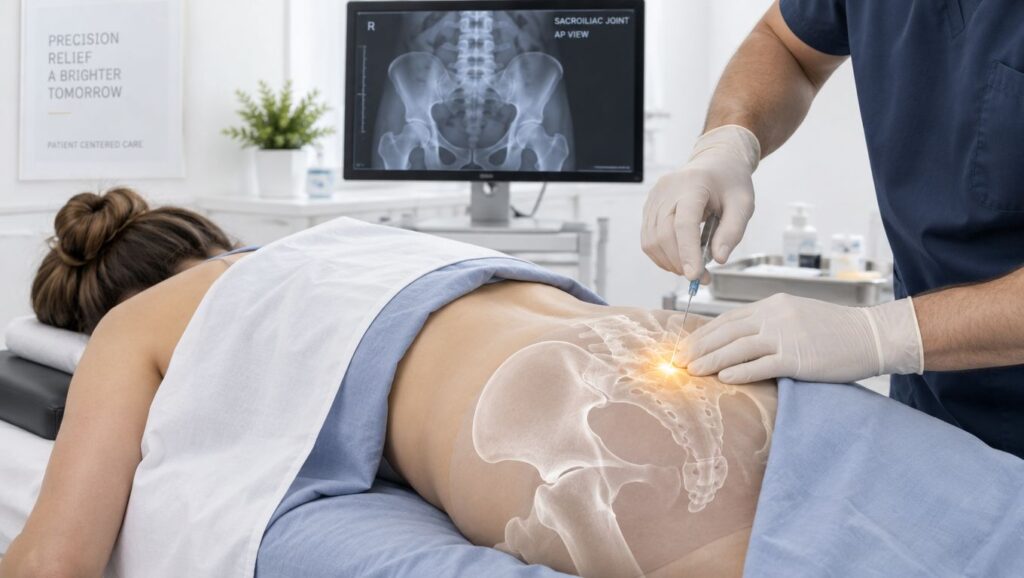
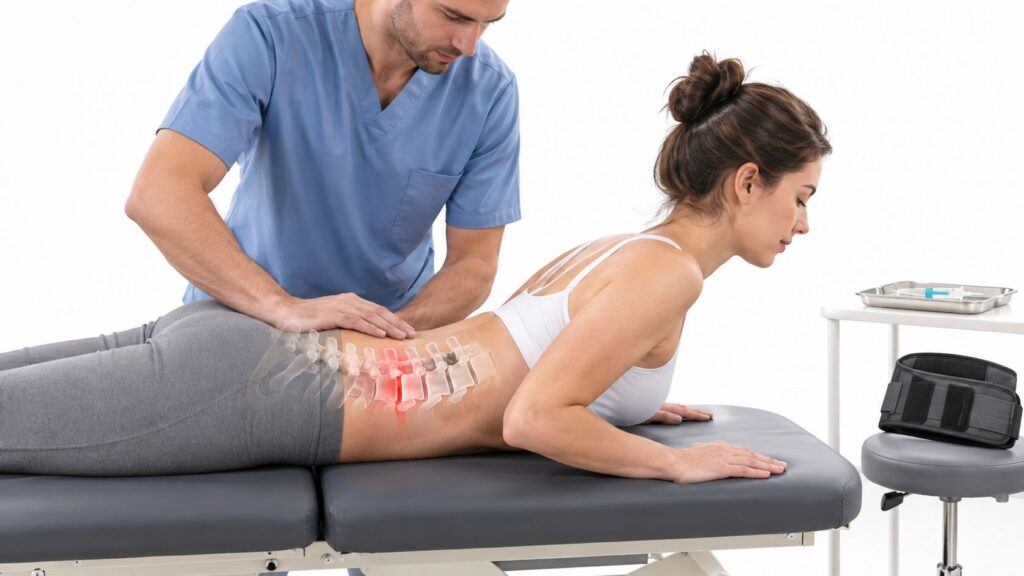
You turn to check behind you, lean back at the kitchen counter, or try to settle into bed, and the same patch of neck or lower-back pain returns. You've tried resting and doing general exercises, but you still don't have a clear explanation. Then an imaging report mentions “facet arthritis,” leaving you wondering whether that finding explains your pain or describes how your spine looks.
Table of Contents
- When Back or Neck Pain Has No Clear Explanation
- The Anatomy and Biomechanics Behind the Pain
- Symptoms That Raise Suspicion and Patterns That Overlap
- Why Imaging Alone Cannot Confirm Facet Joint Syndrome
- Treatment Options From Conservative Care to Interventional Procedures
- When to Refer for Specialist Pain Care
- A Practical Path Forward After Reading This
When Back or Neck Pain Has No Clear Explanation
A scan report can give you a medical term without answering your most important question: What's hurting? You might know where the discomfort starts and which movements aggravate it, yet still feel unsure about what to do next.
Consider a familiar situation rather than a specific patient case. Your lower back aches when you straighten up, and turning makes it worse. Someone has called it arthritis, but nobody has explained which structure is responsible or how that conclusion was reached.
Facet joint syndrome means pain arising from the small paired joints at the back of the spine. Clinicians also call it facet-mediated pain or zygapophyseal joint pain. The name identifies a suspected pain source, not every possible cause of chronic back or neck pain.
A recognized condition, not a catch-all label
Doctors have considered these joints potential pain generators for a long time. Spinal facet joints were proposed as a source of pain as early as 1911, Ghormley introduced the term facet syndrome in 1936, and Mooney and Robertson reported in 1976 that anesthetizing facet joints could relieve pain in selected patients, helping establish the modern clinical concept (medical history of facet joint syndrome).
That history matters because this isn't a newer name for unexplained discomfort. There's an anatomical structure to investigate and a targeted way to test whether its pain signals contribute to your symptoms.
The useful question: Which structure best explains your usual pain, and what evidence would support treating it?
A structured evaluation starts with your experience. Where does the pain begin? What happens when you move? What activities have you stopped doing? Your clinician then compares those details with examination findings and considers other explanations.
The answer isn't automatically another MRI, nor is it automatically an injection. Sometimes imaging is needed to investigate another condition. When the clinical picture points toward the facet joints, a targeted diagnostic procedure may answer a different question than a scan can.
You deserve an explanation that connects the proposed diagnosis to your symptoms and the next treatment decision.
The Anatomy and Biomechanics Behind the Pain
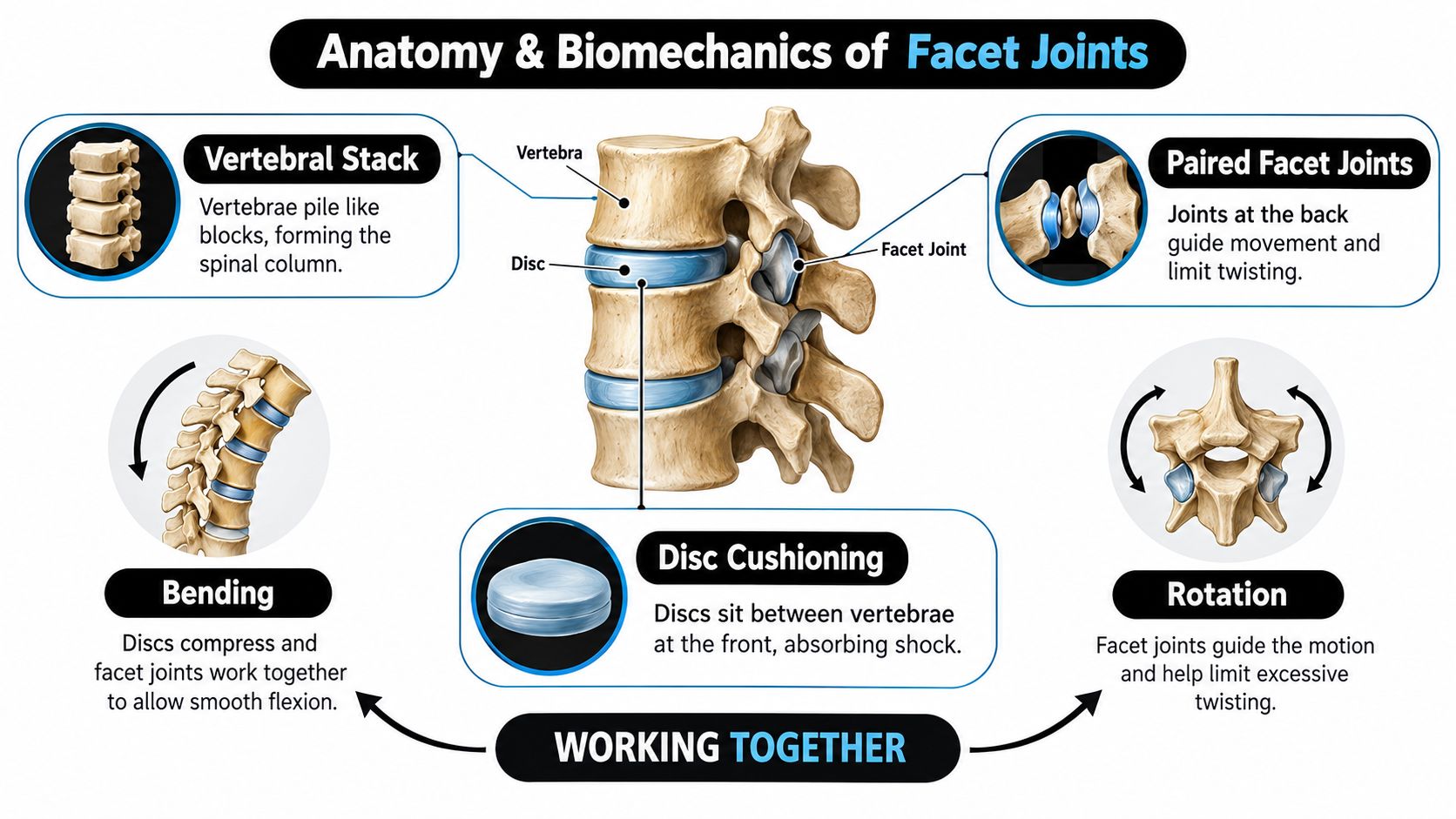
Think of a spinal segment as stacked blocks with cushioning toward the front and paired hinge-and-rail guides toward the back. The analogy isn't exact, but it helps explain why your spine can move while remaining supported.
The vertebrae form the stack. Discs provide cushioning between them, while the facet joints guide and limit movement at the back. These components work together rather than functioning as separate parts.
How a small joint can become painful
Facet joints are synovial joints, meaning they have a joint lining and an enclosing capsule. They guide motion and share load during forward bending, backward bending, and rotation. Degeneration can involve cartilage loss, joint-space narrowing, subchondral sclerosis, synovial irritation, capsular strain, and osteophyte formation; aging, disc degeneration, and joint orientation can increase mechanical stress (facet joint anatomy and mechanisms of pain).
Those terms become easier to understand when translated into the parts involved:
- Cartilage loss and narrowing: The joint's smooth surface deteriorates, and the space between its surfaces becomes smaller.
- Synovial irritation: The lining inside the joint becomes irritated.
- Capsular strain: The sleeve around the joint experiences mechanical stress.
- Subchondral sclerosis and osteophytes: Bone beneath the cartilage becomes denser, and bony projections, often called bone spurs, develop.
The capsule, synovium, and bone beneath the cartilage contain nerves capable of carrying pain signals. This helps explain why both mechanical overload and inflammatory irritation can contribute to pain.
Why the rest of the spinal segment matters
A hinge doesn't work independently of the structure around it. Similarly, changes in a disc or the orientation of a facet joint can alter how force passes through a spinal segment.
That's why a clinician considers the whole segment rather than focusing on an isolated joint. The question isn't only whether a facet looks worn. It's whether the joint is being stressed and whether that stress plausibly connects with your symptoms.
This explanation also avoids blaming every painful movement on “bad posture.” Your anatomy, degeneration, and movement demands deserve individual consideration. A treatment plan should respond to that combination rather than assume everyone needs the same exercise or correction.
Symptoms That Raise Suspicion and Patterns That Overlap
Axial pain means pain centered in the spine and nearby tissues. It's a useful term because it distinguishes a regional neck or back complaint from the classic pattern of pain traveling along an irritated nerve root.
Facet-mediated pain may feel localized or one-sided, with stiffness and discomfort during particular spinal movements. Paravertebral tenderness, meaning tenderness beside the spine, can also raise suspicion, but these findings aren't conclusive (clinical features considered in facet pain evaluation).
A person might describe pain when leaning backward or turning, rather than discomfort with every movement. Neck pain may also be accompanied by discomfort in the head or shoulder; lower-back pain may refer toward the buttock or thigh. The historical clinical description includes these patterns, but also emphasizes their overlap with other spinal and musculoskeletal disorders.
Referred pain isn't the same as nerve-root pain
Referred pain means you feel discomfort away from its originating structure. That doesn't automatically mean a nerve is compressed.
Radiculopathy involves a nerve-root problem and may include neurologic findings. If your main complaint is pain traveling down an arm or leg alongside weakness or altered sensation, your clinician needs to investigate that pattern rather than assume it comes from a facet joint.
A symptom checklist can organize a conversation, but it can't settle the diagnosis:
- Pain during extension or rotation: This can support suspicion, but it isn't a stand-alone confirmation.
- Buttock or thigh discomfort: Location alone doesn't distinguish facet pain from sacroiliac, disc, or muscle-related pain.
- Tenderness beside the spine: A clinician must interpret it alongside the rest of the examination.
A movement that reproduces your pain provides a clue. It doesn't identify the painful tissue with certainty.
Symptoms that deserve a different response
Don't treat every new symptom as another facet flare. Seek prompt medical assessment for fever, unexplained weight loss, pain after significant trauma, or new neurologic deficits, such as weakness. New loss of bladder or bowel control or rapidly worsening weakness warrants urgent evaluation.
These concerns change the priority from selecting a pain procedure to investigating another potentially important cause. Tell your clinician about them even if an older scan already mentions arthritis.
A careful examination should test the proposed explanation, not merely confirm the label you arrived with. That includes asking whether disc disease, sacroiliac pain, muscle disorders, or nerve compression better accounts for what you feel.
Why Imaging Alone Cannot Confirm Facet Joint Syndrome
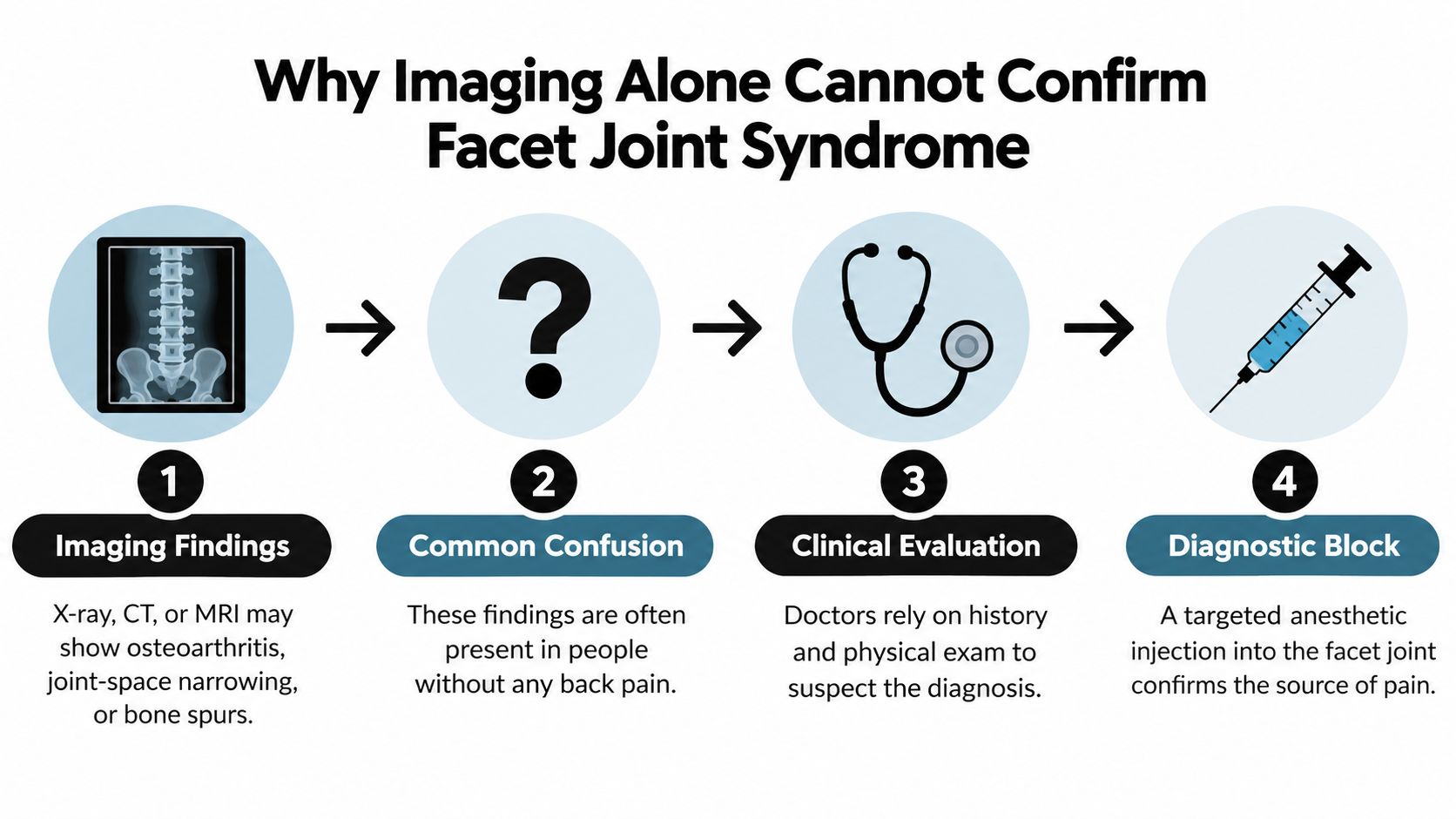
An MRI showing facet arthritis isn't enough to establish that the facet joint is causing your pain. A scan describes structure. Your clinician must determine whether that structure is clinically relevant.
X-rays, CT scans, and MRI may show joint narrowing, enlarged joints, or bone spurs in people without symptoms. The anatomical research discussed earlier also describes the limited relationship between imaging abnormalities and pain intensity. A striking report therefore doesn't necessarily explain severe pain, and a less dramatic report doesn't invalidate your experience.
What a diagnostic block tests
Clinicians first consider competing causes, including discogenic pain, sacroiliac disease, fracture, stenosis, infection, tumor, and radiculopathy. When facet pain remains a reasonable explanation, a diagnostic anesthetic block can help test it.
A medial branch block, or MBB, places local anesthetic near the nerves supplying the suspected joint. An intra-articular block places anesthetic inside the joint itself. These are different targets, even though both can help investigate facet-related pain.
For suspected lumbar facet pain, fluoroscopy- or CT-guided MBB is the most actionable diagnostic approach. Each joint receives dual sensory innervation from medial branches at its level and the level above; consensus guidance favors MBB over intra-articular injection before radiofrequency ablation and commonly defines a positive response as greater than 50% pain relief, while acknowledging the trade-offs of stricter thresholds (lumbar facet diagnostic and treatment consensus guidance).
For a patient-focused explanation of the procedure, review what a medial branch block involves.
What meaningful relief looks like
Concordant relief means the improvement matches the pain being investigated. If turning normally provokes your familiar lower-back ache, your clinician wants to know whether that particular ache improves during the anesthetic's expected window.
Feeling generally relaxed or noticing improvement in an unrelated discomfort isn't the same result. The clinician should document your baseline pain and function, use image guidance, and interpret the response in context.
- Before the block: Identify the usual pain and activities that reveal it.
- During the assessment window: Follow the clinician's instructions and record what changes.
- At follow-up: Describe both pain reduction and functional differences, without rounding an uncertain response into complete relief.
The diagram simplifies the process, but a block supports the diagnosis rather than proving it absolutely. Its value comes from careful targeting and interpretation, not merely from receiving an injection.
Treatment Options From Conservative Care to Interventional Procedures
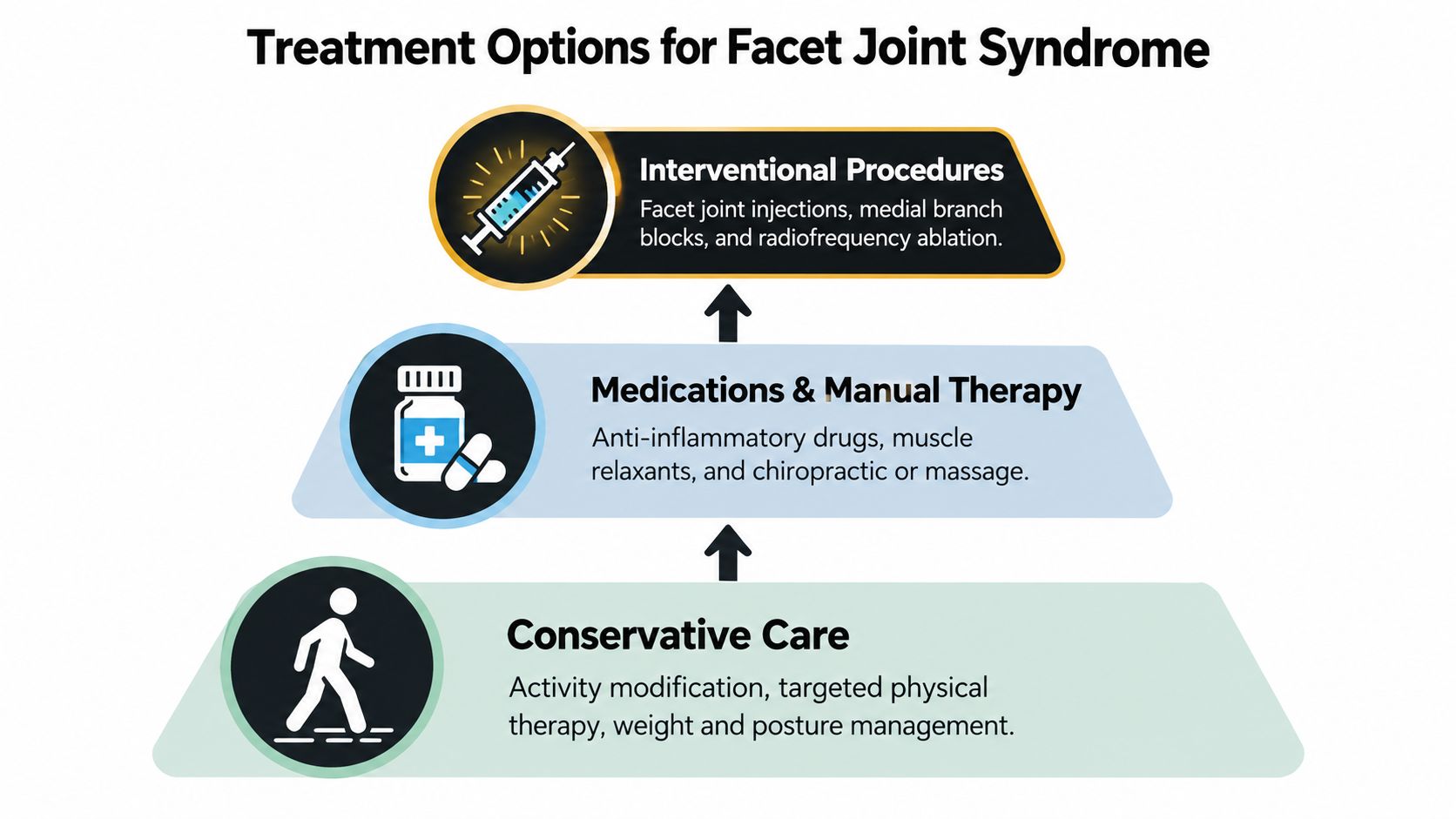
A useful treatment plan separates supporting function, testing the pain source, and treating selected pain signals. These goals overlap, but they aren't interchangeable.
You don't need to view treatment as a ladder you must climb to the most invasive option. Your clinician should choose the least burdensome reasonable approach and reconsider the diagnosis when the response doesn't fit expectations.
Conservative care should be individualized
Discuss activity modification, targeted physical therapy, and relevant weight or posture strategies. Exercise-based rehabilitation can be part of a pain-management plan without making this a physical-therapy diagnosis.
For example, a useful starting question is whether you can modify a repeatedly aggravating task while maintaining other tolerable activities. That's more specific than being told either to rest indefinitely or push through every painful movement.
Medication discussions may include NSAIDs or acetaminophen. Certain anticonvulsants or antidepressants may be considered when a separate nerve-related pain component is present, rather than assumed necessary for isolated facet pain. Ask your clinician which symptom a medication is intended to address and whether it fits your medical history.
For broader self-care reading, River of Life's resource on safe natural pain management approaches can serve as a discussion starter. Don't assume “natural” means appropriate for you, and review proposed supplements or remedies with your clinician.
Injections and ablation have different jobs
An intra-articular facet injection delivers medication into the joint. A diagnostic MBB primarily tests whether temporarily quieting the relevant nerves changes your usual pain. You can review the facet joint injection procedure before discussing which target fits your evaluation.
Single diagnostic blocks can produce false-positive results in approximately 17% to 49% of patients; controlled dual blocks can improve selection by checking whether relief is reproducible before radiofrequency ablation (systematic assessment of lumbar facet diagnostic blocks).
That uncertainty matters. Anesthetic spread, placebo response, or temporary effects on nearby tissues can complicate interpretation, so an encouraging result still needs clinical judgment.
Radiofrequency ablation, or RFA, heats and interrupts the medial branch nerves carrying facet pain signals. It's considered after appropriate diagnostic selection, and it doesn't rebuild cartilage or reverse arthritis (facet pain treatment selection and radiofrequency procedures).
Expectation check: Ask what improvement would justify the procedure for you, including sleep, movement, or a specific daily task. Don't accept a guaranteed duration of relief.
Regenerative options and minimally invasive spinal decompression shouldn't be treated as interchangeable facet treatments. Ask what diagnosis each proposed procedure targets. Decompression belongs in a discussion about an appropriate structural problem, while regenerative options require a separate conversation about evidence and uncertainty.
An opioid-sparing, multimodal approach can combine selected procedures with rehabilitation and medical management. The aim is a coherent plan, not an accumulating list of treatments without a clear purpose.
When to Refer for Specialist Pain Care
Consider a specialist evaluation when pain persists beyond several weeks despite appropriate care, flares repeatedly, disrupts sleep, or prevents you from returning to normal activities. You don't need to wait until you've tried every possible treatment.
Reviews report lumbar facet-mediated pain in approximately 27% to 40% of patients with low-back pain, although estimates vary with diagnostic standards (clinical review of lumbar facet syndrome). These aren't local prevalence figures or a prediction of your diagnosis. They indicate a potential pain source worth considering when an initial explanation remains incomplete.

What to look for in a specialist evaluation
An interventional pain specialist should connect the history, examination, and proposed procedure. Access to image guidance is important, but so is a clear explanation of how the result will change your care.
- Ask about selection: What makes facet pain more likely than another diagnosis?
- Ask about interpretation: Would a repeat controlled block be appropriate, and what happens if relief is unclear?
- Ask about coordination: How will the plan involve your primary care provider, rehabilitation therapist, chiropractor, or surgeon when needed?
Adults seeking facet joint syndrome care around Chicago Ridge, IL, may also be looking for pain management in Palos Heights, IL; Palos Hills, IL; Evergreen Park, IL; or Hickory Hills, IL. These Illinois communities form the relevant local service area.
A pain and wellness clinic, not a physical-therapy practice alone, provides the appropriate setting for considering diagnostic blocks and other interventional procedures alongside coordinated rehabilitation. Reviewing an interventional pain management clinic's approach can help you prepare questions before arranging an appointment.
A Practical Path Forward After Reading This
The practical answer to “What is facet joint syndrome?” includes both a suspected source and a method of testing it. Don't turn a scan label into a treatment decision without a clinical explanation.
- Keep a pain and activity diary: Note location, aggravating movements, sleep disruption, and activities you can't comfortably complete.
- Ask your current provider: Has facet-mediated pain been considered as a specific cause?
- Request referral when appropriate: If a reasonable conservative-care trial hasn't restored function, discuss specialist assessment.
Diagnostic and Treatment Sequence for Suspected Facet Joint Syndrome
| Step | What Happens | What It Tells You |
|---|---|---|
| Clinical evaluation | The clinician reviews symptoms and examines you. | Whether facet pain is plausible and other causes need attention. |
| Conservative care | You try an individualized management plan. | Whether symptoms and function improve without intervention. |
| Diagnostic block | Targeted anesthetic is followed by response assessment. | Whether relief supports the suspected pain source. |
| Treatment selection | You review the findings and appropriate options. | Whether a targeted procedure fits your situation. |
Bring prior imaging reports, a list of treatments and their effects, and your diary. Ask what evidence supports the diagnosis, what remains uncertain, and what improvement you should reasonably pursue.
Midwest Pain & Wellness offers personalized, opioid-sparing pain care, including medial branch blocks, facet joint injections, and radiofrequency ablation when appropriate. If persistent neck or back pain is limiting your life, visit Midwest Pain & Wellness to arrange an evaluation and discuss whether your facet joints may be contributing to your symptoms.