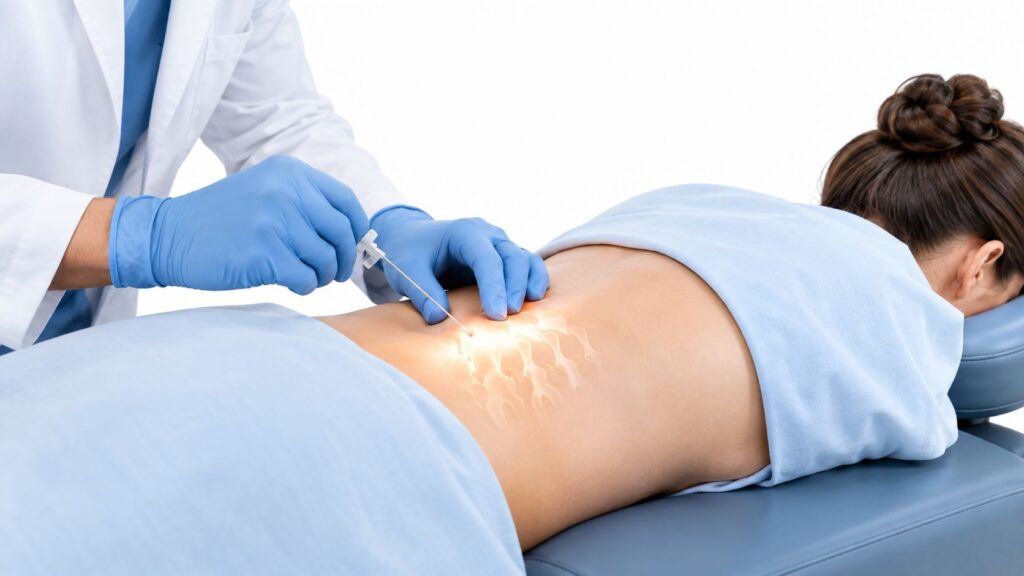
You might be lying in bed with a hot ache running from your back into your leg, or you may have woken up after a small twist, like lifting a grocery bag, and suddenly the pain feels sharper, farther down, and harder to ignore. That's the moment many people start wondering whether they need surgery right away, but in a lot of cases, herniated disc treatment without surgery is the right first move.
A lumbar disc herniation happens when the soft inner material of a spinal disc pushes through a weakened outer layer and irritates a nearby nerve root. That nerve irritation is what often creates the burning, shooting, or numb feeling in the leg. The body can settle this down over time, and one review notes that up to 66% of lumbar disc herniations may resolve spontaneously over time https://pmc.ncbi.nlm.nih.gov/articles/PMC4799068/, which is why the first question usually isn't “Why not operate?” but “What's the smartest first step?”
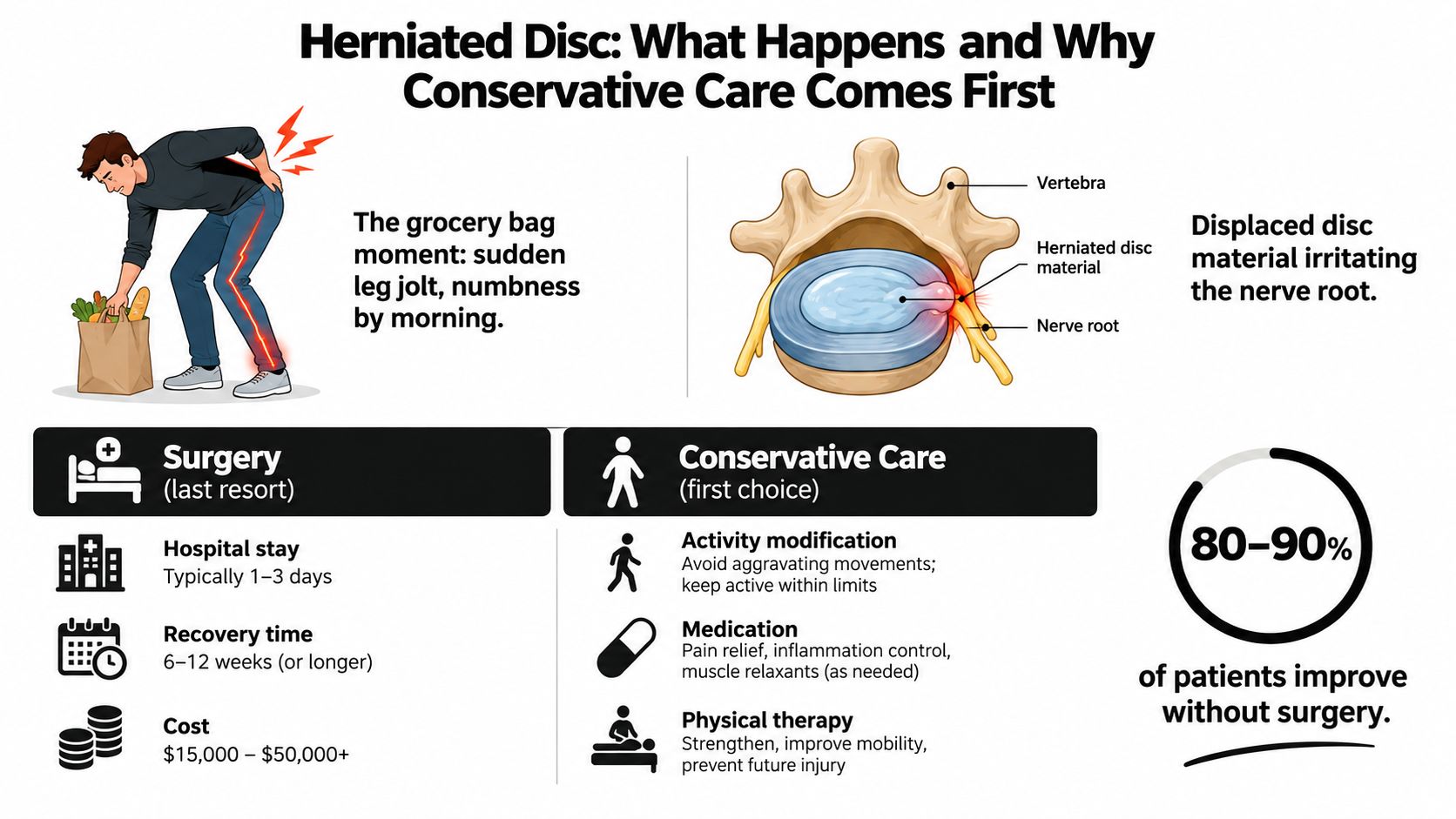
Table of Contents
- What a Herniated Disc Is and Why Conservative Care Usually Comes First
- Activity Modification, Medications, and Targeted Physical Therapy
- Image-Guided Injections for Nerve Root Pain
- Radiofrequency, Nerve Procedures, and Regenerative Options
- When Conservative Care Stops Working and Surgery Becomes the Next Step
- Building a Personalized Plan in Chicago Ridge and the Southwest Suburbs
- Common Misconceptions About Healing Without Surgery
- Questions Patients Ask About Herniated Disc Treatment Without Surgery
What a Herniated Disc Is and Why Conservative Care Usually Comes First
A sudden flare can make a disc problem feel like a structural emergency. The disc material has shifted through a weakened outer layer, and nearby nerve tissue may become irritated. That irritation can produce sharp back pain, burning, tingling, numbness, or pain traveling into the leg, even when the spine remains stable and recovery without an operation is possible.
A herniated disc also differs from a simple bulging disc. The terms describe different changes in the disc's outer layer and inner material, so understanding the difference between a bulging and herniated disc can make an imaging report easier to interpret.
Why the first step is usually not the operating room
Severe pain does not always indicate severe structural damage. Pain intensity and the appearance of a scan can vary widely from one person to another. A loud pain signal may come from inflammation around a nerve, while the underlying disc problem still has time to settle.
The examination supplies the next piece of the puzzle. A clinician considers where symptoms travel, whether sensation or strength has changed, how reflexes respond, and whether imaging matches those findings. The symptom pattern, neurologic exam, and imaging together matter more than the scan by itself https://pmc.ncbi.nlm.nih.gov/articles/PMC4799068/. If leg pain follows a nerve pattern, the examination supports that pattern, and no emergency warning signs are present, conservative care is usually a reasonable starting point.
Practical rule: when pain is intense but strength and bladder function remain stable, the initial sequence usually focuses on calming the nerve, preserving safe movement, and reassessing at a defined checkpoint.
The six-week checkpoint helps organize that sequence. Improvement in pain, walking, sleep, or strength supports continued nonsurgical care. Limited progress may prompt a closer examination, updated imaging when appropriate, or a targeted injection to create a better window for rehabilitation. Worsening weakness, new bladder or bowel problems, or other urgent neurologic changes require prompt medical assessment rather than routine observation.
A disc problem can be real while the body still settles inflammation and restores function. The goal is to treat the disc in the right order rather than ignore it.
| First-Line Options at a Glance | What It Does | Typical Time to Notice Improvement |
|---|---|---|
| Activity modification | Reduces repeated nerve irritation while keeping you moving | Often within days |
| Medications | Calms inflammation and pain enough to move and sleep | Often within days to 2 weeks |
| Structured rehab | Rebuilds tolerance and function without flaring the nerve | Usually over several weeks |
Sleep, regular movement, hydration, and inflammation-friendly eating habits can support the broader recovery process. A general background resource on joint wellness nutrition basics can help explain that part of self-care.
Activity Modification, Medications, and Targeted Physical Therapy
A patient may wake with sharp leg pain, sit briefly, then feel symptoms travel farther down the leg. Early care aims to calm that response while preserving safe movement. Short walks, frequent position changes, and less slumped sitting usually work better than staying in bed. A pillow beneath the knees when lying on the back can reduce strain. Side sleepers may rest more comfortably with a pillow between the knees.
What the early phase should feel like
Use symptoms as your guide. Choose movement that keeps leg pain stable or reduces it, then stop before numbness or weakness worsens. That may mean short walks, fewer repeated forward bends, and avoiding loaded twisting. The target is controlled activity, not complete shutdown.
Medication can create enough relief to restore sleep and participation in rehabilitation. An anti-inflammatory medicine may reduce irritation around the nerve root. In selected cases, a short course of oral steroids is used when inflammation is intense. A muscle relaxant may help when muscle guarding limits movement. If nerve pain dominates, a neuropathic medication such as gabapentin or duloxetine may be considered. A clinician should review medical history, other medicines, and risks before choosing any of these options.
Physical therapy should match the symptom pattern rather than rely on generic stretching. The therapist may test directional preference, meaning a movement direction that reduces leg symptoms. McKenzie-style extension can be useful for some patients, while others need a different approach. The program then builds core stabilization and progressive loading, increasing tolerance in measured stages instead of relying on passive treatment alone.
The best exercise is the one that reduces leg symptoms without worsening numbness or weakness.
At the 4 to 6 week reassessment, ask practical questions: Is walking easier? Is sleep improving? Can you sit, work, or complete daily tasks for longer? If leg pain remains unchanged or function is stuck, the clinician may revisit the diagnosis, review imaging when appropriate, or consider the next treatment window.
In the SPORT trial, patients who remained in nonoperative care improved substantially, with roughly 37 points in bodily pain and 35 points in physical function on 100-point scales at two years https://www.ncbi.nlm.nih.gov/pmc/articles/PMC2553805/. These figures describe trial outcomes, not a promise that every patient follows the same timeline.
Runners can apply the same principles by reducing aggravating mileage, hills, or speed, then rebuilding gradually. This guide for runners with back issues offers practical ideas for modifying activity while symptoms settle.

Image-Guided Injections for Nerve Root Pain
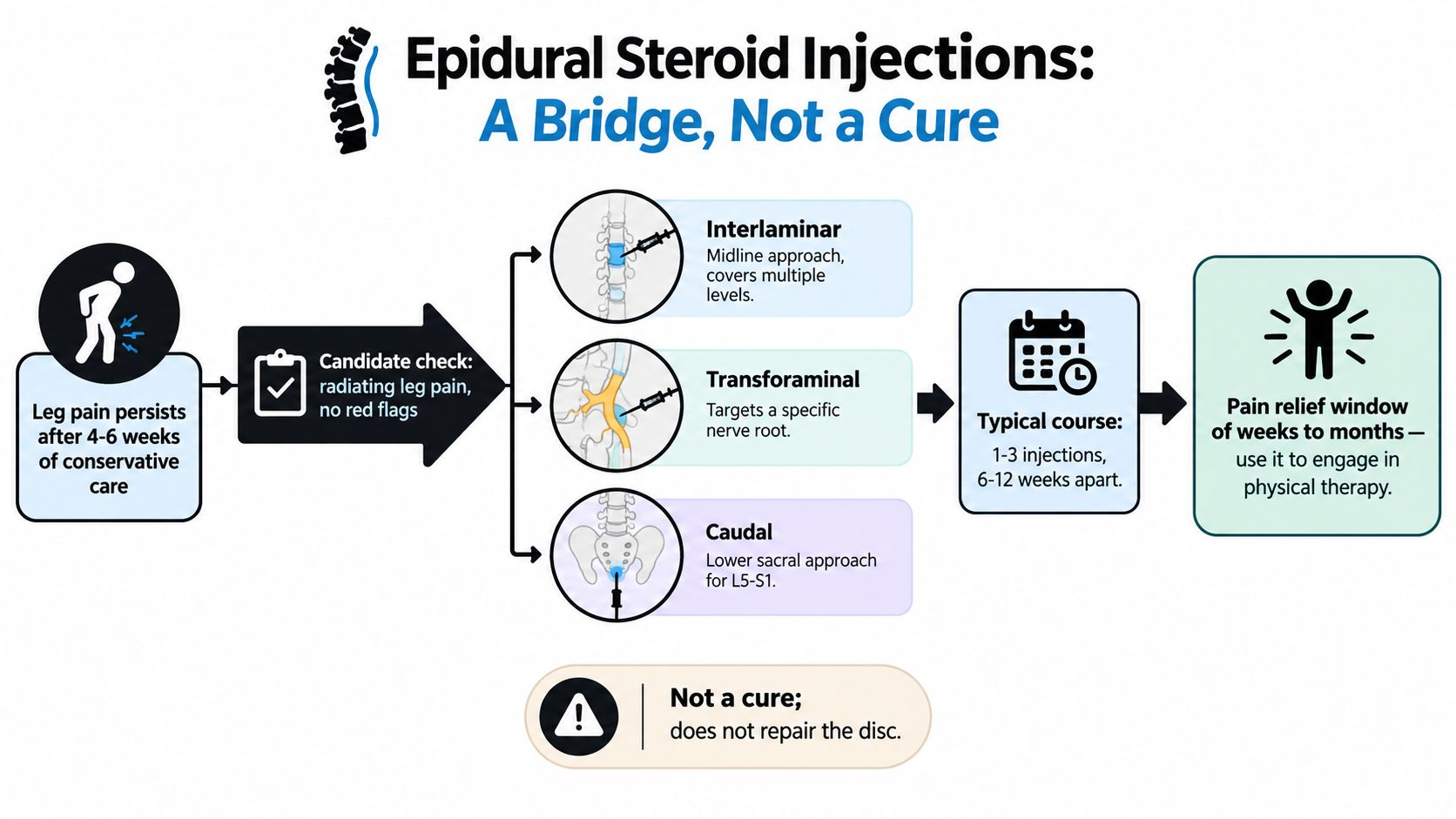
When leg pain stays loud after a fair trial of activity changes and rehab, an epidural steroid injection can be the next step. It is a bridge rather than a cure. The goal is to calm the irritated nerve enough that walking, sleeping, and rehabilitation become possible again.
Who is a candidate
The best candidates have radiating leg pain, a matching exam, and imaging that fits the symptoms. In that setting, the aim is to reduce inflammation around the irritated root. NICE recommends considering an epidural steroid injection for severe acute sciatica from a herniated lumbar disc while advising against spinal injections for nonspecific low-back pain or central spinal stenosis https://www.nice.org.uk/guidance/ng59/chapter/recommendations.
There are three common ways the medication is placed. An interlaminar epidural spreads medication more broadly in the epidural space. A transforaminal injection targets a more specific nerve root. A caudal approach enters lower and can be useful in selected lower-lumbar patterns.
Image guidance matters because it helps place the medication where the nerve irritation is happening. A procedure performed with fluoroscopy or CT is more targeted than one done by feel alone. If you want a plain-language walk-through of the process, fluoroscopy-guided injection details explain how the visit is typically set up. In a typical appointment, the skin is numbed first, the needle causes only mild pressure, and the steroid effect usually builds over the next few days rather than immediately.
The evidence is honest about the limits. Guideline reviews describe epidural steroid injections as offering a short-term, modest reduction in pain and disability for lumbar radiculopathy, not a permanent fix. That is why the right mindset is to use the pain relief window well, so the nerve settles and rehab can continue.
Radiofrequency, Nerve Procedures, and Regenerative Options
Once the early steps have been tried, the next question is whether the pain is still coming from the same structure. Sometimes the disc is still the main issue. Other times, the back pain pattern includes facet joint pain, which behaves differently and can respond to other procedures.
Matching the procedure to the pain generator
Radiofrequency ablation is used for facet-related pain, not for directly “fixing” a herniated disc. Before it's considered, a clinician usually performs medial branch blocks, which are diagnostic injections that help confirm the pain source. If those blocks clearly reduce pain, radiofrequency treatment can be used to interrupt the pain signal for a longer period.
For persistent neuropathic pain that doesn't settle with earlier measures, peripheral nerve stimulation or spinal cord stimulation can enter the discussion. These are typically later-stage tools, used after a careful trial period and after the pain pattern has proven stubborn.
Regenerative treatments require careful wording. PRP, or platelet-rich plasma, uses a patient's own concentrated platelets and is being explored for some spine-related pain patterns. Cell-based therapies are a different category altogether, and their use is much more limited and more investigational for most spine problems.
| Advanced Interventional Options | Best Target | Evidence Level | Typical Role |
|---|---|---|---|
| Medial branch block | Confirms facet pain source | Diagnostic | Before radiofrequency treatment |
| Radiofrequency ablation | Facet-mediated pain | Established for selected patients | Longer-lasting pain reduction |
| PRP | Selected pain generators | Emerging | Considered case by case |
| Stimulation procedures | Persistent neuropathic pain | Established in select chronic cases | Later-stage option after trial |
A reasonable local pain plan may also include a consultation for persistent spine pain at a clinic such as Midwest Pain & Wellness, especially when a coordinated, nonsurgical pathway is needed rather than a one-off procedure. For patients with ongoing pain around the Chicago Ridge area, the important thing is not the label of the treatment, it's whether the procedure matches the pain source.
PRP injection background can be helpful if you're comparing regenerative terminology and want to separate standard care from newer options.
When Conservative Care Stops Working and Surgery Becomes the Next Step
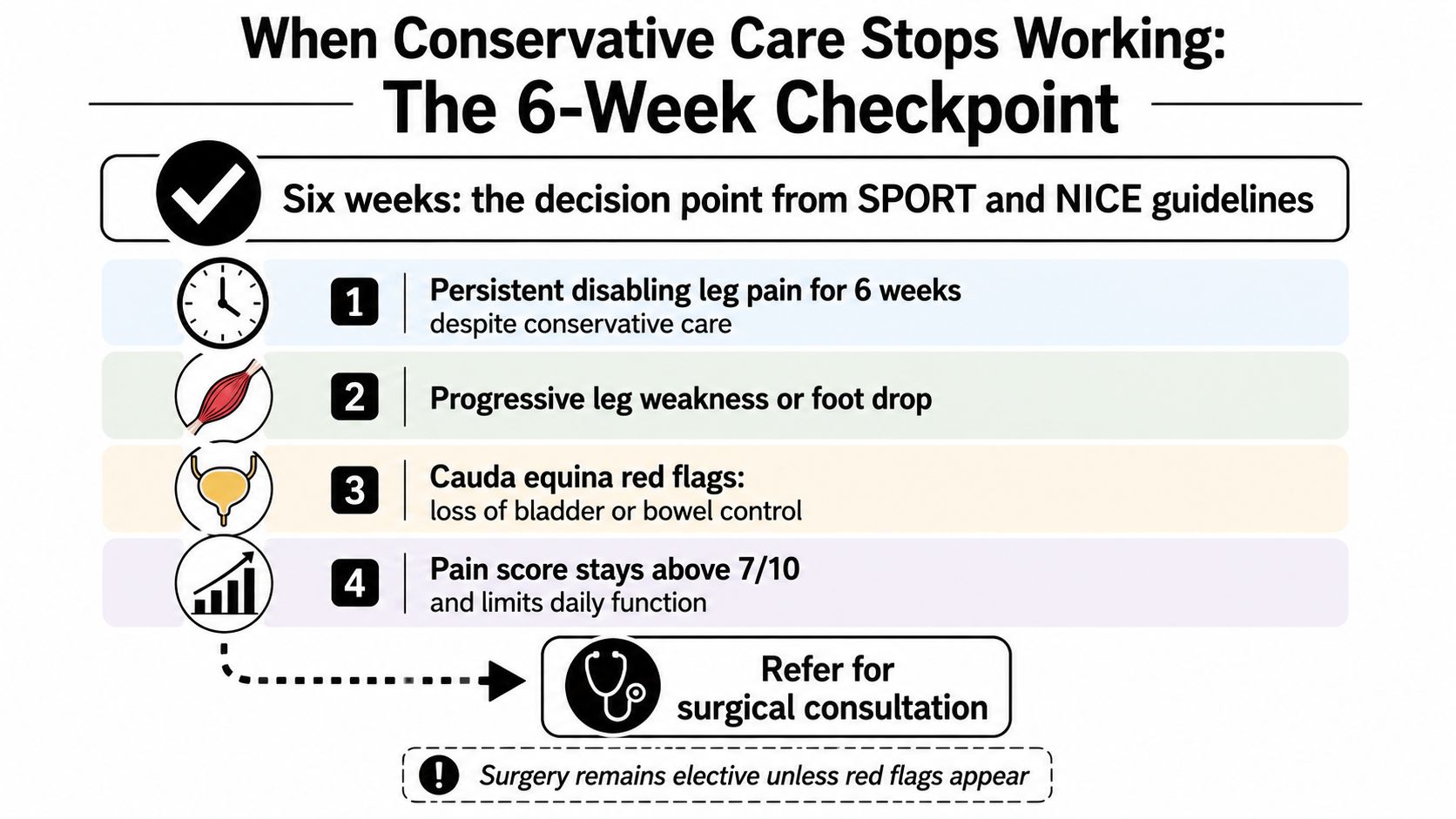
There is a point where staying on the same path is no longer the best move. If leg pain remains disabling after a reasonable conservative trial, and the MRI matches the exam, surgical consultation becomes the next planned step. That checkpoint is part of good care; it does not mean nonsurgical treatment failed.
The red flags that change the timeline
Some symptoms need attention right away. Progressive motor weakness, foot drop, saddle anesthesia, or loss of bladder or bowel control can point to major nerve compression or cauda equina syndrome. Those findings do not belong on a routine watch-and-wait timeline.
The more common escalation point is persistent disabling leg pain after about 6 weeks of coordinated care, as long as the symptoms, exam, and imaging line up https://pmc.ncbi.nlm.nih.gov/articles/PMC8246101/. A normal-looking MRI by itself does not settle the question. Surgery is based on function, neurologic findings, and persistence, not just whether a disc bulge appears on the scan.
Urgent rule: worsening weakness or bowel and bladder changes change the plan immediately.
The SPORT randomized cohort shows why some patients move on to surgery after starting with nonoperative care. Among patients assigned to that pathway, 30% had surgery within three months, 41% by one year, and 45% by four years. Those numbers do not mean people gave up. They show that some patients appropriately advanced to the next stage when pain and function still did not improve enough.
Building a Personalized Plan in Chicago Ridge and the Southwest Suburbs
A good plan for someone in Chicago Ridge, Palos Heights, Palos Hills, Evergreen Park, or Hickory Hills should not feel like a random menu. It should move in stages, with each step tied to a decision point. That's especially important when the pain is interfering with work, driving, sleep, or walking.
How the sequence fits together in real life
The first visit usually focuses on reviewing the symptoms, checking strength and sensation, and matching the story to the imaging if you already have it. Conservative measures start quickly, not weeks later. If the pain pattern suggests a nerve root flare, an injection may be timed to create enough relief to participate in rehab rather than waiting until you're too stiff and guarded to do anything useful.
In a coordinated pain and wellness setting, the plan can include epidural steroid injections, medial branch blocks, radiofrequency ablation, peripheral nerve stimulation, spinal cord stimulation, MILD and Vertiflex Superion, kyphoplasty, and PRP when appropriate. The point isn't to do everything. The point is to choose the least invasive step that fits the pain generator.
The other practical piece is coordination. When a pain specialist, primary care clinician, surgeon, chiropractor, or rehab therapist is all looking at the same problem, the patient doesn't have to re-explain the story at every visit. That saves time, reduces confusion, and makes the next step easier to choose.
The SPORT observational cohort also supports patience when the exam is stable. Of 191 patients who initially chose nonoperative care, only 2% had surgery in the first six weeks, 16% by six months, and 22% by two years, meaning 78% had not undergone surgery at the two-year mark https://www.ncbi.nlm.nih.gov/pmc/articles/PMC2562254/. For many people, that's the reassurance they need that an initial nonsurgical path is not a detour, it's the expected route.
Convenience matters too. Weekday access, workers' compensation support, personal injury case coordination, and shorter travel for follow-up visits can make a real difference when you're dealing with a painful back and a hard calendar.
Common Misconceptions About Healing Without Surgery
One of the biggest myths is that pain level equals injury level. That's not how herniated discs always behave. A bad flare can happen while the disc is still in a phase where it's likely to improve, which is why the exam and symptom pattern matter so much.
Another misconception is that an alarming MRI means surgery is automatic. It doesn't. Some disc herniations look dramatic on imaging and still improve with conservative care. The body can calm the nerve irritation, and the disc material itself may settle over time.
What usually doesn't help
Long bed rest doesn't fix the problem. It often makes the muscles around the spine weaker and leaves the nerve more sensitive to normal movement. Gentle activity, adjusted to symptoms, usually does better than lying flat for days.
An epidural injection is also not a permanent repair. It can lower inflammation and create a usable window for movement, but the benefit may fade, and the underlying disc still needs a broader plan. That's why one missed visit or one flare doesn't mean the whole process failed.
A 2025 randomized trial in patients awaiting lumbar disc surgery found that a coordinated combination intervention reduced surgery uptake, with 11 of 34 intervention participants undergoing surgery versus 29 of 38 controls https://pubmed.ncbi.nlm.nih.gov/39894273/. The point isn't that every patient should delay surgery. The point is that coordinated conservative care can change the path for selected people.
Keep track of what matters day to day:
- Walking distance, because worsening tolerance often shows up there first.
- Foot or ankle strength, because weakness is more important than pain alone.
- Bowel and bladder changes, because those are urgent red flags.
- Numbness pattern, because spreading numbness deserves attention.
Questions Patients Ask About Herniated Disc Treatment Without Surgery
A common question is whether a disc can improve without surgery. In many cases, yes. The disc may not return to a perfect shape, but symptoms can settle as nerve irritation cools down and the body gradually reabsorbs part of the herniated material.
Another question is what counts as failed conservative care. It usually means pain is still limiting daily life after a real trial of activity changes, medication, and rehab, or the neurologic picture is getting worse. If pain is still stubborn but moving in the right direction, that is not failure. If walking, sleeping, and routine tasks are still blocked after several weeks, it is time to reassess the next step.
Patients also ask how long an injection lasts. The honest answer is that it varies. The best way to think about it is as a short-term window that can reduce pain enough to keep rehab going. If the benefit fades, the next move is usually to use that window well, with physical therapy, activity changes, and another look at whether the pain source has shifted.
If you are in Chicago Ridge or a nearby southwest suburb, getting started should be straightforward. Bring any MRI report you have, note where the pain travels, and be ready to describe what makes it worse or better. As noted earlier, guideline-based care supports considering an epidural steroid injection for severe acute sciatica from a herniated lumbar disc, while avoiding spinal injections for nonspecific low-back pain or central spinal stenosis.
The main takeaway is simple. Herniated disc treatment without surgery is a staged sequence with checkpoints, not a single fix. Conservative care comes first when the neurologic exam is stable. Injections can buy time when pain blocks progress. Surgical evaluation becomes appropriate when red flags appear or when the 6-week checkpoint shows that improvement has stalled.