You wake up after an epidural injection and notice that your back feels sore, your leg pain seems sharper, or your face feels unusually warm. The first question is usually simple: Is this a normal reaction, or is something wrong?
Most post-injection symptoms are mild and temporary, but an epidural steroid injection is still an invasive procedure with uncommon, medically important risks. Understanding the difference between expected discomfort and a warning sign can reduce anxiety and help you seek care promptly when needed. This guide focuses on back pain epidural injection side effects, what recovery may look like over the first several days, and which symptoms require a call to your pain specialist or emergency evaluation.
Patients in Chicago Ridge, Palos Heights, Palos Hills, Evergreen Park, Hickory Hills, and nearby Illinois communities may also have questions about pelvic symptoms after childbirth or prior neuraxial procedures. A separate resource on pelvic floor therapy after birth may help explain when pelvic rehabilitation deserves its own evaluation.
Table of Contents
- Understanding Your Epidural Injection Journey
- How Epidural Steroid Injections Work
- Common Side Effects and What to Expect
- Rare but Serious Complications
- Recovery Timeline and Warning Signs
- Risk Factors and Patient Considerations
- Making an Informed Decision About Your Care
Understanding Your Epidural Injection Journey
A patient may leave the procedure feeling hopeful, then become uncertain later that evening when the injection site aches or the familiar leg pain briefly returns. That experience doesn't automatically mean the injection failed or injured a nerve. The needle and surrounding tissues can be irritated temporarily, and the steroid's anti-inflammatory effect may not be immediate.
The more useful question isn't whether you feel absolutely normal right away. It's whether your symptoms are stable and gradually settling, or whether they're becoming more severe, progressive, or neurologic. Mild soreness, a temporary pain flare, flushing, headache, dizziness, sleep disturbance, or short-lived numbness can occur after an injection. Serious complications are uncommon, but they require fast recognition because treatment can be time-sensitive.
Practical rule: A temporary symptom is usually less concerning than a symptom that progresses, spreads, or affects strength, coordination, bladder function, or bowel control.
An epidural steroid injection may be considered when inflammation around a spinal nerve contributes to sciatica, radicular pain, a herniated disc, or spinal stenosis. The purpose isn't to promise permanent pain elimination. In selected patients, reducing inflammation can create an opportunity to walk more comfortably, sleep better, and participate in rehabilitation.
Midwest Pain & Wellness is a pain and wellness clinic serving Chicago Ridge and surrounding Illinois communities with individualized, opioid-sparing pain care. A consultation should include your diagnosis, medications, health conditions, previous procedures, and the specific risks and benefits of the proposed injection. That conversation matters more than a generic complication list because your risk depends on the route, medication, dose, health history, and number of injections.
How Epidural Steroid Injections Work
The epidural space is an area near the spinal nerve roots. During an epidural steroid injection, a clinician places medication near an irritated nerve rather than injecting directly into the spinal cord or nerve itself. The corticosteroid is intended to reduce inflammatory activity around the nerve, while the local anesthetic used during the procedure can provide shorter-term numbing.
The process generally involves several deliberate steps:
- Identify the target. Your clinician reviews your symptoms, examination, and imaging to determine whether a particular nerve root or spinal level matches the pain pattern.
- Position and numb the skin. Local anesthetic helps reduce discomfort at the needle entry point.
- Use imaging when appropriate. Fluoroscopy or another imaging method helps guide the needle and confirm its position. Contrast may be used when clinically appropriate.
- Deliver the medication. The steroid is placed near the inflamed nerve, not injected casually into the spine.
- Monitor the response. Your symptoms, strength, and tolerance are considered during recovery and follow-up.
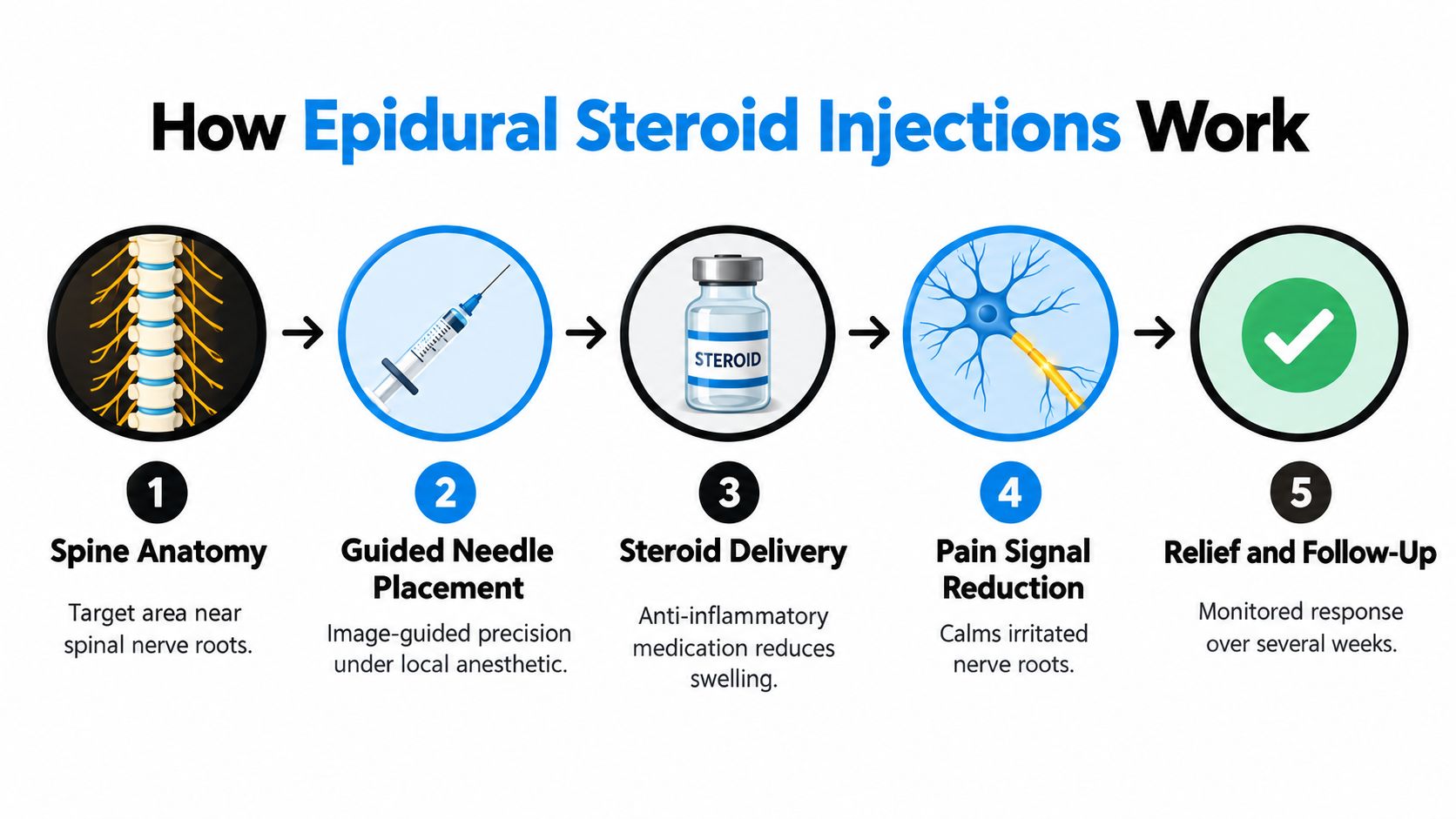
The approach matters. A lumbar transforaminal injection, an interlaminar injection, and an injection at a higher spinal level do not involve identical anatomy or procedural considerations. The route, steroid formulation, dose, and your medical conditions all influence the risk discussion. You can review a plain-language explanation of how epidural injections work before your consultation, then ask your clinician why a particular approach is being recommended.
Common Side Effects and What to Expect
You may leave the clinic feeling little discomfort, then notice soreness or a temporary flare in back or leg pain later that day. That pattern is usually manageable. Large clinical reviews have found no major adverse events in the procedure groups examined, supporting the expectation that common reactions are minor and short-lived. The clinical review of epidural steroid injection safety provides the underlying evidence.
Local reactions and temporary symptom changes
Tenderness, bruising, or irritation around the needle site can last briefly. Pain may increase before the steroid's anti-inflammatory effect develops. Temporary numbness or weakness is also possible while the local anesthetic remains active. It should steadily improve, not spread or become more pronounced.
Follow your clinic's activity instructions, avoid strenuous exertion immediately after the injection, and use only medicines approved by your treating team. Do not stop prescribed blood thinners or change other medicines on your own.
A simple recovery check is useful: expected soreness should trend downward, while worsening pain, progressive weakness, or new loss of sensation deserves a call to the clinic.
Steroid-related effects
Steroid medication can affect the body beyond the injection site. In a study of patients receiving epidural dexamethasone, systemic effects were minor and temporary in the group studied. Facial flushing, hives, and insomnia were among the reported reactions.
You might experience warmth or flushing, difficulty sleeping, mood changes, nausea, dizziness, or a temporary rise in blood glucose. People with diabetes should ask their treating team when and how to monitor glucose after the procedure. These symptoms generally call for observation or a routine call if they persist, provided no serious warning signs appear. Seek urgent medical advice for severe or rapidly worsening symptoms, rather than assuming every reaction is normal.
Rare but Serious Complications
A patient who develops sudden leg weakness, loss of coordination, or major sensory changes after an epidural injection needs urgent assessment. These reactions are uncommon, but their potential consequences make them part of informed consent. The FDA requires corticosteroid labels to warn about serious neurologic events after epidural administration, including spinal-cord infarction, paraplegia, quadriplegia, cortical blindness, and stroke. It also states that the safety and effectiveness of this route have not been established and that corticosteroids are not approved for epidural administration. The FDA corticosteroid label explains these warnings.
Published complication rates vary because studies use different techniques, follow-up periods, and definitions. In one retrospective review of 4,265 injections in 1,857 patients, complications followed 2.4% of procedures, and the identified events were minor. A low probability does not make a severe outcome unimportant, so the practical question is whether symptoms are mild and settling or new, progressive, and neurologically significant.
How severe events can occur
An unintended injection into a radiculomedullary artery can interrupt blood flow to the spinal cord. This concern is particularly relevant with transforaminal injections at higher lumbar or thoracic levels. An embolic event may cause spinal-cord infarction, which is why severe weakness, poor coordination, or substantial sensory loss immediately after the procedure requires emergency care rather than routine observation.
Bleeding presents a separate risk, especially with blood-thinning medication, a clotting disorder, or difficult anatomy. Epidural hematoma is estimated at roughly 1 in 70,000 to 1 in 190,000 injections, according to FDA safety information on epidural corticosteroids. A hematoma can compress nerves and threaten neurologic function.
Image guidance improves accuracy but cannot eliminate every complication. Safe care also depends on patient selection, medication choice, anatomical planning, sterile technique, and close monitoring. Progressive weakness, spreading numbness, or new bladder or bowel problems should be treated as an emergency.
Recovery Timeline and Warning Signs
Recovery is easier to interpret when you judge symptoms by timing, direction, and severity. A stable ache that begins to settle is different from numbness that spreads or weakness that becomes more pronounced.
During the first 24 hours
Mild soreness at the injection site, a temporary pain flare, flushing, nausea, dizziness, headache, insomnia, or short-lived numbness may occur. Rest according to your clinician's instructions and avoid activities that could be unsafe if your leg feels numb or weak. If a symptom is mild and improving, monitor it and follow the discharge guidance you were given.
Call the treating clinic if pain is difficult to control, numbness doesn't improve as expected, or you aren't sure whether a reaction is within the expected range. Your clinical team can assess the specific injection route, medications, and examination findings.
During the first 72 hours
Symptoms should generally remain stable or begin to improve. A mild headache may resolve, but a severe headache that is much worse when upright deserves prompt medical attention because it can be associated with dural puncture. Increasing back pain alone may still be a temporary reaction, but rapidly escalating pain is not something to dismiss.
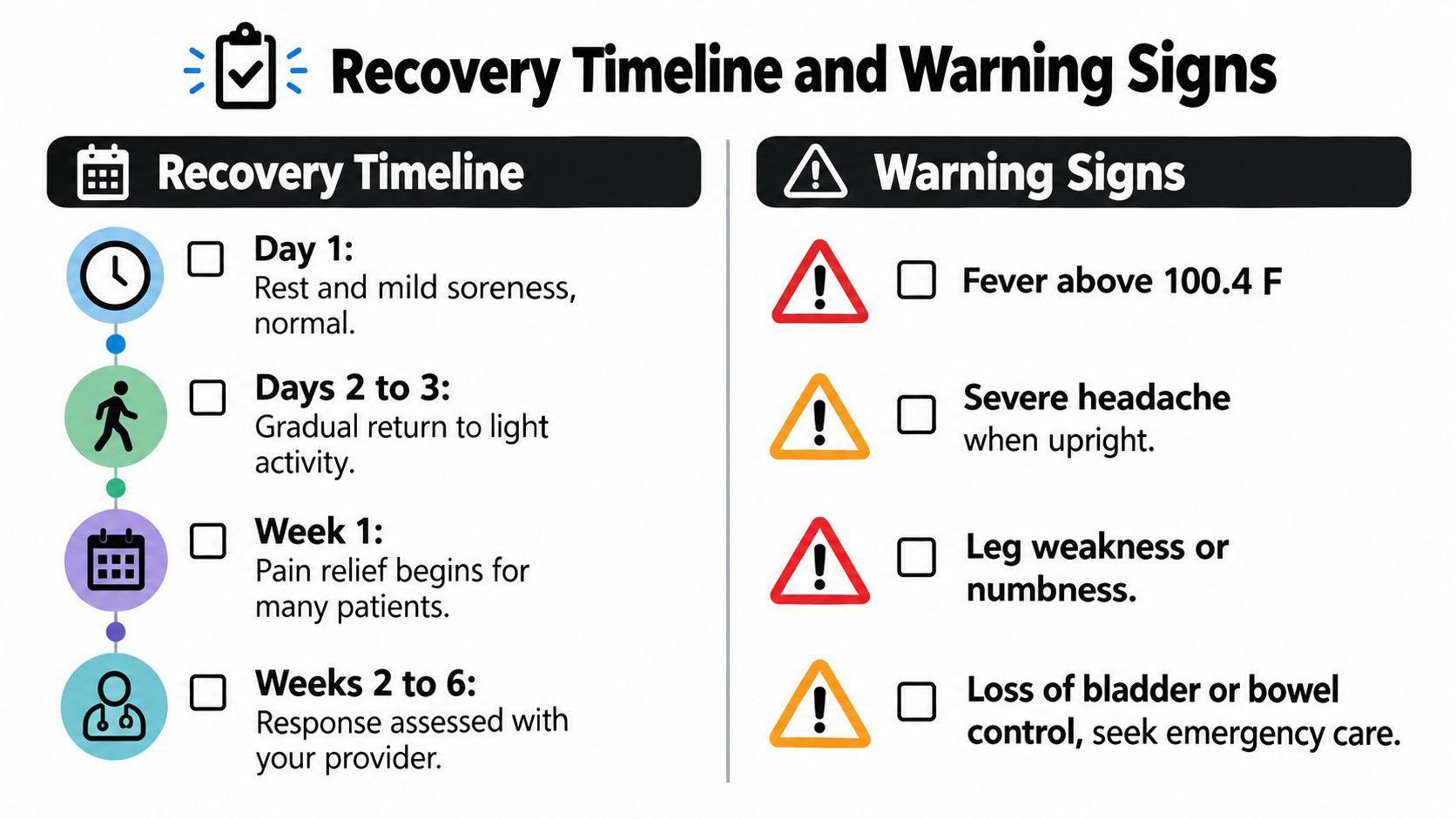
Seek emergency care for new or worsening leg weakness, progressive numbness, loss of bladder or bowel control, fever, severe positional headache, major vision changes, loss of coordination, or rapidly escalating pain. These symptoms can signal infection, bleeding, dural puncture, or neurologic compromise. The epidural steroid injection recovery guidance can supplement your discharge instructions, but it doesn't replace urgent evaluation when red flags appear.
After the early recovery period
The steroid's benefit may take time, and response varies. If symptoms remain severe, relief is very brief, or weakness develops, contact your provider for reassessment rather than assuming another injection is the automatic next step.
Risk Factors and Patient Considerations
Your risk profile is established before the needle is placed. The clinician should review why the injection is being considered, the planned route, your neurologic examination, medicines, allergies, previous procedures, and conditions that may increase bleeding, infection, or steroid-related effects. Bring an accurate medication list and mention any prior reaction to injections.
Medicines and bleeding risk
Anticoagulants, antiplatelet drugs, clotting disorders, and unusual bleeding history require specific review. Your pain specialist may coordinate with the prescriber to decide whether medication changes are appropriate. Never stop a blood thinner on your own. Unplanned interruption can create a serious clotting risk, so any adjustment needs clear instructions from the treating clinicians.
An active infection or significant immune suppression also changes the decision. Infection at the injection site, or infection elsewhere in the bloodstream, may make the procedure inappropriate until the problem has been assessed and treated. Tell the clinic about fever, antibiotics, draining wounds, or recent hospitalization before the appointment.
Diabetes and steroid exposure
Steroids can temporarily raise blood glucose and suppress the body's hypothalamic-pituitary-adrenal axis. If you have diabetes, ask how often to check glucose, which readings should prompt a call, and whether your usual medicines need special attention. Repeated or prolonged exposure deserves the same review, particularly when injections are being considered over several months. One clinical review reported biochemical secondary adrenal insufficiency in 11.8% of patients treated with epidural injections for more than six months, even when they had no symptoms. The finding supports individual risk assessment rather than assuming that repeated injections are harmless.
The steroid formulation also matters. An FDA adverse-event review identified 90 serious neurologic adverse events associated with epidural steroid injections between November 1, 1997, and April 23, 2014. The reported catastrophic events were associated with glucocorticoid suspensions, while only a small number involving solutions produced temporary symptoms. These reports do not establish an incidence rate because the total number of injections performed was unavailable. The FDA adverse-event review explains that limitation.
Prior spine surgery, changed anatomy, glaucoma, immune suppression, diabetes, and repeated-injection plans belong in shared decision-making. Questions about how many steroid injections may be appropriate should be answered for your condition, response, and risk factors, not by an automatic schedule.
Making an Informed Decision About Your Care
An epidural steroid injection can be useful when the diagnosis, symptoms, examination, and imaging point toward inflammation around a spinal nerve. It works best as one part of a broader plan, not as a promise that every source of back pain will disappear. The potential benefit may be improved movement or enough relief to participate in rehabilitation, while the trade-offs include temporary steroid effects, procedural discomfort, and uncommon serious complications.
A sound consultation should answer practical questions:
- What is the target? Ask which nerve or spinal level is suspected of causing your symptoms.
- Why this approach? The route, medication, and use of imaging should have a clear rationale.
- What should I expect afterward? Request written instructions covering soreness, numbness, activity, glucose monitoring when relevant, and follow-up.
- Which symptoms require action? Make sure you know whom to call for persistent symptoms and where to go for emergency warning signs.
- What are the alternatives? Depending on your condition, options may include medication management, rehabilitation, other injections, neuromodulation, surgery evaluation, or observation.
Midwest Pain & Wellness is led by double board-certified interventional pain specialist Dr. Yaw Donkoh and provides personalized, opioid-sparing care for spine and nerve pain, injury-related pain, and post-surgical symptoms in Illinois. The clinic may coordinate with primary care clinicians, surgeons, chiropractors, and rehabilitation professionals when a combined plan is appropriate. Patients dealing with coverage barriers may also find a guide to Medicare prior auth denials useful for understanding administrative questions, although insurance guidance can't replace a clinical risk-benefit discussion.

Understanding side effects isn't a reason to avoid every injection. It gives you the information needed to recognize a normal recovery, report an unexpected reaction, and decide whether the expected benefit justifies the risk in your circumstances. No procedure is risk-free, but informed consent and a qualified specialist can make the decision clearer.
Midwest Pain & Wellness offers individualized evaluation and interventional pain care for back and nerve conditions, including guidance about epidural injection risks, recovery, and alternatives. Visit Midwest Pain & Wellness to request a consultation in Chicago Ridge and discuss a safe, personalized plan for your symptoms.