A migraine rarely starts at a convenient time. It hits during a commute through Oak Lawn, in the middle of a workday in Orland Park, or right before you need to pick up your kids in Evergreen Park. The pain builds, light feels hostile, noise becomes unbearable, and the next question is usually the same: what doctor treats migraine headaches, and where do you even start?
That confusion is common. Many people are told to “see a neurologist,” only to find that the path isn't simple. Some wait months. Some get referred to a general specialist who doesn't focus on migraine care. Some bounce between urgent care, primary care, and emergency visits without a real long-term plan. If you're in Illinois, especially near Chicago Ridge, Palos Hills, Palos Heights, Worth, Bridgeview, Hickory Hills, Alsip, Burbank, Evergreen Park, Oak Lawn, or Orland Park, you need a practical map of the treatment system, not vague advice.
Navigating Migraine Pain and Finding the Right Doctor
A typical migraine story goes like this. A person in Burbank or Palos Heights starts with occasional attacks, manages with over-the-counter medication for a while, then notices the headaches are getting more disruptive. Work suffers. Family plans get canceled. At some point, “maybe this will pass” stops being a workable strategy.
That's when the search begins. Primary care doctor? Neurologist? Emergency room? Pain specialist? The answer depends on how often the attacks happen, how severe they are, what symptoms come with them, and whether medication has already failed.
The access problem is real in the Chicago area. Data shows that 60% of patients seeking a migraine specialist face a 3-6 month wait or are routed to general neurologists lacking specific headache certification, and 45% of patients in major markets like Chicago report being denied specialist care due to insurance or lack of board verification, according to the American Migraine Foundation's guide to finding a migraine specialist.
For many patients, that delay creates a second problem. While they wait, the migraine pattern gets more entrenched.
What patients usually need most
Individuals often don't need more internet searching. They need a clear next step.
- If the headaches are new: start with a clinician who can rule out obvious secondary causes and begin basic treatment.
- If the headaches are frequent or escalating: move toward specialty care sooner.
- If pills aren't enough or side effects are limiting: procedure-based treatment may be appropriate.
Practical rule: The right migraine doctor isn't always the most obvious title. It's the clinician whose training matches the stage and severity of your condition.
If you're still sorting out whether your symptoms fit migraine, this guide on how to identify a migraine can help you organize what you're experiencing before your visit. Some patients also look at nonprescription support options while building a medical plan, and it can be useful to compare migraine solutions for 2026 so you can separate symptom relief products from actual medical treatment pathways.
Your First Stop The Role of Primary Care
For many adults in Worth, Bridgeview, or Hickory Hills, the best first appointment is with a primary care provider. That's especially true if the headaches are new, still intermittent, or haven't been evaluated before. Primary care is where the basic workup begins.
Right near the start of that visit, patients should expect a careful conversation about pattern, triggers, timing, associated symptoms, and what the pain feels like.

What primary care can do well
A good family doctor or internist can handle several important parts of migraine care:
- Initial diagnosis: They can distinguish likely migraine from other common headache patterns based on history and exam.
- First-line treatment: They may start acute treatment for attacks and discuss basic preventive strategies if headaches are becoming more frequent.
- Medication review: They can spot common problems such as overuse of pain relievers or interactions with other prescriptions.
- Referral coordination: They often control the next step if your insurance requires referral-based specialty access.
Primary care is also where a headache diary becomes useful. Keep it simple. Date, duration, pain location, nausea, light sensitivity, possible trigger, and what medication you took. That kind of record often matters more than a vague summary like “I get bad headaches a lot.”
When primary care is enough, and when it isn't
If migraines are infrequent and respond well to treatment, primary care may be all you need for now. That's the efficient route, and there's no reason to overcomplicate it.
But there are clear signs that a family doctor visit shouldn't be the end of the story:
- Attacks are becoming more frequent
- Symptoms are more disabling
- Basic medications don't work well
- Side effects make treatment hard to continue
- The diagnosis isn't clear
If migraine starts controlling your schedule, your care likely needs to move beyond general management.
Primary care is the front door. It isn't the whole house. When the pattern becomes more complicated, specialty care matters because migraine treatment gets much more specific.
When to See a Neurologist for Specialized Migraine Care
A neurologist is often the first specialist considered when migraine becomes harder to manage, and for good reason. Migraine is a neurologic disorder, not just a bad headache. Once attacks become frequent, severe, unusual, or resistant to first-line treatment, neurology involvement becomes more important.
This is also where a common misunderstanding needs to be cleared up. Not every neurologist focuses primarily on migraine. Some treat a broad range of neurologic conditions. Others build their practice around headache disorders.
What makes neurology care different
Neurologists, especially UCNS-certified headache specialists, are the primary doctors for migraines. They prescribe preventive therapies such as beta-blockers and CGRP inhibitors, and abortive medications such as triptans. For chronic migraine, they may also use Botox (OnabotulinumtoxinA), administered every 12 weeks to block pain signals, as described in this review of how neurologists treat migraines.
That wider treatment range matters when migraine isn't responding to standard steps. A neurologist can adjust the plan based on aura pattern, medication response, coexisting neurologic symptoms, and whether the headache pattern suggests something more complex than straightforward episodic migraine.
Signs you should move past primary care
Neurology referral makes sense when any of these are happening:
- Frequent attacks: Headaches are no longer occasional and are interfering with normal responsibilities.
- Escalating severity: The pain, nausea, sensory sensitivity, or recovery time is getting harder to manage.
- Complex symptoms: Aura, unusual neurologic symptoms, or diagnostic uncertainty raise the stakes.
- Treatment failure: You've already tried reasonable first-line care and still don't have control.
Patients in Oak Lawn, Alsip, and Orland Park often ask whether any neurologist is enough. The honest answer is no. If migraine is severe or persistent, training matters. A general neurologist can still be very helpful, but a headache specialist has additional focus on difficult migraine cases and tends to be more comfortable with advanced preventive planning.
The word “neurologist” is broad. For difficult migraine, the better question is whether that neurologist has dedicated headache expertise.
Locally, this page for a Chicago headache specialist is a useful starting point for understanding what specialized headache-focused evaluation should include.
What neurology doesn't always solve
Neurologists are critical, but there's a practical limitation that many patient guides ignore. Medication management is only one part of migraine care. Some patients don't improve enough with pills. Others can't tolerate them. Some need targeted procedures for the muscles, peripheral nerves, or pain pathways contributing to chronic migraine.
That's where another doctor type becomes highly relevant.
Advanced Relief with an Interventional Pain Specialist
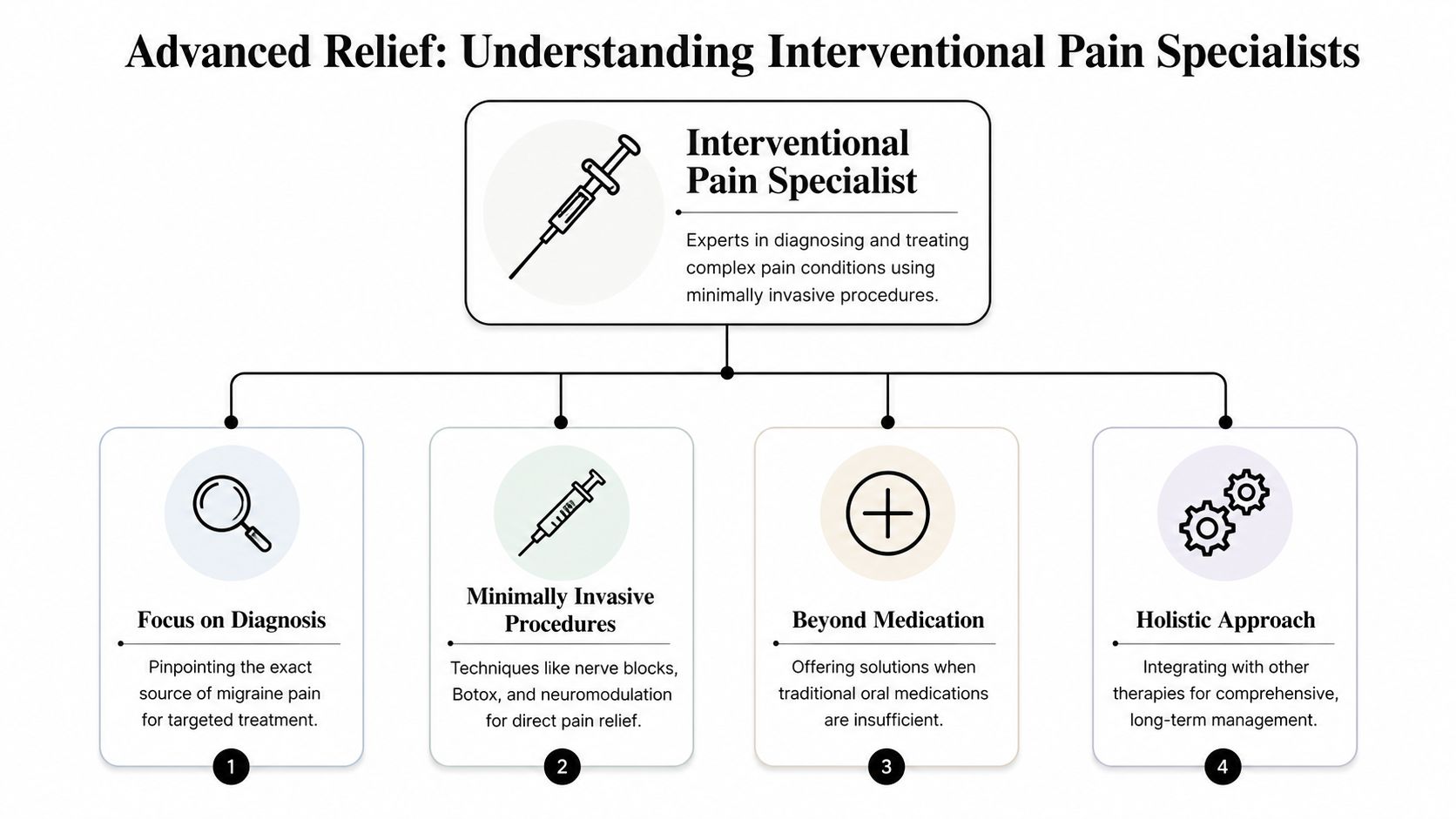
Many articles answer the question “what doctor treats migraine headaches” as if neurology is the only serious option. That's incomplete. For patients with persistent, disabling, or medication-resistant migraine, an interventional pain specialist can be one of the most useful doctors on the care team.
These physicians focus on procedure-based, opioid-sparing treatment. That matters when oral medications haven't provided enough control, when side effects are wearing you down, or when the headache pattern has become chronic and function is slipping.
Why this pathway is often missed
This isn't fringe care. Data shows that 30% of migraine treatment plans now include interventional pain specialists who perform occipital nerve blocks, trigger point injections, and Botox® for chronic migraine, often without a prior neurology referral, according to Henry Ford's migraine treatment overview.
That reflects something pain physicians see every day. Migraine care isn't only about selecting the next pill. It's often about targeting pain pathways directly.
What interventional pain specialists actually do
Interventional pain care is most useful when migraine has moved beyond simple attack treatment.
Botox for chronic migraine
Botox is not a cosmetic migraine treatment. It is a medical procedure used in selected patients with chronic migraine. A trained clinician injects onabotulinumtoxinA at specific sites around the head and neck to reduce the release of pain-related chemicals and quiet the pattern over time.
This option is especially relevant for patients who have recurring functional loss and haven't done well with standard medication plans.
Occipital nerve blocks
Some migraine patterns involve tenderness and pain generation around the occipital nerves at the back of the head. A nerve block can reduce that irritation and can be especially useful when headaches radiate from the neck or base of the skull.
Not every migraine patient needs one. The value depends on the pattern and physical exam.
Trigger point injections
When neck and upper shoulder muscle tension feeds into the headache cycle, targeted trigger point treatment may help reduce the muscular component. This doesn't “cure migraine,” but in selected patients it removes one of the amplifiers that keeps attacks going.
A migraine plan works better when it addresses both the neurologic disorder and the physical pain generators that keep flaring around it.
Who should consider this kind of care
Interventional pain evaluation is worth considering when:
| Situation | Why this pathway helps |
|---|---|
| Medication side effects are limiting | Procedures may reduce reliance on repeated medication use |
| Attacks remain disabling | Targeted treatment can address chronic pain contributors |
| Migraine has become chronic | Advanced therapies become more relevant |
| Access to neurology is delayed | Procedure-based care may still move treatment forward |
For patients in Palos Hills, Evergreen Park, Bridgeview, and nearby Illinois communities, this matters because specialty access is often uneven. Waiting passively for the “perfect” referral can leave people suffering longer than necessary. A qualified pain clinic offering interventional pain management can be part of a smart, early strategy, not just a last resort.
Comparing Doctors and Recognizing Migraine Red Flags
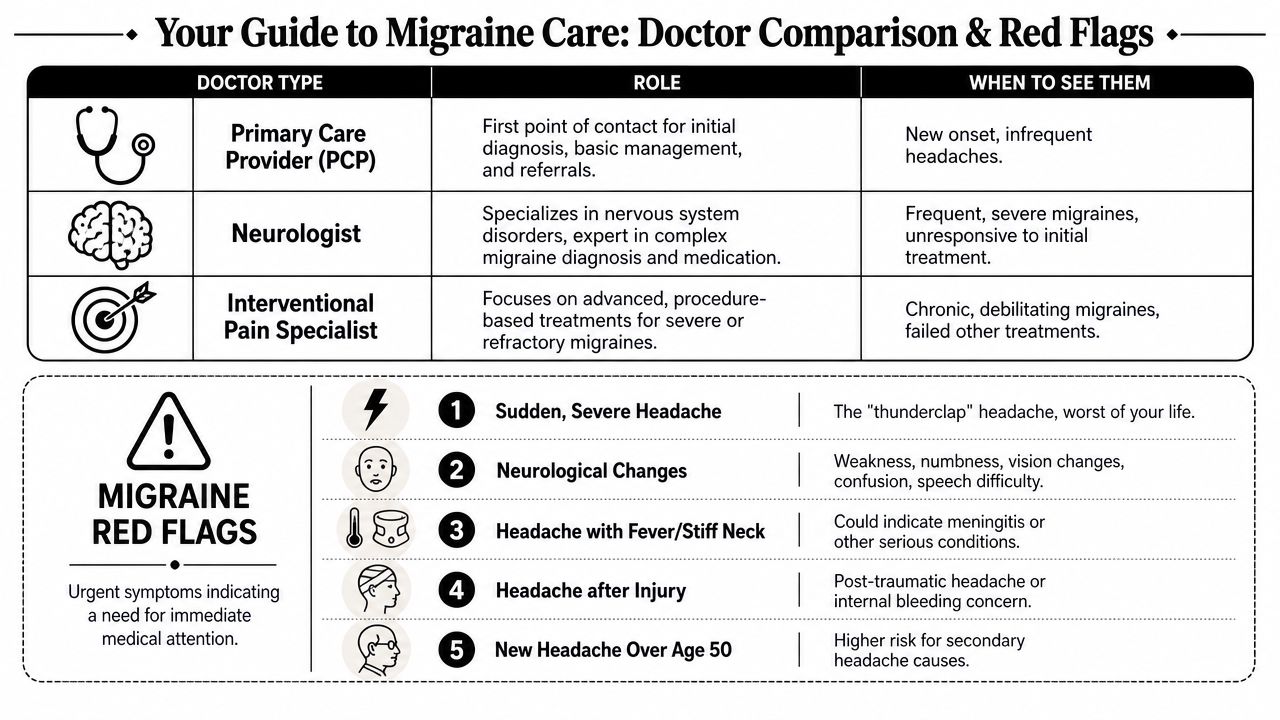
Patients don't usually need every type of migraine doctor at once. They need the right level of care for the pattern they have now. The easiest way to decide is to match the doctor to the problem in front of you.
Which doctor fits your situation
| Doctor type | Best time to see them | Main role |
|---|---|---|
| Primary care provider | New headaches, less frequent attacks, first evaluation | Initial diagnosis, basic treatment, referral if needed |
| Neurologist | Frequent, severe, unusual, or treatment-resistant migraine | Specialized diagnosis and medication management |
| Interventional pain specialist | Chronic, debilitating migraine or poor response to oral treatment | Procedure-based, opioid-sparing care |
One key threshold is chronic migraine, which is clinically defined as headaches occurring on at least 15 days per month for more than three months, as outlined in this review of chronic migraine criteria and advanced treatment eligibility. When patients hit that level, the treatment conversation usually changes. More advanced care becomes reasonable.
Red flags that should not wait
Some headaches need urgent medical evaluation, not routine scheduling.
- Sudden severe headache: A “thunderclap” headache or the worst headache of your life needs immediate attention.
- Neurologic symptoms: Weakness, numbness, confusion, vision loss, or trouble speaking can signal something more serious.
- Fever or stiff neck: Headache plus systemic illness can point to infection.
- Headache after injury: Trauma changes the risk picture.
- New headache later in life: A new pattern in an older adult deserves prompt evaluation.
Don't self-diagnose a red-flag headache as “probably migraine.” Get evaluated urgently.
A simple decision filter
If the headache is new, begin with primary care.
If it keeps breaking through treatment, bring in neurology.
If function is still poor and oral treatment hasn't gotten you there, interventional pain care deserves serious consideration.
That's the practical answer to what doctor treats migraine headaches. More than one kind of doctor can treat it. The right one depends on severity, timing, and what has or hasn't worked already.
Your Next Step to Migraine Relief in the Chicago Area
The best migraine care is rarely one-dimensional. Patients do better when the plan matches the pattern. Some need diagnosis and medication adjustment. Some need procedural care. Many need both. The goal is not only to survive the next attack. It's to reduce disruption, protect function, and avoid a cycle of repeated suffering.
For adults in Chicago Ridge and surrounding Illinois communities such as Palos Hills, Alsip, Burbank, Evergreen Park, Oak Lawn, Palos Heights, Worth, Bridgeview, Hickory Hills, and Orland Park, local access matters. Long travel times and fragmented referrals often make an already difficult condition harder to manage.

Why procedure-based care matters for some patients
There comes a point when “try another pill” stops being enough. That's especially true for chronic migraine, neck-linked headache patterns, and cases where standard care has only partly helped.
Botox (onabotulinumtoxinA) is an FDA-approved, evidence-based treatment for chronic migraine that is utilized by specialists like Dr. Yaw Donkoh at Midwest Pain & Wellness as part of a multimodal, opioid-sparing care strategy, as described by Advocate Health's migraine treatment overview.
That opioid-sparing approach matters. Migraine treatment should aim to improve control and restore daily life without creating a separate problem from medication dependence.
What a good next step looks like
A useful consultation should answer practical questions:
- Is this clearly migraine, or is something else contributing?
- Has the headache pattern become chronic?
- Would targeted procedures fit this presentation?
- What's the plan if medications have only helped partially?
The right next step isn't guessing. It's getting evaluated by a clinician who understands both the diagnosis and the advanced treatment options available in Illinois.
If chronic migraine is disrupting your life in Chicago Ridge, Oak Lawn, Palos Hills, Palos Heights, Worth, Bridgeview, Hickory Hills, Alsip, Burbank, Evergreen Park, or Orland Park, Midwest Pain & Wellness offers compassionate, opioid-sparing care built around the patient, not a one-size-fits-all protocol. Schedule a consultation to discuss whether a personalized plan, including advanced interventional treatment for migraine, could help you regain steadier days and better function.