You've probably tried the usual fixes already. A pill takes the edge off for a while, a rest day helps a little, then the back, knee, neck, or shoulder pain comes right back when you try to move normally. That pattern leaves people feeling stuck, especially when they want relief that doesn't depend on more medication.
Mind-body techniques for pain relief give patients another path. They don't pretend pain is “all in your head.” They work because pain is processed by the nervous system, and the nervous system responds to attention, stress, breathing, movement, and learned coping skills. In real care, that means these techniques can sit alongside injections, rehabilitation, and other medical treatments instead of competing with them.
For patients in Chicago Ridge, IL, and nearby Palos Heights, IL, Palos Hills, IL, Evergreen Park, IL, and Hickory Hills, IL, the practical question is usually simple, can this help me function better without pushing me toward stronger medicine? This guide answers that question step by step, with plain explanations, realistic expectations, and concrete ways to bring mind-body care into an Illinois pain plan.
Table of Contents
- Introduction to Mind-Body Techniques for Pain Relief
- Understanding Mind-Body Techniques
- Evidence Adoption and Guidelines for Pain Relief
- Specific Mind-Body Techniques for Pain Relief
- Practical Implementation Tips and Safety Considerations
- Integrating Mind-Body Techniques in Multimodal Opioid Sparing Care
- Local Resources and Referral Guidance in Illinois
- Conclusion and Next Steps
Introduction to Mind-Body Techniques for Pain Relief
A common scene in clinic is the patient who has done “all the right things” and still hurts. They have tried rest, anti-inflammatory medicine, and maybe a few different injections or braces, yet pain keeps shaping the day. At that point, the next question is not whether they are trying hard enough, it is whether the plan is missing a piece.
That missing piece is often mind-body care. These methods use breathing, attention, relaxation, movement, and thought training to help calm a pain system that has become too reactive. They are not a replacement for medical treatment when a joint, nerve, or spine problem needs care, but they can be a useful adjunct when the goal is better function and less reliance on medication.
Patients often ask why these approaches matter if the pain started in a knee, back, shoulder, or nerve. The answer is that pain is never only a tissue story. It is also shaped by stress, sleep, fear of movement, and the body's own protective signals. At Midwest Pain & Wellness, that matters because mind-body work can fit beside injections, medication planning, physical therapy, and other interventional care rather than compete with them, which gives patients more than one way to calm the system and keep moving.
Practical rule: if a technique makes you calmer, steadier, and more willing to move within your limits, it is doing useful work even before pain disappears.
Patients usually want to know five things. What the techniques are, how well they work, how to start, what can go wrong, and where they fit in a real treatment plan. The rest of this guide walks through those questions without hype, so you can judge whether these methods fit your pain pattern and your life.
Understanding Mind-Body Techniques
Pain doesn't travel in a straight line from the injured area to your brain. It's filtered, interpreted, and amplified or dampened by the nervous system. That's why two people with similar scans can have very different day-to-day pain, and why stress, fear, sleep loss, and constant monitoring can make pain feel louder.
A useful way to think about it is a volume knob. Tissue irritation may turn the signal on, but attention, stress, and protective muscle tension can turn the volume up. Mind-body techniques try to turn it down by changing the conditions that keep the nervous system on alert.
What These Methods Actually Target
Mindfulness teaches you to notice pain without immediately spiraling into panic or bracing. Cognitive restructuring helps you catch the thoughts that make flares feel catastrophic, then replace them with a more accurate response. Relaxation response practices, like slow breathing and progressive muscle relaxation, shift the body away from stress activation and toward a calmer state.
That matters because the pain experience has both sensory and emotional parts. The ache in the joint is real, and so is the fear of making it worse. Mind-body methods target both at the same time, which is why they can be helpful for people whose pain is tangled up with anxiety, guarding, or flare-related avoidance.
The NCCIH notes that a 2018 Agency for Healthcare Research and Quality systematic review found that exercise, cognitive behavioral therapy, massage, tai chi, qigong, acupuncture, and multidisciplinary rehabilitation improved function and/or pain for at least one month, and that the American College of Physicians strongly recommends nonpharmacologic treatment, including exercise or mindfulness-based stress reduction, for chronic low-back pain (NCCIH provider digest).
For patients trying to understand the mental side of chronic pain in more depth, this guide to mental health and chronic pain gives a useful local perspective on why mood, stress, and pain often travel together.
Pain relief often starts with a smaller goal than “zero pain.” Better sleep, less guarding, and a lower flare intensity are meaningful wins.
Evidence Adoption and Guidelines for Pain Relief
A patient with persistent back pain, neck tightness, or flare-driven anxiety often asks a practical question first, what helps without adding more medication? Mind-body techniques answer that question well because they fit into real pain care, including the kind of stepped treatment plan used at Midwest Pain & Wellness. They are often used alongside physical therapy, activity changes, and interventional care, not as a replacement for them.
The clearest evidence is not that these methods erase pain. It is that they can reduce pain intensity, improve function, and make symptoms more manageable for people who are willing to practice them consistently. The NCCIH analysis shows that complementary health approaches, including meditation and yoga, have become more common, and pain is a major reason people choose them. That matters because it reflects how patients use these tools, as part of pain treatment rather than as a separate wellness habit.
What the Controlled-Trial Evidence Shows
The strongest evidence supports meditation, hypnosis, and yoga, which the International Association for the Study of Pain identifies as the mind-body practices with the clearest scientific support for chronic pain (IASP fact sheet). A systematic review of randomized clinical trials found that mind-body therapies were linked to a moderate reduction in pain intensity and a small but statistically significant reduction in opioid dose. Another meta-analysis reported pain reduction with Cohen d = -0.51 and reduced opioid dose with Cohen d = -0.26, which points to moderate and small effect sizes respectively.
For patients, that usually means a realistic goal. Pain may not disappear, but the flare may feel less intense, sleep may settle, and movement may feel less threatening. That kind of gain is often enough to matter in everyday life, especially when the pain problem is chronic and layered with stress, muscle guarding, or fear of activity.
A separate review of mindfulness meditation found a statistically significant pooled effect on pain, although the authors rated the evidence as low because the studies were uneven and there was concern about publication bias. In plain language, the treatment signal is real, but it is not uniform across every condition or every person. That is why pain specialists treat these approaches as adjuncts, not as stand-alone cures.
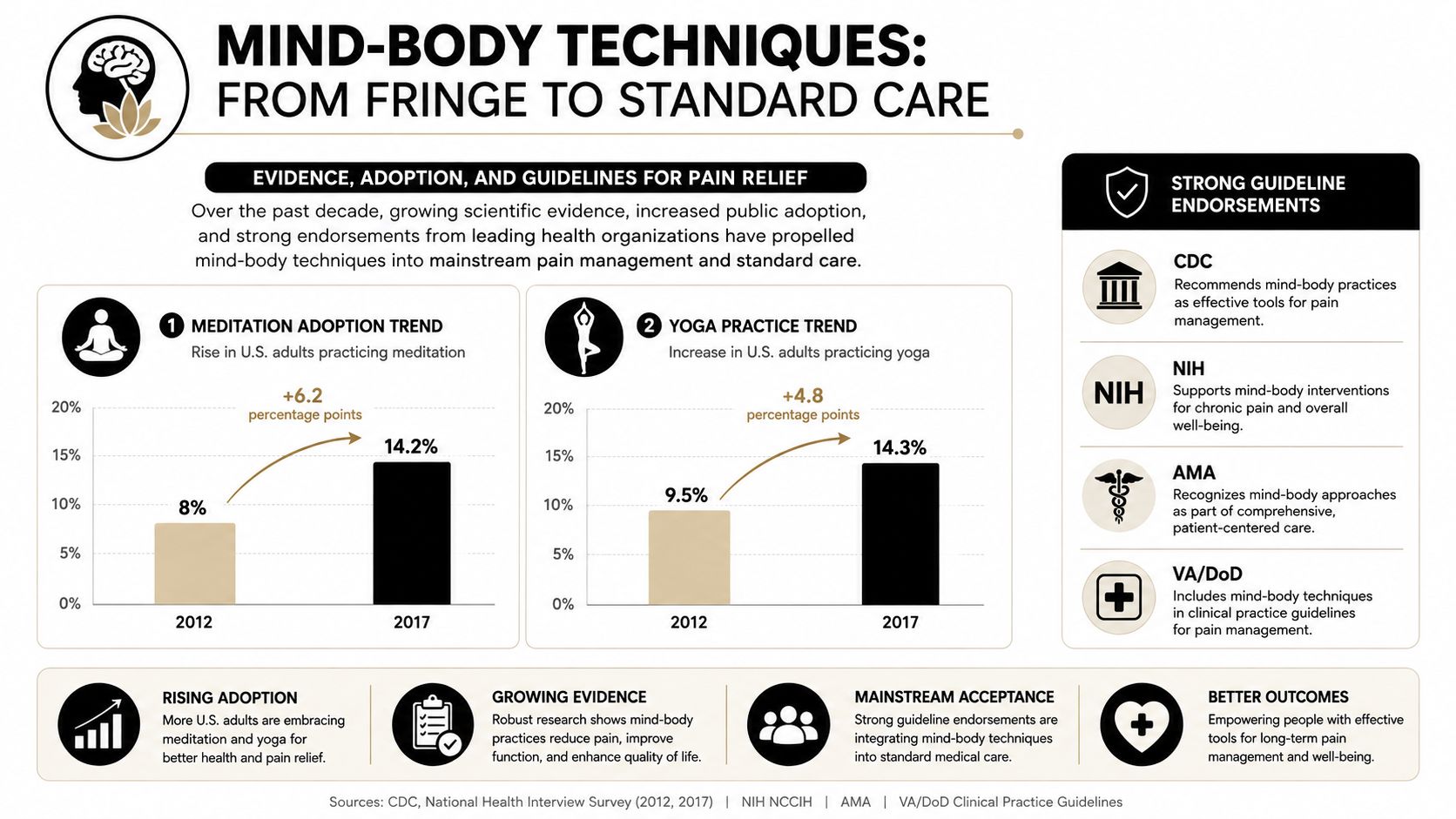
One practical way to read the evidence is this. More patients are trying these methods, major pain organizations support selected techniques, and the results are often meaningful even when they are not dramatic. For many people, that is exactly the right level of improvement, especially when the goal is fewer flares, better function, and a treatment plan that can fit with advanced interventional care instead of competing with it.
A helpful next step is to match the method to the pain pattern. Relaxation-oriented skills fit well when stress and muscle tension dominate. Meditation-based work often helps when attention keeps snapping back to pain. Biofeedback can be a useful option when patients need a clearer picture of how the body is responding, and our guide to biofeedback for pain management explains that role in more detail.
Specific Mind-Body Techniques for Pain Relief
A patient may come in with tight shoulders, shallow breathing, and pain that spikes after a stressful day. Another may notice that fear of movement makes every flare feel larger than it is. Those are different pain patterns, and they call for different mind-body tools. The best plan matches the method to the pain behavior, so the approach fits the way the nervous system is reacting.
The Main Techniques and Where They Fit
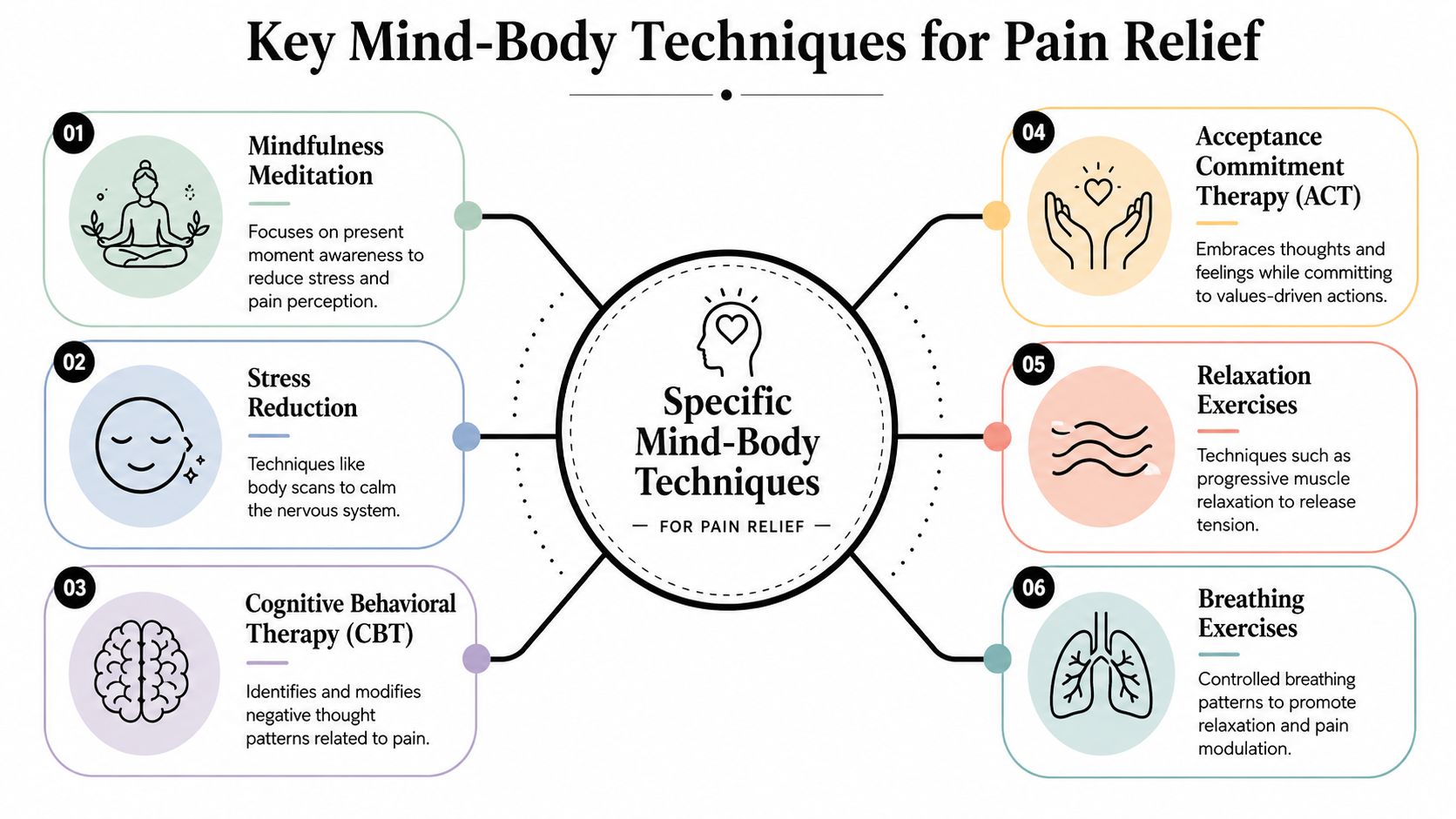
Mindfulness meditation is useful when pain becomes the center of attention. It trains patients to notice sensations without instantly fighting them, which can lower the emotional charge around a flare. Deep breathing and progressive muscle relaxation work more directly on the body's stress response, so they are often practical for tightness, guarding, and pain that worsens with anxiety.
Cognitive behavioral therapy, or CBT, targets the pain-thought loop. If every flare produces the thought, “This means I'm damaging myself,” pain usually feels louder and movement feels riskier. A PubMed review concluded that multi-component methods combining stress management, coping skills training, cognitive restructuring, and relaxation therapy can be useful adjuncts for chronic low back pain, and that CBT paired with educational components can help rheumatoid and osteoarthritis pain management (PubMed review). The same review also noted relaxation and thermal biofeedback as options for recurrent migraine, while relaxation and muscle biofeedback may help recurrent tension headache.
For readers who want a practical explanation of sensor-based training, this complete guide to biofeedback pain management is a helpful companion.
Yoga and tai chi add controlled movement to the mix. They can be a good fit for people who need gentle mobility work but do not tolerate high-impact exercise well. The point is not athletic performance, it is coordinated movement with enough pacing to avoid a flare.
A technique is working if it changes your pattern, not just your mood. Less bracing, less panic, better sleep, or easier movement all count.
Practical Implementation Tips and Safety Considerations
A patient often starts with good intentions, then life gets busy or pain flares and the routine stops. That pattern is common, but it does not build a steady nervous-system habit. A better plan is small enough to repeat on ordinary days, because consistency teaches the body more than occasional effort.
How to Practice Without Overdoing It
Start with one method and keep it brief. If you are trying progressive muscle relaxation, Harvard Health recommends tightening each muscle group for a short hold before releasing it slowly, then using mini-relaxation exercises several times through the day and pacing activity so a noticeable pain increase means you pause and reset (Harvard Health).
A simple starter plan can look like this. It is not a test of willpower, it is a way to teach the nervous system that calm input is safe.
- Begin small: choose one practice, not five, and make the first sessions short enough that you are willing to repeat them.
- Use repetition: brief daily practice usually works better than occasional long sessions, because the body learns the pattern more quickly.
- Track symptoms: note whether the session reduced tension, improved sleep, or changed the next flare.
- Adjust the dose: if a movement practice increases pain, shorten the range, slow the pace, or switch to breathing work for that day.
- Report warning signs: dizziness, panic, or a sharp increase in pain should be discussed with a clinician, especially if you have a spine, nerve, or balance problem.
For patients who are also getting medical treatment, these habits can support care plans that include injections, medication changes, or other advanced options. A discussion with the team at advanced pain management at Midwest Pain & Wellness can help match the practice to the rest of the plan so the body is not asked to do too much at once.
When Caution Matters
Yoga helps many people, but every pose does not fit every body. Deep twists, extreme forward bends, or unsupported balance work can irritate a sensitive spine, so those moves should be modified or skipped. If pain changes character, such as new numbness, weakness, or spreading symptoms, that is a medical issue, not a toughness test.
The safest approach is to treat these methods like graded rehabilitation for the nervous system. Breathing, movement, and calm attention are the signals, and the goal is to reduce alarm without provoking a flare.
Integrating Mind-Body Techniques in Multimodal Opioid Sparing Care
Mind-body care works best when it's part of a bigger plan, not the only plan. A patient with facet-mediated back pain may still need an image-guided procedure. A person with headache and neck tension may still need medication adjustments or targeted injections. The mind-body piece helps those medical treatments work in a calmer, less reactive system.
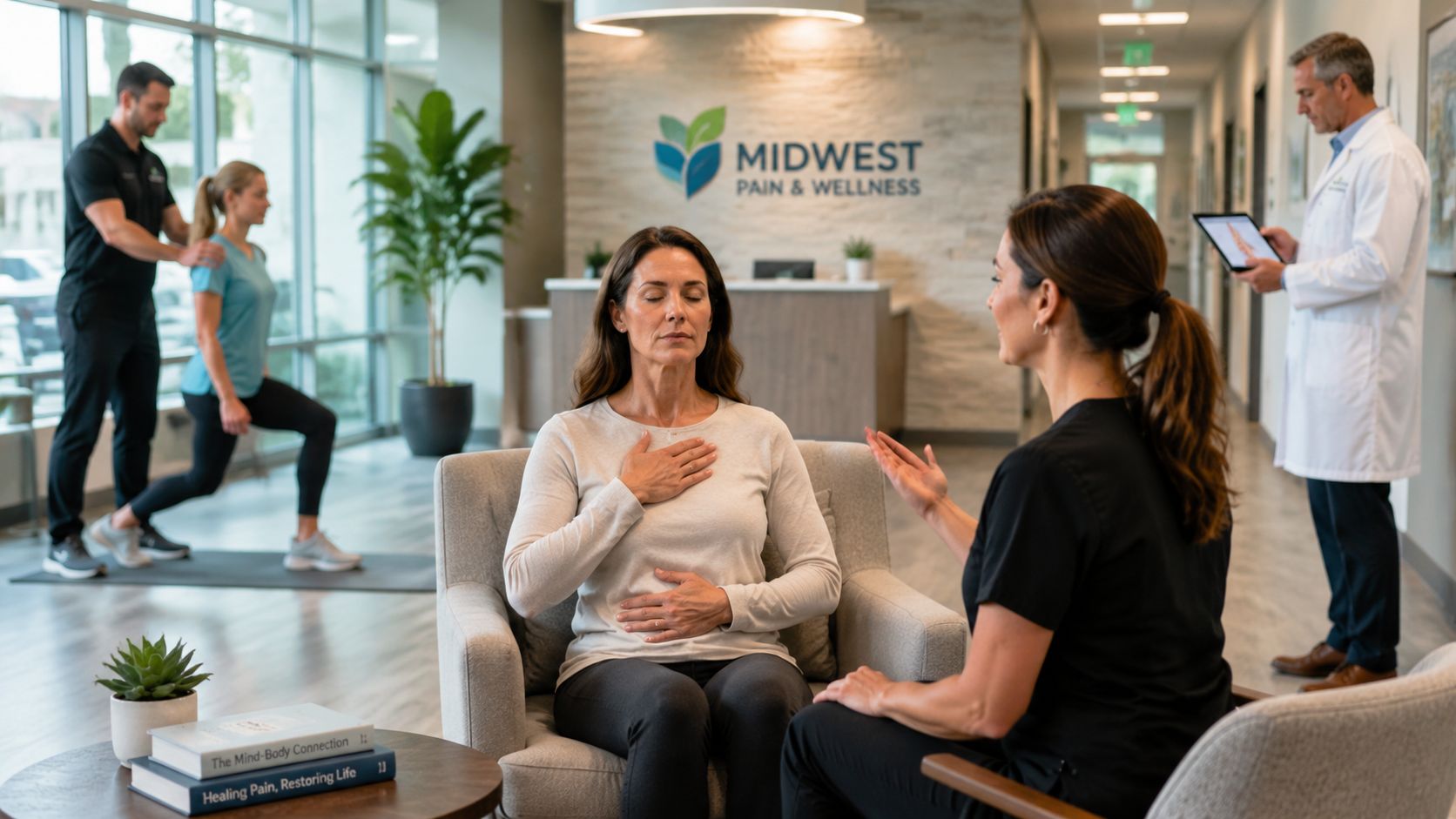
At Midwest Pain & Wellness, mind-body methods can sit alongside interventional care for chronic pain, spine and nerve disorders, injury and post-surgical pain, and headache conditions. That kind of layered approach matters because pain often has more than one driver, and each driver may need a different tool.
Why Combination Care Makes Sense
A recent update on non-pharmacological interventions notes that multi-component strategies using psychological approaches, expectation management, and emerging VR therapies alongside established mind-body methods can significantly reduce pain intensity and medication use when integrated with procedural care (PMC update). That finding fits day-to-day practice. When a patient trusts the plan, understands what a procedure can and can't do, and has a relaxation routine for flares, the whole plan tends to hold together better.
One patient might use breathing and relaxation before a spine injection to reduce procedure anxiety. Another might pair graded activity pacing with recovery after a nerve procedure so they don't bounce between overdoing it and shutting down. The same principle applies after surgery, when fear of movement can prolong stiffness even after the tissue itself is healing.
For readers who want a broader look at how procedures and conservative care fit together, this advanced pain management overview shows how individualized interventional plans are built around function, not just symptom suppression.
Mind-body care also helps clinicians set realistic expectations. If a treatment lowers pain from an eight to a five, that may still be a meaningful shift when it allows walking, sleep, or physical activity. That's the kind of outcome patients usually care about most.
Local Resources and Referral Guidance in Illinois
If you live in Chicago Ridge, IL, or the surrounding Illinois suburbs, the easiest next step is to ask for a referral plan that fits your exact pain pattern. Some patients do best with a mind-body class, others need one-on-one cognitive or relaxation coaching, and many need both a class and a medical pain visit.
A practical referral pathway often starts with your pain clinic or primary care provider, then branches to a licensed behavioral health clinician for CBT, a qualified instructor for yoga or mindfulness, or a biofeedback-trained clinician when muscle tension or headache cycles are a major issue. Insurance and workers' compensation coverage can vary by service type, so it helps to ask whether the visit is billed as medical pain management, behavioral therapy, or wellness instruction before you schedule.
For patients near Palos Heights, IL, Palos Hills, IL, Evergreen Park, IL, and Hickory Hills, IL, coordinated care works best when your providers share the same goals, less medication dependence, better sleep, and steadier function. Telehealth can be useful for education, CBT-style support, and follow-up coaching, especially when driving to repeated appointments is hard because of pain or work schedules.
If you're already in an interventional pain plan, bring up mind-body options at the same visit. A good referral conversation should cover your diagnosis, what movements aggravate symptoms, what your current medication goals are, and whether your care team wants you to start with breathing, relaxation, CBT, or a movement-based option first.
Conclusion and Next Steps
Mind-body techniques for pain relief work best when you treat them as practical clinical tools, not vague wellness add-ons. The evidence supports them as adjuncts for chronic pain, especially when the goals are better function, less fear around movement, and, for some people, less reliance on opioids. Realistic progress is often the right target. Smaller flares, steadier nerves, and more confidence using your body again can change day-to-day life in meaningful ways.
If you're dealing with back, joint, headache, or nerve pain in Illinois, the next move is a conversation, not a guess. Ask how a breathing practice, CBT, relaxation training, or graded movement could fit into your current treatment plan, especially if you are already considering injections or other interventional care. These approaches can work like different parts of the same plan, with one helping calm the nervous system while another addresses the pain source itself.
Dr. Yaw Donkoh and the Midwest Pain & Wellness team can help you decide whether mind-body techniques belong in your plan and how to combine them with medical treatment in a way that fits your symptoms, schedule, and goals. Bring your questions, your prior treatments, and your pain triggers, then shape the next step with a team that understands both the physical and nervous-system sides of pain. That kind of coordination matters when you want improvement that feels practical in real life, not just good on paper.
If you're ready to make your pain plan more complete, schedule a visit with Midwest Pain & Wellness and ask how mind-body strategies can fit alongside interventional care. The team can help you connect practical relaxation tools with a personalized treatment plan so you are not managing pain alone.