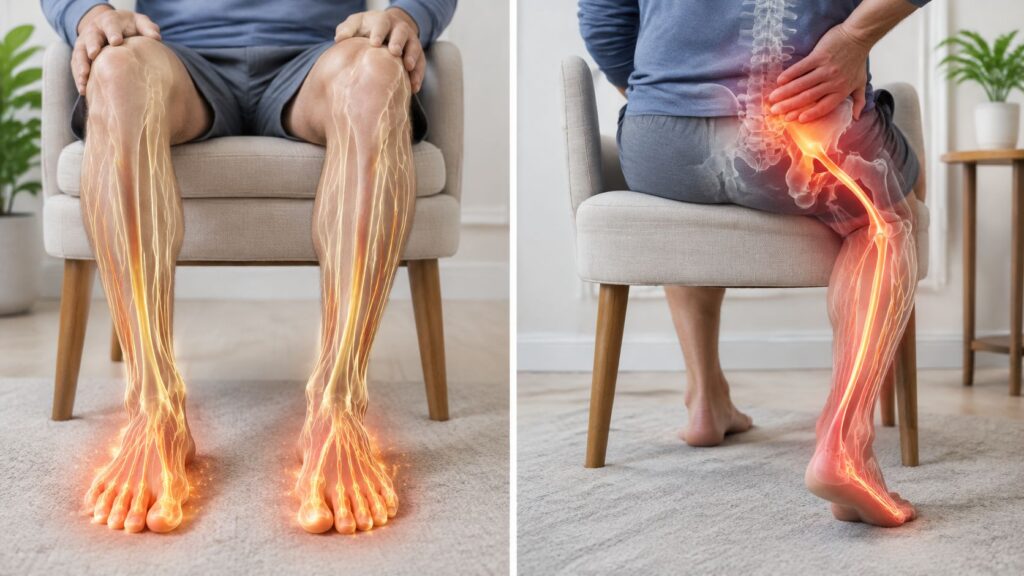
You had an injection, felt better for a while, then watched the pain return. Maybe the second injection helped less than the first. Now you're in a Chicago Ridge, Palos Heights, Palos Hills, Evergreen Park, or Hickory Hills pain clinic hearing about radiofrequency ablation versus steroid injection, and you want a useful answer, not another vague promise.
The honest answer is that neither procedure wins for every diagnosis. A steroid injection is usually aimed at inflammation and can serve as treatment or a diagnostic trial. Radiofrequency ablation, or RFA, targets sensory nerves from a specific joint and usually makes more sense when the pain generator has already been confirmed. The right choice depends on where the pain starts, how long you need relief, and what your earlier treatment proved.
Table of Contents
- Two Procedures, One Decision
- How Radiofrequency Ablation and Steroid Injections Work
- Side-by-Side Comparison of Key Criteria
- What the Evidence Says About Pain Relief
- Candidacy, Procedure Day, and Recovery
- Risks and Side Effects You Should Know
- Cost, Coverage, and Why Sequencing Matters
- Choosing the Right Option for Your Situation
Two Procedures, One Decision
Suppose you've had one or two epidural steroid injections for back or leg pain. The first helped, but the relief faded. The next one produced only a short improvement, or it helped your leg pain but not the aching across your lower back. At that point, being offered RFA doesn't automatically mean you should accept it. It means the clinical question may have changed.
Start with the pain generator. Is the pain coming from an irritated spinal nerve, a facet joint, the sacroiliac joint, a knee, or another peripheral nerve? Epidural injections are designed for a different problem than medial branch RFA. Genicular nerve RFA for knee pain is different again. A procedure can be technically successful and still disappoint you if it targets the wrong structure.
Next, decide what time horizon matters. If you need enough relief to participate in rehabilitation during an inflammatory flare, a steroid injection may be reasonable. If you're dealing with chronic, predictable joint pain and want relief that lasts beyond a brief window, RFA deserves consideration after appropriate diagnostic testing.
Finally, review the workup. Your clinician should know what your examination showed, what imaging does and doesn't explain, how you responded to previous injections, and whether a diagnostic nerve block reproduced the expected relief. Don't choose based on which procedure sounds newer or more definitive.
Practical rule: A short-lived response isn't automatically a failure. It can be useful evidence that the target is involved, especially when the pain returns after the medication wears off.
Both treatments have legitimate roles. The mistake is sequencing them by habit instead of matching them to the diagnosis. That starts with understanding what each procedure does.
How Radiofrequency Ablation and Steroid Injections Work
A steroid injection delivers a corticosteroid, often with a local anesthetic, near the structure believed to be causing pain. Depending on the diagnosis, the medication may enter the epidural space, a facet joint, the sacroiliac joint, or the tissues around a peripheral nerve. The aim is to reduce inflammation and interrupt the pain cycle long enough for movement, sleep, and rehabilitation to improve.
That approach can be useful when inflammation is active. An epidural injection may be considered for radiating pain associated with an irritated nerve root. A joint injection may calm an acute flare or provide information about whether the joint is contributing to symptoms. For a plain-language explanation of the medication and delivery process, see how steroid injection works.
Radiofrequency ablation works differently. Under image guidance, the clinician places a specialized needle near a sensory nerve that carries pain signals from a selected joint. Radiofrequency energy creates a controlled lesion, interrupting that nerve's ability to transmit pain. The intended benefit is measured in months rather than the shorter relief window often associated with anti-inflammatory medication.
The target determines the RFA technique
For facet-mediated neck or back pain, the usual target is the medial branch nerve. For certain chronic knee pain patterns, the target is a group of genicular nerves. Other targets may be considered only when the examination, imaging, and diagnostic testing support them.
RFA typically isn't a first-line treatment. Before treating a sensory nerve, the clinician should have a strong reason to believe that nerve is carrying the relevant pain. A diagnostic block temporarily numbs the nerve. Meaningful, concordant relief supports proceeding, while little or no relief argues for reassessing the diagnosis.
Patients comparing procedures for knee symptoms may also benefit from broader education on non-surgical knee pain care, especially when the goal is to improve function without immediately moving to surgery. The same principle applies across treatment choices: identify the source first, then select the least burdensome intervention that fits the goal.
Side-by-Side Comparison of Key Criteria
The most useful comparison isn't “which treatment is stronger?” It's “which treatment fits this pain pattern and this timeframe?” Steroid injections are medication-based and inflammation-focused. RFA is nerve-targeted and depends more heavily on accurate diagnosis.
| Criterion | Steroid Injection | Radiofrequency Ablation |
|---|---|---|
| Mechanism | Reduces inflammation and may temporarily quiet pain signals | Interrupts transmission through a selected sensory nerve |
| Typical target | Epidural space, facet or sacroiliac joint, or tissues around a nerve | Medial branch, genicular, or another carefully selected sensory nerve |
| Best-supported role | Radicular pain, acute inflammatory flares, and selected diagnostic or therapeutic trials | Chronic joint-mediated pain after a concordant diagnostic block |
| Relief pattern | Often quicker, but commonly shorter-lived | Usually slower to assess, with potential for more durable relief |
| Diagnostic value | May clarify whether an inflamed region contributes to pain | Diagnostic block is generally used before lesioning |
| Candidacy | Active inflammation, an acute flare, or an uncertain pain source | Confirmed pain generator, meaningful block response, and failed conservative care |
| Recovery burden | Usually modest, with temporary soreness possible | Usually modest, with post-procedure soreness or nerve irritation possible |
| Main trade-off | Repeated exposure may create cumulative medication concerns | More invasive nerve-targeted treatment with uncommon but meaningful procedural risks |
| Ideal use case | A short-term window for function, rehabilitation, or clarification | Sustained relief for chronic, well-localized joint pain |
Evidence reviews generally support an RFA advantage for durability in selected conditions, but the certainty can be limited. That distinction matters. A treatment may outperform another in a trial without being appropriate for every patient who has the same broad label, such as “back pain.”
Steroid injections can also be reasonable when the pain pattern is predictable and the patient gets useful, repeatable relief. If an injection reliably restores function during flares, repeating it may be more sensible than escalating automatically. If it barely helps, repeating it without changing the diagnostic reasoning isn't a plan.
People sometimes add non-procedural tools to the discussion, including electrical stimulation for symptom management. A practical guide to TENS machines UK can explain that category, but it doesn't replace a diagnosis or answer whether a spinal joint or nerve is the pain source.
What the Evidence Says About Pain Relief
The strongest practical message from the evidence is durability after correct patient selection. A 2024 systematic review and meta-analysis comparing RFA with steroid injections for spinal facet and sacroiliac joint pain found higher pain intensity among corticosteroid-treated patients than among RFA-treated patients at three months and six months. The reported standardized mean differences were 0.92 at three months and 1.53 at six months, but the certainty of evidence was low to very low because of imprecision and study limitations (systematic review and meta-analysis).
For sacroiliac joint pain, a randomized controlled blinded study found that 73% of patients in the RFA group achieved at least 50% pain relief at one month, 60% at three months, and 53% at six months. The steroid group reached 20% at one month and had no sustained benefit at the later measured time points (sacroiliac joint trial).
| Indication | RFA outcome | Steroid injection outcome |
|---|---|---|
| Sacroiliac joint pain | Higher rates of meaningful relief that persisted through the measured follow-up | Early improvement in a smaller proportion, without sustained benefit in the cited trial |
| Facet and sacroiliac pain overall | Generally better pain relief over several months in the 2024 review | Higher pain intensity at the measured follow-up points |
| Knee osteoarthritis | Cooled RFA provided a longer-term option for pain, function, and quality of life after conservative care failed | Less durable comparison treatment in the randomized evidence |
| Chronic sacroiliac pain across randomized trials | A systematic review found positive results in 15 of 16 randomized controlled trials, with benefit supported up to one year (systematic review) | Less consistent durability |
| Knee osteoarthritis in a 2026 review | Superior and sustained benefits from one through six months, including pain reduction and satisfaction | Better results during the first week (knee osteoarthritis review) |
The evidence supports RFA most clearly when the pain generator is a joint served by a treatable sensory nerve. It doesn't make RFA the standard answer for disc-related nerve compression or every form of axial back pain. The 2026 network meta-analysis of sacroiliac treatments included 18 trials and 1,075 patients, found RF-based interventions consistently outperformed steroid injections for pain relief, and still rated the certainty low to very low, with more mixed disability rankings across time points (network meta-analysis).
I weigh three things before recommending escalation: the size of the response, how long it lasted, and whether the result can be repeated or extended safely. A brief response may justify a different target. A strong but temporary response may support diagnostic progression.
Candidacy, Procedure Day, and Recovery
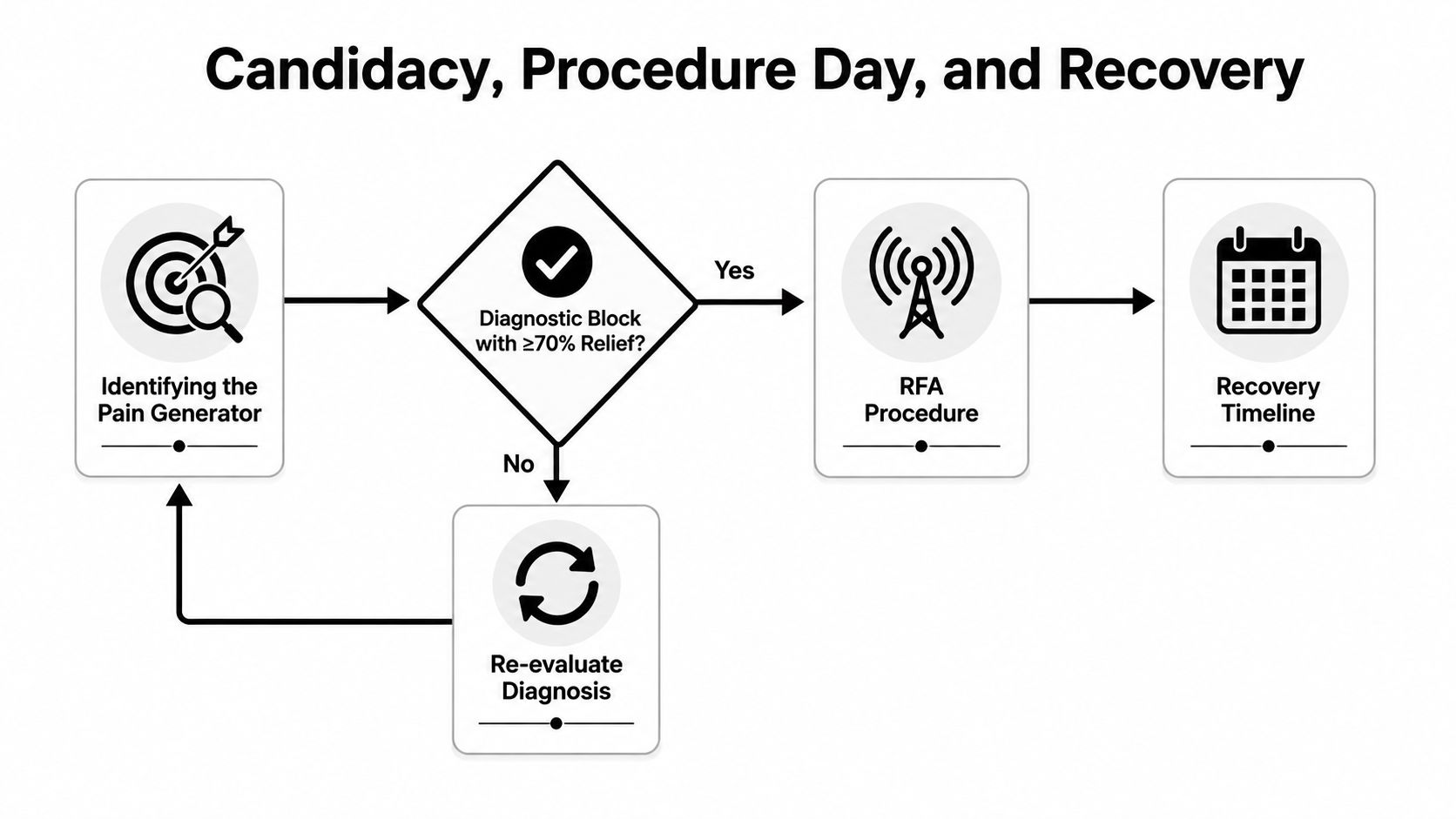
Candidacy begins with the suspected pain generator, not with a request for a particular procedure. RFA is most reasonable for facet-mediated axial neck or back pain, selected sacroiliac joint pain, certain chronic knee pain patterns involving the genicular nerves, and some cervicogenic headache patterns when testing supports the target.
A diagnostic medial branch or genicular nerve block should produce substantial, concordant relief for the duration expected from the local anesthetic. Many clinicians use a threshold in the 70% to 80% range, but the exact authorization and clinical standard can vary by procedure and payer. Imaging may support a structurally clear target, but imaging alone doesn't prove that a joint is generating the pain.
Steroid injections fit a different candidacy profile. They may be appropriate for active inflammatory radiculopathy, an acute facet flare, or diagnostic uncertainty where a therapeutic trial can help clarify the source. That doesn't mean every patient should receive an injection first. It means the lower-burden option can be useful when inflammation or uncertainty is central to the decision.
What the procedure day looks like
At Midwest Pain & Wellness, the process begins with check-in at the Chicago Ridge clinic and a review of the planned target. IV placement is optional. Patients are positioned prone or supine, depending on the procedure, and monitored during care.
Fluoroscopy helps guide needle placement. Contrast injection is used to improve safety and confirm the intended spread. For RFA, sensory and motor testing helps verify that the needle is near the intended sensory target and not an unintended motor structure. Lesion time is roughly 90 seconds per nerve, and discharge generally occurs within 30 to 45 minutes.
Recovery requires a fair assessment
Expect soreness for 2 to 5 days after RFA. Light activity can usually resume the next day, with full activity often returning within a week if recovery is uncomplicated. Don't judge the final result immediately. Pain assessment commonly starts around the second week, when the clinician can evaluate whether the expected response is developing.
If you're unfamiliar with the diagnostic step, review what a medial branch block involves before your appointment. The purpose isn't to put you through extra procedures. It's to reduce the chance of treating the wrong nerve.
Risks and Side Effects You Should Know
RFA and steroid injections carry different kinds of risk. RFA is more technically targeted, so uncommon complications can be more serious if the needle or lesion is misplaced. Steroid injections are usually less disruptive procedurally, but repeated medication exposure and certain injection routes create their own concerns.
RFA can cause temporary soreness or neuritis, meaning irritation along the treated nerve. Thermal injury to an adjacent nerve root, vascular injury including a lumbar artery breach, deafferentation pain, and, in cervical procedures, vertebral artery injury are uncommon but real possibilities. Risk reduction depends on precise fluoroscopic positioning, contrast venography where appropriate, sensory and motor testing, and careful selection of conventional, cooled, or bipolar techniques for the target.
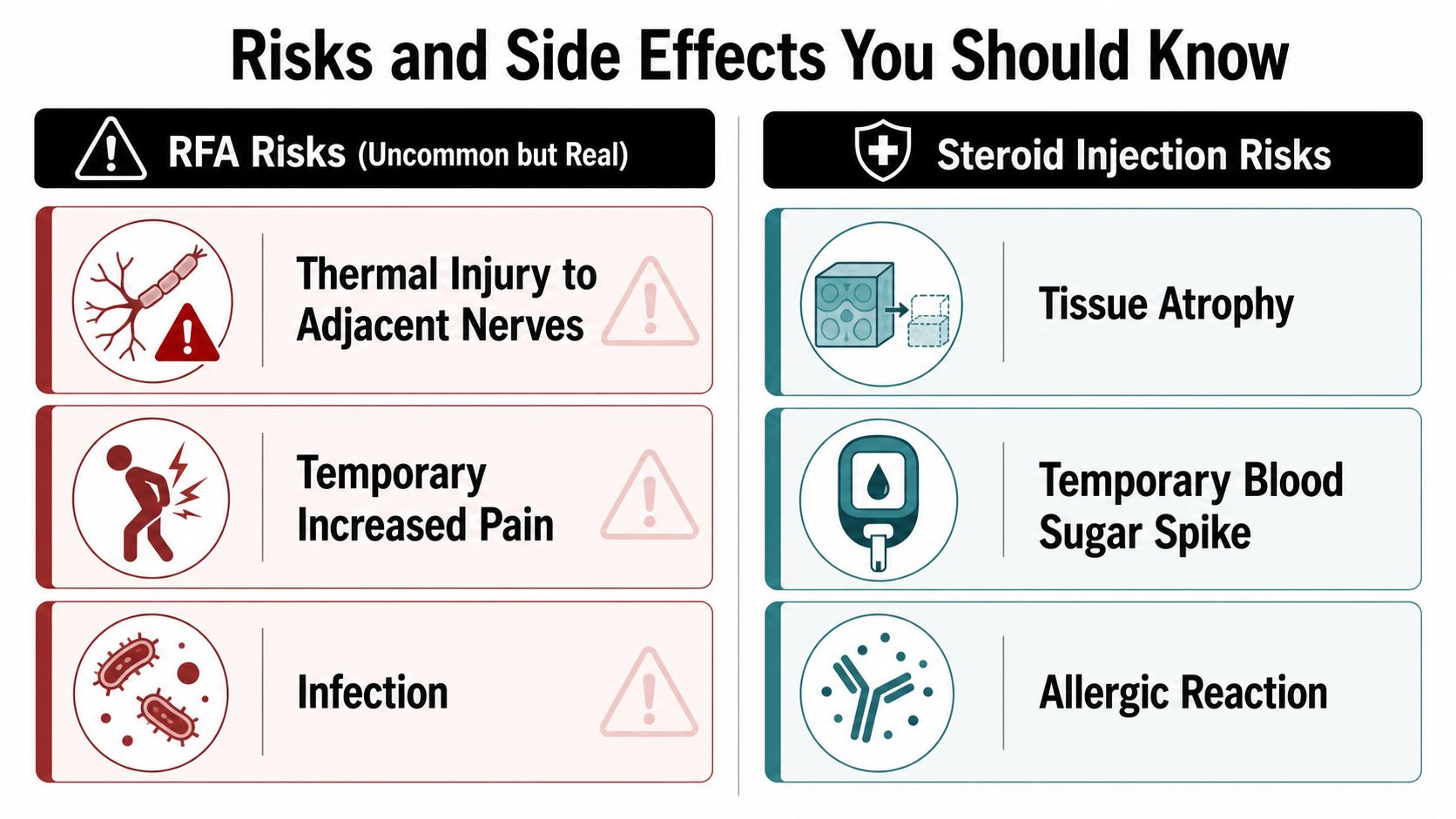
Steroid injection side effects are often temporary. Patients may experience injection-site soreness, facial flushing, water retention, mood or sleep changes, a short pain flare, or a transient blood sugar rise. Blood sugar changes matter particularly for people with diabetes. More serious risks include dural puncture headache after an epidural, infection such as discitis or epidural abscess, and vascular uptake with embolic complications from particulate steroid during a transforaminal injection.
For cervical transforaminal injections, Midwest Pain & Wellness uses non-particulate dexamethasone as a safety measure. That choice doesn't remove every risk, and it doesn't make a procedure appropriate without a clear indication. Repeated steroid exposure also deserves discussion for patients with conditions where systemic steroid effects or bone health are concerns.
Ask before scheduling: What structure are you treating, what complication is most relevant to my medical history, and what will we do if the procedure doesn't help?
Cost, Coverage, and Why Sequencing Matters
Cost depends on the procedure, facility, insurance plan, authorization requirements, and whether sedation or additional services are involved. I won't give you a fabricated Illinois price range because a number without your insurance details can mislead you. Ask for a written estimate that separates the professional fee, facility fee, medication, imaging, and any anesthesia-related charge.
Medicare and commercial plans commonly require documentation that conservative care failed and that the procedure is medically necessary. Authorization rules vary, but payers often expect a documented response to diagnostic blocks before approving RFA. A steroid injection may be authorized under a different clinical pathway, particularly when the record shows radicular symptoms or another inflammatory indication.
| Factor | Steroid Injection | Radiofrequency Ablation |
|---|---|---|
| Upfront financial burden | Often lower than an ablation pathway, depending on the site and coverage | Often higher because of diagnostic testing, procedural complexity, and authorization requirements |
| Documentation | Diagnosis, symptoms, prior care, and medical necessity | Diagnosis, failed conservative care, diagnostic block response, functional goals, and medical necessity |
| Coverage question | Ask whether the specific injection route and medication are covered | Ask whether the diagnostic block and ablation each require separate authorization |
| Best financial logic | Useful when a short-term response can restore function or clarify the target | More rational when earlier relief was meaningful but repeatedly short-lived |
| Chicago-area planning | Verify network status and site-of-service rules before scheduling | Confirm the full staged pathway, not just the ablation fee |
At the Chicago Ridge clinic, sensible sequencing means confirming a specific pain generator, documenting functional goals, trying an appropriate less-durable option when clinically justified, and reserving ablation for patients whose response supports it. That approach can prevent you from paying for a procedure that never had a reasonable target.
Before comparing estimates, read the clinic's explanation of radiofrequency ablation cost and then call your insurer. Coverage is a contract question, not a promise that applies uniformly across Illinois plans.
Choosing the Right Option for Your Situation
Use four questions to make the decision practical.
What is generating the pain?
Facet pain, sacroiliac pain, knee pain, occipital nerve pain, and nerve-root irritation require different strategies. If the symptoms radiate along a nerve and inflammation appears central, a steroid injection may fit better. If the pain is joint-mediated and a diagnostic block produces concordant relief, RFA becomes more logical.
How long do you need relief?
A short-term need, such as getting through an important event or opening a rehabilitation window, may favor an injection. Chronic daily pain that repeatedly returns after temporary relief points toward evaluating whether RFA can provide a longer interval, provided the target is confirmed.
What did prior treatment teach you?
If you've never had a steroid injection, or if your symptoms have changed, a therapeutic trial may still be useful. If an injection produced strong but fleeting relief, that response can support further diagnostic work. If it produced no meaningful benefit, don't assume RFA will fix the problem. Reconsider the diagnosis first.
What access and follow-up can you manage?
Adults in Chicago Ridge, Palos Heights, Palos Hills, Evergreen Park, and Hickory Hills should consider travel, follow-up availability, insurance network status, and the time required for staged diagnostic testing. A treatment plan only works if you can complete the evaluation, recovery, and rehabilitation steps.
Bring prior imaging, procedure reports, medication records, and a short description of what improved and for how long. At your evaluation, ask: Which structure is most likely causing my pain? What did my last injection prove? Do I need a diagnostic block? What functional goal will define success?
Midwest Pain & Wellness offers targeted image-guided injections, diagnostic blocks, and radiofrequency ablation for selected chronic spine, joint, and nerve pain conditions. Visit Midwest Pain & Wellness to request an evaluation at the Chicago Ridge clinic and discuss whether your history supports another injection, diagnostic testing, or a carefully selected ablation.