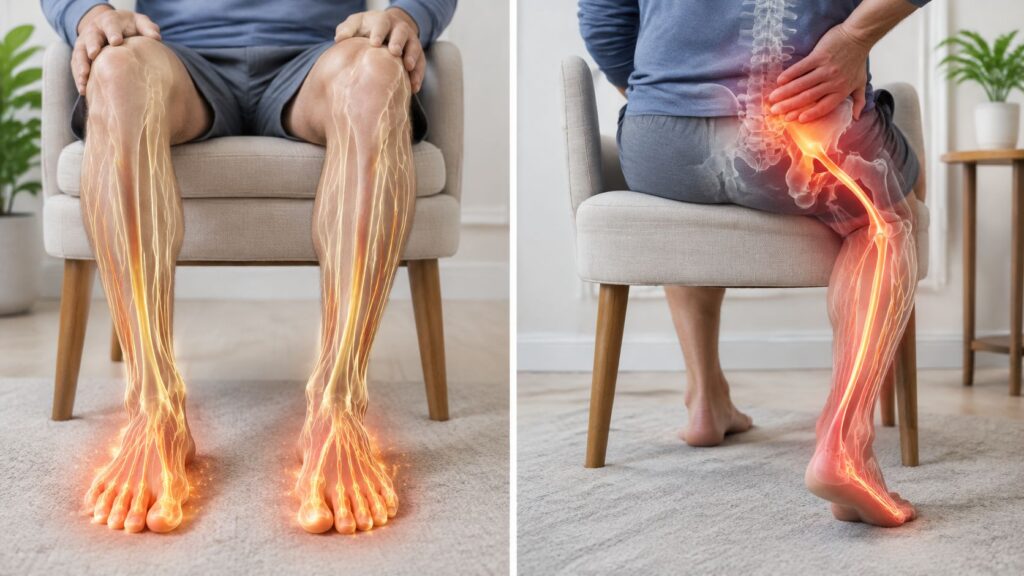
For facet-mediated chronic low back pain, most patient reviews and controlled studies describe meaningful relief lasting roughly 6 to 12 months, and results vary sharply by pain generator. The strongest trial-based support is for facet joint pain and sacroiliac joint pain, while discogenic and nonspecific low back pain produce much less reliable reviews and much less convincing study results.
That's usually the point where people start searching for radiofrequency ablation for back pain reviews. They've already done months of aching, stiffness with standing, pain with twisting, anti-inflammatories, home exercise, and often an injection that helped briefly or didn't help enough. Now they want a plain answer: is RFA worth it, or is it another procedure with a good sales pitch and mixed real-world follow-through?
The honest answer in Illinois is that RFA is not a general back pain treatment. It's a targeted nerve procedure that works best when the pain source has been identified correctly first. That matters for patients in Chicago Ridge, Palos Heights, Palos Hills, Evergreen Park, and Hickory Hills, because the difference between a strong candidate and a poor candidate is often the difference between a very good review and a very disappointed one.
Table of Contents
- What Patients Want to Know Before Choosing RFA
- How Radiofrequency Ablation Actually Works
- What the Reviews and Trials Say About Effectiveness
- How Long Relief Typically Lasts
- Outcomes by Indication and Pain Generator
- Side Effects, Recovery, and the First Two Weeks
- Who Is a Good Candidate and Why Diagnostic Blocks Matter
- Illinois Coverage Rules and What a Chicago Ridge Visit Looks Like
- RFA Compared With Steroid Injections and Ongoing Conservative Care
- Quick-Reference Checklist for Your Consultation
- Honest Answers to the Questions Patients Hesitate to Ask
What Patients Want to Know Before Choosing RFA
Most patients who look up radiofrequency ablation for back pain reviews are at a familiar stage. Their pain isn't brand new, and it isn't catastrophic enough to force surgery, but it's persistent enough to wear down sleep, work, driving, and mood.
A common version is this: low back pain has lasted for months, physical therapy helped only somewhat, anti-inflammatory medication takes the edge off but doesn't hold, and a steroid injection may have helped for a short period before the pain returned. At that point, people aren't looking for theory. They want to know what happens to actual patients after the procedure.
The four questions almost everyone asks
Patients usually come in with four practical questions:
- How much relief should I realistically expect? Not marketing language. Actual change in pain and function.
- How long does it last? Days and weeks don't matter much if the pain comes right back.
- What does recovery feel like? People want to know whether they'll be laid up or just sore.
- Do diagnostic blocks really predict success? Many reviews mention them, but few explain why they matter so much.
Most of the confusion starts when people treat RFA as if it were one treatment for all low back pain. It isn't.
What RFA does and what it doesn't do
RFA targets a pain-transmitting nerve. It does not heal arthritis, reverse degeneration, or repair a disc. If the pain generator is the facet joint or, in some cases, the sacroiliac joint, interrupting that nerve signal can matter a great deal. If the pain source is something else, the same procedure can feel like a miss.
That's why reviews split so widely. Good candidates often describe months of improved function and steadier relief. Poor candidates often say it “did nothing,” and in many of those cases the problem wasn't the technology. It was the diagnosis.
How Radiofrequency Ablation Actually Works
RFA is a percutaneous outpatient procedure. A needle-like electrode is guided with fluoroscopy to a very specific target nerve. For lumbar facet pain, that target is usually the medial branch nerve. For sacroiliac pain, the target is typically the lateral branch nerves.
What happens during the procedure
The treatment area is cleaned and numbed with local anesthetic. Once the electrode is in the right position, radiofrequency energy creates a controlled thermal lesion. In routine practice, the active tip is heated to roughly 60 to 80°C for about 60 to 90 seconds per lesion.
The actual lesioning part is short. The whole visit usually takes around 30 to 45 minutes because positioning, sterile prep, imaging, confirmation, and local anesthetic all take time.
What patients usually feel
During the procedure, most patients describe:
- Pressure more than pain
- A warm or buzzing sensation during lesioning
- Brief positional discomfort from lying still
Some clinics use local anesthetic alone. Some also offer light sedation depending on the situation and the patient.
Practical rule: If someone expects RFA to feel like surgery, they're usually relieved by how straightforward the visit is. If they expect zero soreness afterward, they're often surprised.
What the first few days are like
Afterward, soreness at the needle sites is common. Many patients feel bruised, tight, or mildly flared for a few days. That doesn't mean the treatment failed. It means a needle-based thermal procedure was just performed near irritated spinal structures.
The key point is simple: RFA works by interrupting pain signaling, not by removing tissue or stabilizing the spine.
What the Reviews and Trials Say About Effectiveness
A typical consult goes like this. One patient says, “The reviews make this sound life-changing.” The next says, “I read just as many comments saying it did nothing.” Both can be telling the truth, because radiofrequency ablation is not one treatment for one diagnosis. Results depend heavily on the pain generator.
That distinction matters more than any star rating.
A major review of radiofrequency ablation for chronic low back pain found the best support for lumbar facet joint pain and sacroiliac joint pain. In that review, five of six randomized trials for lumbar facet pain showed statistically significant pain reduction, and both randomized trials for sacroiliac pain were positive. The authors rated radiofrequency neurotomy as Level II evidence for both short-term and long-term efficacy (review of randomized evidence for lumbar facet and sacroiliac pain).
A separate systematic review reached a similar practical conclusion. It found support for lumbar facet joint pain and sacroiliac joint pain, while describing discogenic pain results as mixed (systematic review of lumbar facet, sacroiliac, and discogenic pain outcomes).
That matches what clinicians see in practice. Reviews tend to be strongest when patients had a clearly identified target, pain reproduced in a pattern that fit that target, and meaningful temporary relief from a diagnostic block before ablation. Reviews are much less favorable when the diagnosis was “back pain” without a well-confirmed source.
Prospective follow-up data also matter because short-term relief can look better than real-world durability. In a large prospective study of lumbar facetogenic pain, 71% of patients felt “very much” or “much improved” at 1 month, and 67.1% still reported that level of improvement at 24 months. The study also reported improvement in pain, disability, quality of life, and satisfaction across follow-up points (prospective lumbar facet RFA outcomes study).
At the same time, the evidence is not uniformly enthusiastic. A 2026 systematic review of 55 randomized trials found only small improvements in pain and function versus sham, steroid injection, or standard care, and concluded that the clinical relevance may be limited and that better studies are still needed (2026 systematic review on magnitude of benefit).
Those findings are not as contradictory as they first appear. Broad reviews often combine different back pain diagnoses, different techniques, and different patient selection standards. Once outcomes are separated by indication, the picture is more useful.
Reported Effectiveness of RFA by Pain Generator
| Pain Generator | What the evidence supports | What reviews usually sound like |
|---|---|---|
| Lumbar facet pain | Best-supported spinal indication. Many trials and coverage frameworks use at least 50% pain relief at 6 months as a practical success benchmark in selected patients (meta-analysis and CMS benchmark discussion) | Most favorable when diagnostic blocks were clearly positive |
| Sacroiliac joint pain | Supported in selected patients, but with a smaller evidence base than lumbar facet pain | Often positive when the pain pattern and target were clear |
| Discogenic pain | Mixed and less predictable | Frequently mixed or disappointing |
| Nonspecific axial low back pain | Weak support because no single pain generator was confirmed | Common source of negative reviews |
For patients in Illinois, especially the ones trying to decide whether an RFA consult is worth scheduling, the practical screening question is simple: is the suspected source facet-mediated or sacroiliac-mediated, and did a diagnostic block support that impression? Review pages rarely separate those groups. They should, because that is where expectation-setting becomes much more accurate.
How Long Relief Typically Lasts
A patient who can stand through a grocery trip, sleep through the night, and drive without constantly shifting in the seat usually asks a simple question: how many months is this likely to help?
For properly selected patients, radiofrequency ablation is usually a months-long treatment, not a 48-hour reset. In practice, the most common expectation I set is relief measured in several months, with the exact duration tied to the pain generator, the accuracy of the diagnostic workup, and whether the first procedure matched the source of pain.
Earlier evidence summaries in this article noted the common 6-month benchmark used in trials and coverage policies. That benchmark is useful, but patients usually care more about function than percentages. Relief that lasts long enough to restore walking tolerance, sleep, driving comfort, or exercise capacity is often the more meaningful goal.
Why relief fades
The treated nerve can recover over time. The joint or surrounding structure can also remain mechanically irritated, so pain may return even after an initially strong response.
Common reasons relief shortens or fades include:
- Nerve regrowth
- Ongoing facet or sacroiliac joint irritation
- Persistent load intolerance, weak stabilizing muscles, or deconditioning
A repeat ablation does not automatically mean the first one failed. It often means the first treatment worked, the nerve regenerated, and the same pain pattern came back.
What this looks like by indication
For lumbar facet pain, duration is usually the most predictable. This is the group where I am most comfortable discussing a reasonable chance of relief lasting for months, especially when diagnostic medial branch blocks were clearly positive and the pain pattern stayed mostly axial.
For sacroiliac joint pain, meaningful benefit can also last for months, but durability is often less consistent than the best facet outcomes. Reviews in this group tend to split more sharply between patients who were accurately diagnosed and patients whose pain was coming from more than one structure.
For discogenic pain or nonspecific axial low back pain, duration is much less dependable. Some patients report little change, some improve briefly, and some describe relief that never matches what they were hoping for. That is usually a selection problem, not a marketing problem. If the pain generator is uncertain going in, the relief window is harder to predict coming out.
That is why I prefer to discuss expected benefit in terms of function over time. If a procedure gives six to ten months of better mobility, less night pain, and fewer pain flares with routine activity, many patients consider that a good result even if some pain remains.
Outcomes by Indication and Pain Generator
The best way to interpret radiofrequency ablation for back pain reviews is to sort them by diagnosis, not by body region. “Low back pain” is too broad to be useful.
Lumbar facet pain
This is the clearest indication. Facet-mediated axial pain in the cervical, thoracic, or lumbar spine is the evidence-based use case when conservative care hasn't provided enough relief (facet-mediated spinal pain indication overview).
The practical hallmark is pain that stays mostly axial, often worsens with extension, twisting, or prolonged standing, and responds to medial branch blocks. If that sounds like your pattern, the detailed overview of facet joint pain relief is more useful than generic “back pain” pages.
Sacroiliac joint pain
SI joint pain can also respond, but patient selection is tighter. The pain pattern usually sits lower, often around the buttock crease or posterior superior iliac region, and can mimic lumbar pain if the exam isn't careful.
Conservative strategies still matter in this group. Many patients benefit from combining interventions with simple lower back pain relief tips such as heat, pacing, sleep-position changes, and gentle movement between procedures.
Discogenic and nonspecific pain
Discogenic pain is where a lot of confusion begins. Evidence is mixed, and standard lumbar medial branch RFA is not a broad fix for disc-driven pain. Nonspecific axial low back pain without a confirmed generator is an even weaker setup.
That's why reviews become misleading when all indications are lumped together. A patient with a positive medial branch block and classic facet loading pain is in a different category from a patient with diffuse, poorly localized, multistructural pain.
RFA Outcomes by Pain Generator
| Pain Generator | Evidence Strength | 6-Month Meaningful Relief | Typical Duration |
|---|---|---|---|
| Lumbar facet-mediated pain | Strongest | Often meaningful in well-selected patients | Commonly measured in months |
| Sacroiliac joint pain | Moderate | Can be meaningful when the diagnosis is confirmed | Often months, sometimes less predictable |
| Discogenic pain | Mixed | Inconsistent | Unreliable |
| Nonspecific axial low back pain | Weak | Poor expectation | Poor durability |
Side Effects, Recovery, and the First Two Weeks
The first two weeks shape a lot of online reviews. Some patients write their review too early, while they're still in the soreness phase, and that can distort expectations.
What's common and expected
Typical short-term effects include:
- Needle-site soreness
- Mild bruising
- A temporary flare in the usual back pain
- Patchy numbness near the treatment area
That post-procedure flare is common. The treated area can feel irritated before it settles, and many patients don't feel the effect until the second week.
What recovery usually looks like
Resume light activity within a day or two. Walking is usually encouraged. Heavy lifting, aggressive twisting, and intense workouts usually wait until soreness calms down.
Helpful measures during the first several days often include:
- Ice early
- Short-course anti-inflammatory medication if medically appropriate
- Gentle movement instead of bed rest
A rough first few days doesn't predict a poor final result. The more useful checkpoint is whether function starts improving as the flare settles.
What should prompt a call
Serious problems are uncommon, but patients should contact the treating physician for warning signs such as fever, increasing redness, drainage, significant new weakness, or unusual nerve symptoms that don't fade. Bleeding risk also matters in patients using anticoagulants, which is one reason medication review before the procedure is important.
The pattern most patients should expect is simple: soreness first, then gradual assessment of actual relief once procedural irritation fades.
Who Is a Good Candidate and Why Diagnostic Blocks Matter
The strongest predictor of a good RFA review isn't the MRI. It's the diagnostic block.
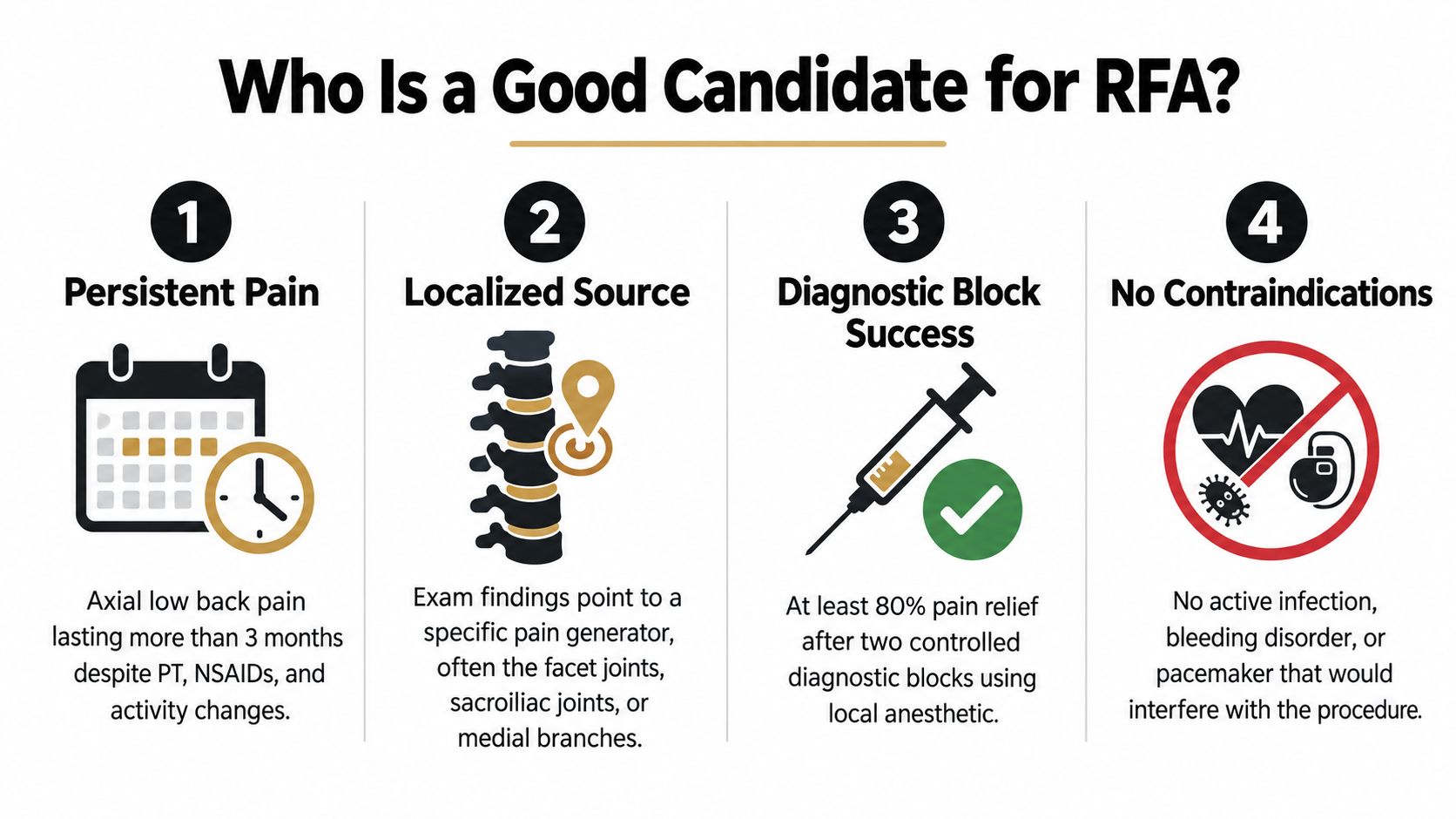
A 2025 CMS coverage policy states that lumbar medial branch RFA should be performed when previous diagnostic or therapeutic facet injections have provided temporary relief. That policy point matters because it makes patient selection central, not optional (CMS local coverage policy on lumbar medial branch RFA selection criteria).
What usually makes someone a good candidate
A strong candidate usually has:
- Axial back pain that has persisted despite conservative care
- Exam findings that point to a specific source
- Temporary relief from diagnostic medial branch or lateral branch blocks
- Real functional limits that improvement would matter for
Many patients in Chicago Ridge, Palos Heights, Palos Hills, Evergreen Park, and Hickory Hills arrive with imaging that shows arthritis or degeneration. Imaging can support the picture, but it doesn't prove which structure is causing the pain. That's why medial branch blocks are so important in practical decision-making.
Who tends to do poorly
RFA is less convincing when pain is diffuse, symptoms don't match a facet or SI pattern, or the temporary block response was weak or ambiguous. It also tends to disappoint patients who expect a structural cure rather than symptom control.
A positive block doesn't guarantee success. But a poorly matched or nonresponsive block is one of the clearest warnings that the ablation may not help enough to matter.
Illinois Coverage Rules and What a Chicago Ridge Visit Looks Like
Insurance rules in Illinois usually follow a predictable pattern. The procedure is generally approved more easily when the chart clearly shows a specific pain generator, prior conservative care, and documented response to diagnostic blocks.
One Illinois policy states that conventional RFA for chronic cervical or lumbar pain may be considered medically necessary only after at least 3 months of pain, failure of at least 3 months of conservative therapy, and significant functional impact. It also limits repeat treatment to at most 2 procedures per side and level within 12 months, no more than 4 joints per session, and no more than twice annually at the same level if the prior procedure produced at least 50% relief for 6 months (Illinois policy criteria for chronic back pain RFA).
Illinois RFA Coverage at a Glance
| Requirement | Typical Illinois Payer Standard |
|---|---|
| Pain duration | Chronic pain with sustained symptoms |
| Conservative care | Documented trial before escalation |
| Pain generator | Usually facet or sacroiliac pattern must be identified |
| Diagnostic blocks | Relief should be documented clearly |
| Repeat treatment | Usually tied to prior benefit and timing limits |
What the clinic pathway usually looks like
A Chicago Ridge-area pain and wellness clinic typically starts with consultation, exam, review of prior imaging and treatment history, then diagnostic blocks if the pain pattern fits. If those blocks match the symptoms and give temporary relief, RFA becomes a reasonable next step.
Patients often ask practical questions about billing and authorization before they commit, so reviewing radiofrequency ablation cost information ahead of time can help frame that part of the discussion. At Midwest Pain & Wellness, that process fits into an interventional pain workflow rather than a general therapy model, with image-guided diagnosis and treatment decisions based on the pain generator.
RFA Compared With Steroid Injections and Ongoing Conservative Care
Patients usually aren't choosing between “doing nothing” and RFA. They're choosing between repeating injections, staying with conservative treatment alone, or moving to a nerve-targeting procedure.
Steroid injections
Steroid injections can be useful, especially when the diagnosis is still being clarified or when shorter-term anti-inflammatory relief is the goal. Their weakness is durability. Many patients describe useful but temporary improvement.
RFA aims at the sensory nerve supply itself, so the logic is different. It typically requires more front-end diagnostic work, but the expected payoff is a longer relief window for the right candidate.
Ongoing conservative care
Conservative care still matters after RFA. Better pain control often creates a window where exercise progression, sleep improvement, weight management, and movement tolerance become easier to achieve.
That said, RFA is not a replacement for rehabilitation. It's a way to reduce a pain signal enough that patients can participate more effectively.
A practical decision framework
Use this question: do you want shorter-term symptom relief with less workup, or a more targeted procedure that depends heavily on confirming the pain source first?
| Factor | Thermal RFA | Steroid Injection | Conservative Care |
|---|---|---|---|
| Main target | Nerve signaling | Inflammation | Function, mechanics, symptom management |
| Best use case | Confirmed facet or SI pain | Temporary symptom control or diagnostic help | Foundation of treatment plan |
| Workup needed | Higher | Lower | Ongoing |
| Relief pattern | Typically longer when selection is good | Often shorter | Variable |
Quick-Reference Checklist for Your Consultation
A good consultation is easier when patients bring a short, concrete record instead of trying to remember everything in the room.
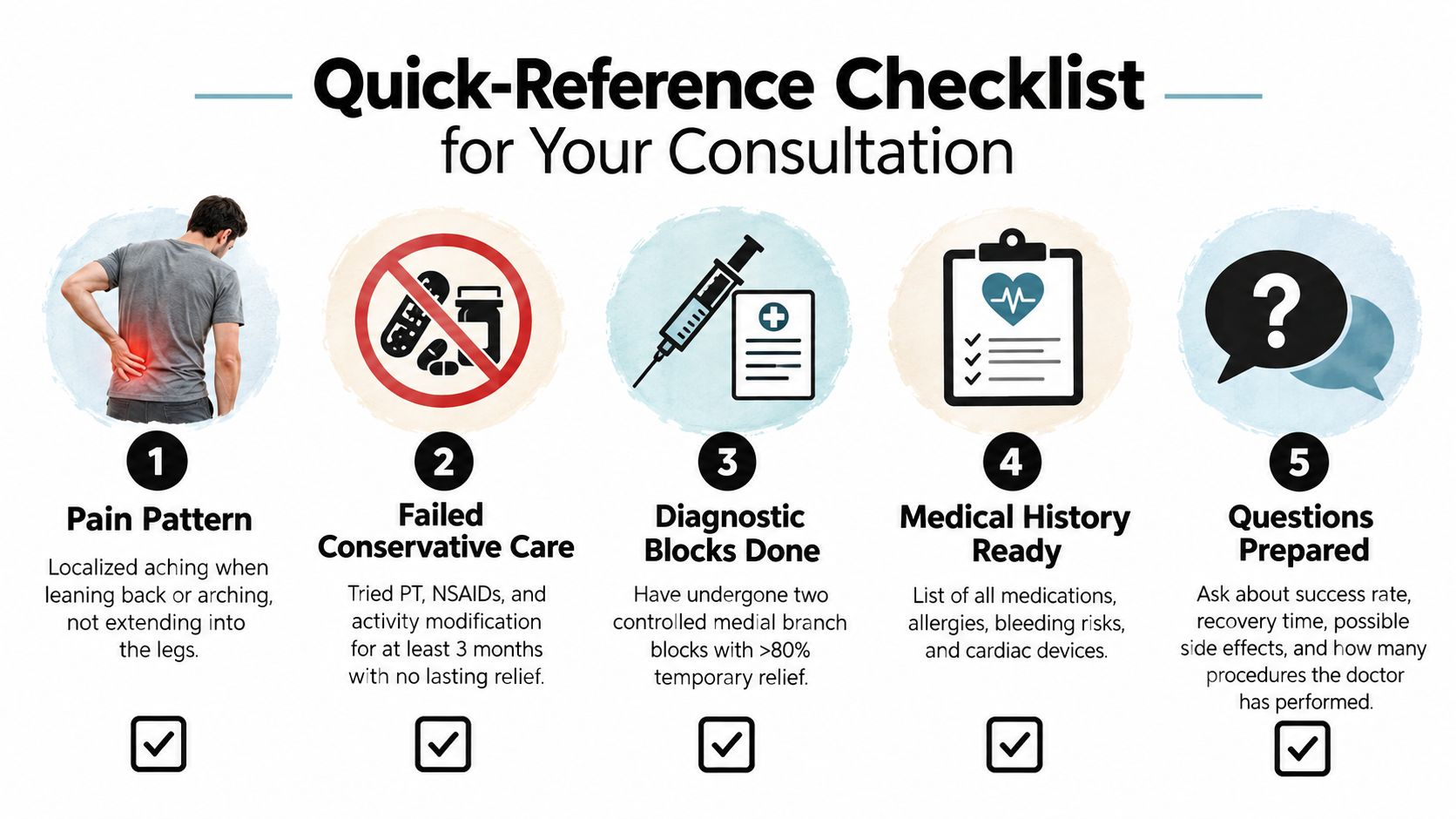
What to bring in writing
Bring a one-page note that covers these points:
Pain pattern
Is it mainly low back pain with arching, standing, or twisting, or does it sit lower near the sacroiliac region?Prior treatment history
List physical therapy, anti-inflammatories, activity modification, and any prior injections.Block response
Write down whether the temporary numbing injection matched your usual pain and whether the relief was clearly meaningful.Functional limits
Note what the pain is stopping you from doing. Walking, sitting, lifting, sleep, work tolerance, or exercise are all useful examples.
Questions worth asking directly
Patients often forget the most important questions once the visit starts. Put these on paper:
- Which pain generator do you think is most likely?
- Which nerves were or would be blocked?
- If I respond, what kind of relief is realistic for my diagnosis?
- If relief is short, how do you decide whether the target was wrong or the indication was weak?
- What restrictions should I follow after the procedure?
The best consultation notes are short, specific, and tied to your actual pain pattern. That gives the physician something actionable.
Honest Answers to the Questions Patients Hesitate to Ask
The word “success” can hide a lot. What most patients really want to know is whether the result will feel meaningful in daily life.
Is the benefit usually dramatic
Sometimes, yes. More often, it's moderate but useful. A realistic goal is meaningful pain reduction with better standing, walking, sleeping, driving, or bending tolerance. Patients often function better than the raw pain score alone would suggest.
A 2022 systematic review and network meta-analysis of chronic low back pain included 10 randomized controlled trials totaling 715 patients and found that endoscopic radiofrequency ablation denervation was more effective than sham control for short-term and long-term pain relief, with standardized mean differences of −3.07 and −4.00. The authors also classified the evidence as fair, which is important because it supports effectiveness while still acknowledging variability in technique and patient selection (2022 systematic review and network meta-analysis of ERFA denervation).
Can it be repeated
Yes, in the right candidate. If the first response matched the target and lasted meaningfully, repeat procedures are common when symptoms recur. Repeat treatment shouldn't be viewed as unusual. Nerves can regenerate, and the underlying joint problem may still be there.
What if it barely helps
Then the first question is whether the diagnosis was right. Short or incomplete relief can mean the wrong level was treated, another pain generator is also present, or the original block result overstated how clear the target really was.
If that happens, the next step isn't automatically “do more RFA.” The next step is reassessment.
If your back pain pattern suggests facet joint or sacroiliac involvement, Midwest Pain & Wellness offers image-guided evaluation, diagnostic blocks, and radiofrequency ablation as part of an opioid-sparing pain management plan. Patients in Chicago Ridge, Palos Heights, Palos Hills, Evergreen Park, and Hickory Hills can learn more or request an evaluation through Midwest Pain & Wellness.