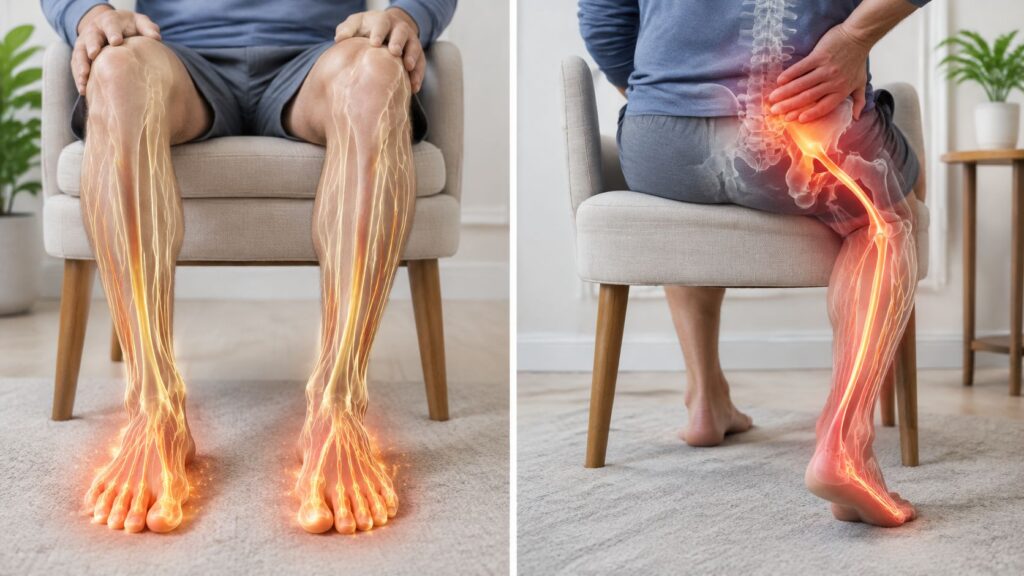
Nerve pain has a way of narrowing your world. A trip to the grocery store becomes a calculation. Sleep turns into a series of position changes. You search for the best injection for nerve pain, and every result seems to promise something different.
Patients seeking help aren't really asking for a syringe. They're asking a harder question. Why does the pain run from the low back into the leg? Why does the neck pain burn into the shoulder or hand? Why did one treatment help briefly while another did nothing at all?
The most useful answer usually isn't “this injection is best for everyone.” It's “we need to identify your pain generator first.” In other words, we need to find the exact structure producing the pain before choosing the procedure. For people in Illinois communities around Chicago Ridge, including Oak Lawn, Palos Hills, Palos Heights, Worth, Bridgeview, Hickory Hills, Alsip, Burbank, Evergreen Park, and Orland Park, that distinction matters. It often separates a well-targeted treatment from a frustrating detour.
Navigating Your Path to Nerve Pain Relief
Many patients arrive after months of trying to piece things together on their own. They may have been told they have a “pinched nerve,” but they don't know whether the underlying problem is a disc, a narrowed canal, an irritated nerve root, or a pain pattern coming from a different structure entirely.
That uncertainty creates the most common mistake I see. People start comparing procedures before anyone has clearly defined the target.

A better way to think about treatment is to think like a map reader. If your pain shoots from the back into the calf and foot, the destination isn't “get an injection.” The destination is “find the source of the nerve irritation, then choose the most precise treatment for it.” That's why education matters, and why many patients first start with practical guidance on how to relieve nerve pain.
What patients are usually deciding between
Before a procedure is scheduled, the main decision often falls into a few categories:
- Radiating spinal nerve pain: Pain travels from the neck or back into an arm or leg.
- Localized nerve pain: Pain stays tied to a specific nerve distribution or small region.
- Mixed pain patterns: Burning, aching, numbness, and mechanical pain all appear together.
- Unclear pain source: Symptoms and scans don't point to the same structure.
The best injection for nerve pain is only “best” when it matches the structure causing the pain.
For some patients, that ends up being an epidural steroid injection. For others, a selective nerve root block, a peripheral nerve block, or a facet-related diagnostic block makes more sense. The right answer isn't generic, and it shouldn't be rushed.
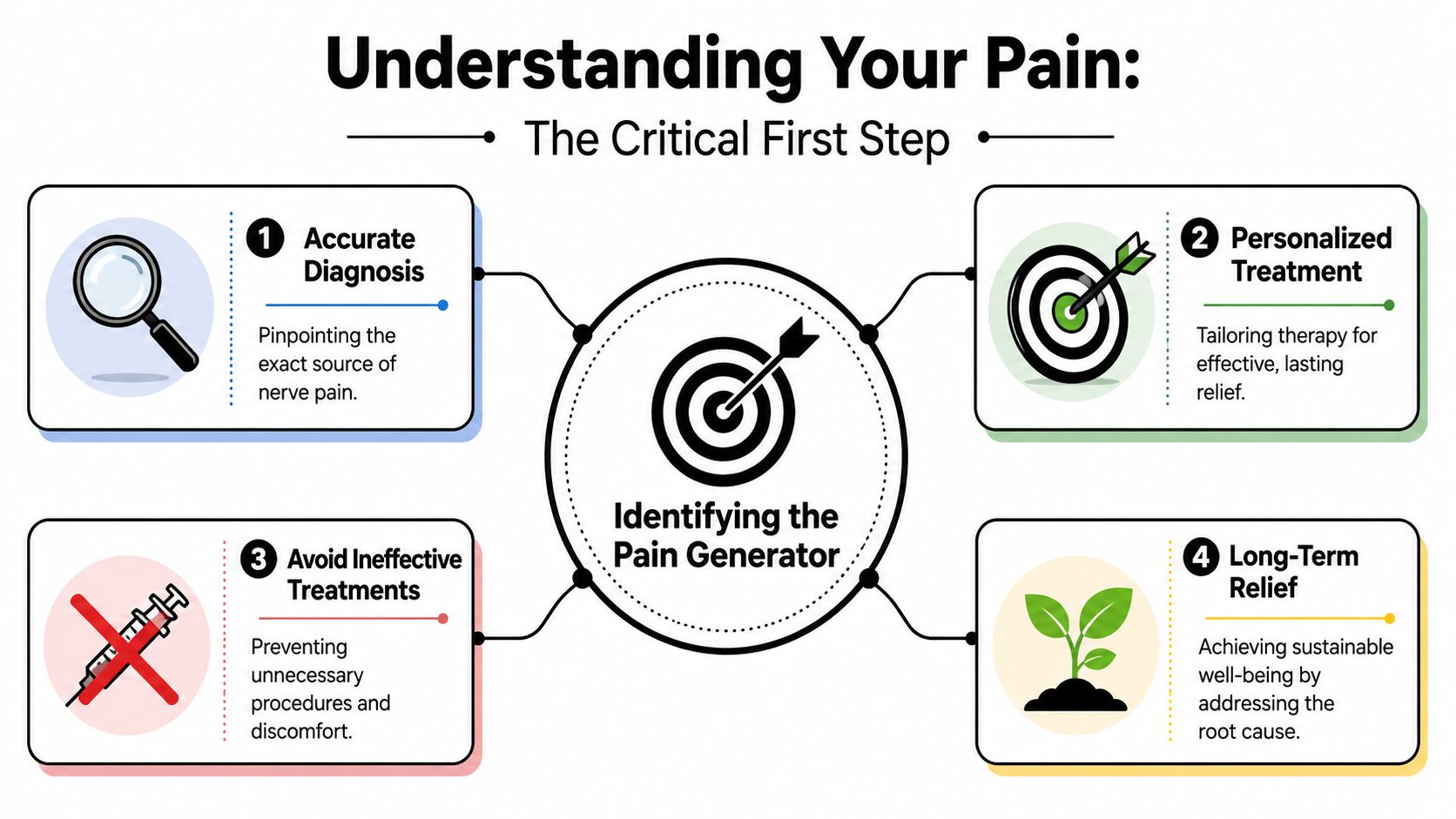
Why Finding the Pain Generator Is the Critical First Step
If water stains appear on a ceiling, you don't start by repainting the drywall. You find the leak. Nerve pain works the same way. The pain generator is the structure creating the symptoms, such as an inflamed spinal nerve root, a compressed exiting nerve, or a smaller peripheral nerve irritated along its course.
Many failed procedures aren't failures of medicine. They're failures of targeting.
Why symptoms and scans don't always match
An MRI can show a disc bulge on one side while your symptoms travel on the other. A scan can look dramatic, yet the exam suggests a different level is responsible. That's why procedure selection can't come from imaging alone.
The diagnostic process usually combines:
- History: Where the pain starts, where it travels, what aggravates it, and whether numbness or weakness is present.
- Physical exam: Reflexes, strength, sensation, tension signs, and movement patterns.
- Imaging review: Not just reading the report, but matching the images to the clinical picture.
- Diagnostic injection when needed: A targeted block can help confirm whether a suspected structure is driving the pain.
What the data tells us
Precision matters more than popularity. Recent 2025 guidance discussed here notes that epidural steroid injections succeed in only 30 to 45% of sciatica cases when imaging and symptoms don't align, while diagnostic nerve blocks that confirm the pain generator improve treatment match accuracy by 2.3x and long-term relief rates by 40%.
Those numbers explain why some patients say, “I had the right procedure, but it didn't work.” In many cases, the issue wasn't the category of injection. The issue was that the injection was aimed at the wrong place.
Clinical takeaway: If a treatment plan skips the question “what exactly is generating this pain,” the odds of disappointment rise quickly.
Questions worth asking before any injection
A thoughtful consultation should answer more than whether insurance covers a procedure. It should answer whether the target makes sense.
Consider asking:
- What structure do you think is causing my symptoms?
- Does my exam match my imaging?
- Is this injection mainly diagnostic, therapeutic, or both?
- What result would tell us we're treating the correct pain generator?
Patients who ask those questions usually make better decisions. They also feel less trapped by trial-and-error care.
A Comparison of Common Interventional Nerve Pain Injections
A patient may arrive convinced they need “the strongest shot for nerve pain,” then describe numbness into the thumb, aching at the shoulder blade, and MRI findings at two different levels. In that situation, the best injection is the one that answers the right question first.
That is why I compare these procedures by job, not just by name. Some injections are used to calm inflammation. Some help confirm which structure is generating pain. Some can do both when the history, exam, and imaging line up well.
| Nerve Pain Injection Comparison | Primary Target Area | Best For (Condition) | Main Goal | Typical Relief Duration |
|---|---|---|---|---|
| Epidural Steroid Injection | Epidural space around spinal nerves | Radiating pain from sciatica, herniated disc, spinal stenosis | Reduce inflammation around irritated spinal nerves | Often weeks to months |
| Selective Nerve Root Block | A specific spinal nerve root | Sciatica or symptoms linked to one suspected nerve root | Confirm the exact nerve root and provide relief | Often short-term diagnostic relief, sometimes longer |
| Facet Joint or Medial Branch Block | Facet joints or medial branch nerves in the spine | Neck or back pain from facet-related pain patterns | Usually diagnostic, sometimes short-term relief | Hours to days, depending on the medication used |
| Peripheral Nerve Block | A named peripheral nerve outside the spine | Localized nerve pain, neuropathy, CRPS, post-injury nerve pain | Interrupt pain signaling and clarify source | Hours to weeks, depending on target and medication |
Epidural steroid injections
Epidural steroid injections are usually considered when pain tracks down an arm or leg in a pattern that fits an irritated spinal nerve. The target is the epidural space near the inflamed nerve root, where steroid and anesthetic can reduce irritation and create a window for movement, therapy, and recovery.
They are often a good treatment choice for sciatica, cervical radicular pain, or stenosis-related radiating symptoms. They are less helpful for pain that stays only in the low back or neck without a clear nerve root pattern. That distinction prevents a lot of frustration.
If you want a more detailed review of technique, indications, and expected results, this guide to epidural steroid injection for back pain explains where this option fits.
Selective nerve root blocks
A selective nerve root block is narrower and more diagnostic. I use it when the main problem is uncertainty about which nerve root is responsible.
That matters in real clinic decisions. An MRI may show degeneration at more than one level. A patient may have symptoms that overlap two nerve distributions. In those cases, a selective block can help confirm whether the suspected root is reproducing and relieving the familiar pain pattern.
The trade-off is straightforward. A broader epidural may treat inflammation across a region, while a selective block gives cleaner information about one suspected level. If the diagnosis is cloudy, precision usually matters more than coverage.
Facet joint and medial branch blocks
Facet and medial branch blocks belong in the conversation because many patients call all spine pain “nerve pain,” even when the source is mechanical joint pain from the small joints in the spine. These injections are usually aimed at diagnosis.
The pattern is different. Pain often stays in the neck, shoulder girdle, or low back. It may worsen with standing upright, extension, or rotation. It usually does not travel in a classic electric or burning line down the limb.
When the exam fits that pattern, a facet or medial branch block can show whether those joints are the pain generator. If the block produces the expected temporary relief, the next step may be a longer-lasting procedure such as radiofrequency ablation rather than another steroid injection.
Peripheral nerve blocks
Peripheral nerve blocks target a named nerve outside the spine, such as the occipital, intercostal, ilioinguinal, or other peripheral nerves linked to a specific pain territory. These are useful when symptoms are localized and the distribution points to a peripheral source rather than a spinal nerve root.
They can help with diagnosis, treatment, or both. For example, an occipital nerve block may help separate occipital neuralgia from other headache causes. A peripheral block after injury or surgery may reduce pain enough to restore sleep, improve tolerance for therapy, or clarify whether the nerve itself is the main driver.
The expected duration varies widely based on the medication used and the condition being treated. The more important question is whether the response matches the suspected anatomy.
How these injections are usually performed
Accuracy matters. Image guidance with fluoroscopy or ultrasound helps place medication where it is intended to go and lowers the chance of treating the wrong structure based on symptoms alone.
Medication choice also depends on the goal. A diagnostic block may use local anesthetic to test whether numbing a structure changes the familiar pain. A therapeutic injection may include steroid when inflammation is part of the picture. Those are different decisions, and they should be explained clearly before the procedure.
For patients who want to understand how peripheral and occipital block coding is categorized on the billing side, Mastering CPT 64405 and 64450 is a useful administrative resource.
Exploring Advanced and Regenerative Injection Therapies
A patient comes in asking for the "strongest shot" for nerve pain after a friend mentioned PRP or Botox. That question sounds simple, but the right next step depends on what is generating the pain. If the source is an inflamed nerve root, the best option is usually different from what helps tendon injury, muscle overactivity, or a chronic migraine pattern.

Regenerative options
Platelet-rich plasma, or PRP, is made from your own blood and concentrated before injection into a targeted area. Its purpose differs from a steroid injection. Steroids are typically used to calm inflammation. PRP is used in selected cases where tissue healing is part of the treatment goal.
That distinction matters. Pain that feels "neuropathic" is not always coming from a damaged nerve alone. In some patients, an irritated joint, injured ligament, or degenerative tendon can refer pain in a way that mimics nerve pain. In that setting, regenerative treatment may deserve discussion. In a patient with classic radiating pain from a compressed spinal nerve, it may not be the first choice.
For patients considering whether a regenerative approach fits their diagnosis, PRP for neck pain treatment options gives a practical overview.
Neuromodulator injections
Botox also has a specific role. It is not a general injection for sciatica, post-surgical nerve pain, or every case of tingling and burning.
It can be useful when the diagnosis points to conditions such as chronic migraine or cervical dystonia, where abnormal muscle activity and nerve signaling are part of the problem. In those cases, success depends less on choosing a "stronger" injection and more on identifying the correct mechanism. That is why I tell patients that the label on the syringe matters less than the accuracy of the diagnosis behind it.
Where newer options fit
Patients with persistent neuropathic pain sometimes ask about newer, less routine interventions after standard treatments have fallen short. Those discussions are reasonable, but they belong later in the process, after the pain pattern has been defined clearly and after more established options have been weighed against the likely pain generator.
Some of these therapies are offered only in select settings, and their use depends on the diagnosis, prior treatment response, safety profile, and treatment goals. They are not first-line injections for routine back-related leg pain or common neck-related arm pain.
Newer treatment does not mean better treatment. Better targeting does.
The Midwest Pain & Wellness Approach to Your Care
A patient comes in after weeks of burning leg pain. The MRI shows more than one possible problem. The key question is not which injection sounds strongest. The crucial question is which structure is producing the pain.
Good interventional pain care starts there. For patients across Bridgeview, Hickory Hills, Alsip, Burbank, Evergreen Park, and nearby Illinois communities, the goal is to reduce guesswork, define the pain generator, and choose treatment based on that finding.
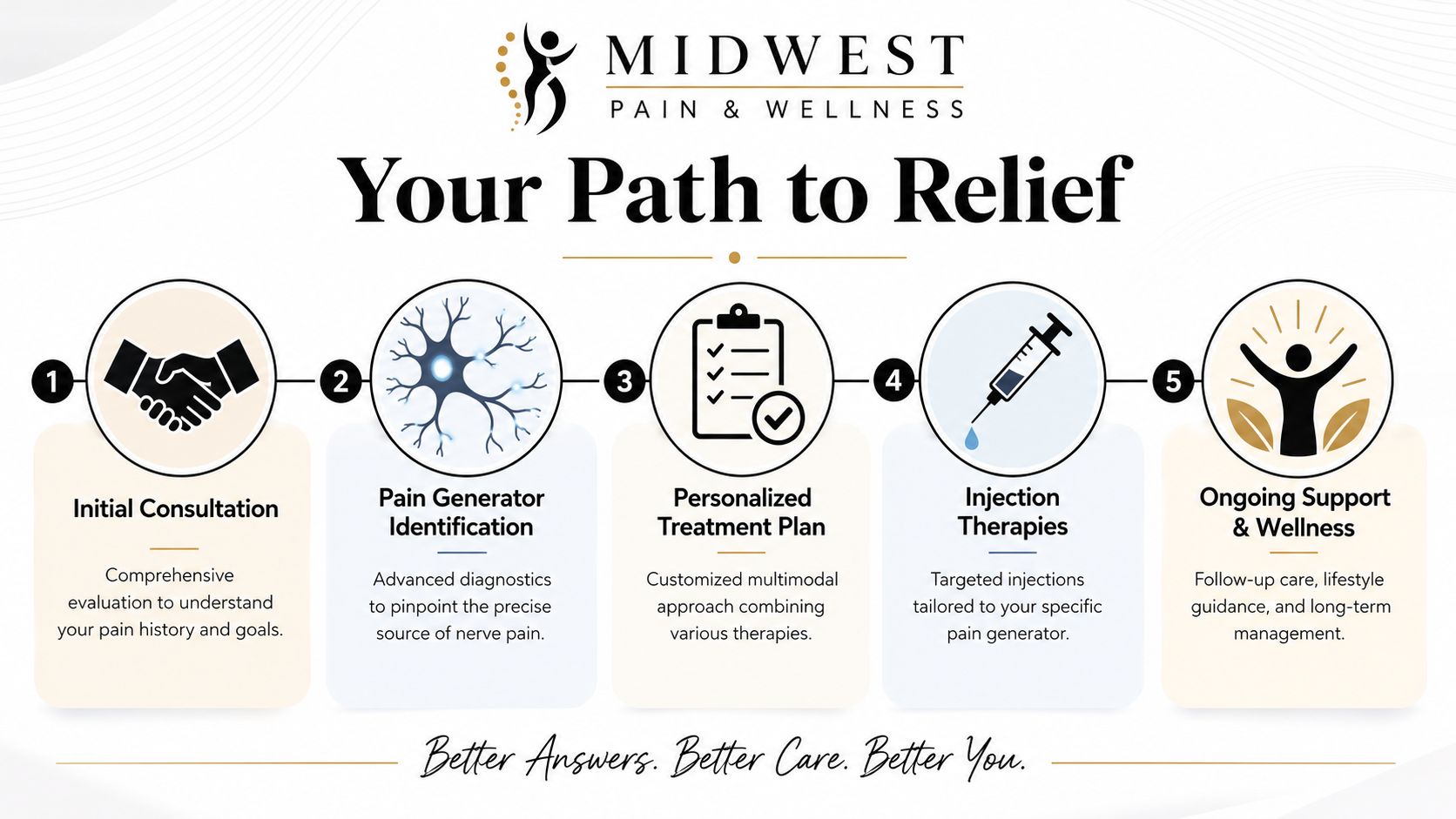
Step one is understanding the pattern
The first visit should slow the process down enough to hear the details that matter. Burning pain radiating below the knee suggests a different source than numbness in the hand, pain that worsens when lying flat, or aching that appears only with standing and walking. Weakness, sensory loss, prior surgery, and the timing of symptoms all change the differential diagnosis.
This part matters because many patients have abnormal imaging that is not the reason they hurt.
Step two is confirming the target
The next step is matching the history, physical exam, and imaging. When all three point to the same structure, the treatment plan is usually clearer. When they do not line up, a diagnostic injection can help answer a specific question.
That question may be whether the pain is coming from an irritated nerve root, a facet-mediated referral pattern, the sacroiliac joint, or a peripheral nerve. A well-chosen block is not just treatment. It is part of the diagnostic work.
The target determines the value of the procedure.
Step three is building a plan that supports function
An injection can reduce inflammation or quiet an irritated nerve, but it rarely solves the whole problem by itself. The better plan connects pain relief to a functional goal. That may mean walking farther, sleeping through the night, getting back to work, or participating in physical therapy without a pain flare.
Midwest Pain & Wellness provides image-guided, opioid-sparing care under a double board-certified interventional pain specialist. The focus is individualized treatment, not a one-size-fits-all procedure schedule. If the response to an injection does not fit the expected pattern, the plan should be reconsidered instead of repeated automatically.
That approach also leaves room for escalation when the diagnosis supports it. Some patients do well with a targeted injection and rehabilitation. Others may need radiofrequency ablation, peripheral nerve stimulation, spinal cord stimulation, minimally invasive lumbar decompression, or another procedure that better matches the confirmed pain source.
What this approach avoids
A precise, opioid-sparing process helps prevent several common mistakes:
- Repeating procedures without a clear reason: If the first injection did not clarify the diagnosis or produce the expected response, repeating it blindly usually adds cost and delay, not clarity.
- Treating the MRI instead of the patient: Imaging supports the diagnosis, but it does not replace the exam or the symptom pattern.
- Measuring success only by short-term pain reduction: Function matters just as much. Better sleep, improved walking tolerance, safer movement, and return to daily activities are more useful markers of progress.
Patients usually feel the difference when care is handled this way. The injection is one tool in a larger plan, and the plan starts with finding the right pain generator.
What to Expect During and After Your Procedure
A patient may walk in expecting the injection itself to be the hard part, then realize the more important question is what the response means. That matters because the procedure is not only treatment. In many cases, it also helps confirm whether the suspected nerve, joint, or spinal level is driving the pain.
On the day of the procedure, the plan is reviewed one more time. The target is confirmed, the expected short-term response is explained, and the team checks for details that affect safety, such as blood thinners, diabetes medications, allergies, or recent illness. Most image-guided injections are brief, but the visit takes longer than the needle portion because careful preparation and observation matter.
During the visit
Positioning depends on the target area. Some patients lie on the stomach for a lumbar epidural, while others are placed on the side or back for a peripheral nerve or joint-related procedure. The skin is cleaned, the area is numbed, and imaging guidance is used to place the needle with precision.
Many patients describe pressure or a brief pinch rather than sharp pain. Sometimes the familiar leg, arm, or burning nerve pain is reproduced for a moment as the needle approaches the irritated structure. That can be useful information, especially in a diagnostic procedure, because it helps match the procedure to your usual symptoms.
After the injection, there is usually a short monitoring period. Temporary numbness, heaviness, or warmth can happen depending on the medication used and the area treated. Staff make sure you are steady on your feet and understand the next steps before discharge.
After the injection
The first several hours do not always predict the final result. If local anesthetic is included, pain may improve quickly and then return as that medication wears off. If steroid is used, the anti-inflammatory effect often takes several days to declare itself, and some patients feel temporary soreness before they feel better.
Relief can last for very different lengths of time. That variation is one reason I advise patients not to judge success too early or by one number on a pain scale. A useful response is one that improves function, supports the diagnosis, or both.
Repeat injections also need context. They should be spaced and selected based on the medication used, your medical history, and how your body responded to the first procedure. A thoughtful plan is safer than automatically scheduling the same injection again.
How to judge whether it worked
The best follow-up question is not just, “Did the pain score drop?” A better question is, “What changed that you could not do before?”
Track changes such as:
- Walking farther with less leg pain
- Sitting or standing longer before symptoms start
- Sleeping with fewer pain-related interruptions
- Needing less rescue medication
- Feeling the radiating pain pull back, even if some soreness remains
A pain diary for the first several days can help. Write down when relief starts, how long it lasts, whether numbness or weakness showed up, and which activities became easier. That pattern often tells us more than a single office visit.
Follow-up is where the procedure becomes clinically useful. If the response matches the exam, symptom pattern, and imaging, confidence in the diagnosis goes up. If it does not, the answer is not to chase the same procedure. The answer is to reconsider the pain generator and adjust the plan.
If you're looking for a clearer answer to the best injection for nerve pain in Oak Lawn, Palos Hills, Palos Heights, Worth, Bridgeview, Hickory Hills, Alsip, Burbank, Evergreen Park, Orland Park, or the Chicago Ridge area, Midwest Pain & Wellness offers evaluation and interventional treatment built around identifying the pain generator first. The goal is targeted, opioid-sparing care that helps restore function, not just temporary symptom chasing.