You got out of bed carefully, waiting to see whether the familiar pain would shoot from your back into your leg. You checked the same strip of numbness along your thigh or calf, walked a few steps, and realized it was still there. By the second or third morning, the injection site may be sore, the local anesthetic has worn off, and you're wondering whether the epidural steroid injection not working means the procedure was wasted.
That isn't the right conclusion yet. A disappointing response is information about your pain, your anatomy, and the target chosen for treatment. The key question is whether you had no response, temporary relief, or an improvement too small to change how you walk, sleep, work, or function.
Table of Contents
- When the Relief You Hoped For Does Not Show Up
- A Realistic Timeline for Epidural Steroid Injections
- Why an Epidural Steroid Injection May Not Work for You
- What to Bring to Your Follow-Up Visit
- Options to Explore When an ESI Falls Short
- Warning Signs That Mean Call the Clinic Now
- A Clear Plan for Your Next Conversation
When the Relief You Hoped For Does Not Show Up
The first week often feels longer than it is. You may move cautiously, keep checking your leg symptoms, and compare each morning with the day before. A mild ache at the injection site can distract you from the larger question, while persistent burning, tingling, or weakness makes the whole procedure feel unsuccessful.
You may also notice a brief change that doesn't last. The leg feels lighter for a few hours, then the pain returns as the local anesthetic fades. That temporary shift matters, but it doesn't prove that the steroid has failed. It tells your clinician to separate the immediate anesthetic effect from the later anti-inflammatory response.
What your first week can and cannot tell you
An epidural steroid injection is intended to calm irritation around a nerve root. It doesn't remove a disc fragment, widen a narrowed passage, repair scar tissue, or correct every source of back and leg pain. If the dominant pain generator is mechanical compression, facet pain, sacroiliac pain, postsurgical change, or another non-radicular source, reducing inflammation may not change your symptoms enough to feel meaningful.
The evidence is mixed because the patient groups and pain patterns are mixed. A major evidence summary of six studies involving 701 patients found immediate pain and functional improvement after epidural steroid injections for sciatica, but the benefit wasn't clinically different from placebo, with no pain or functional difference at short-term or intermediate-term follow-up (AAFP's evidence summary). A newer synthesis reported short-term benefit for cervical and lumbar radiculopathy, but no clear durable long-term pain relief (2025 neurology evidence synthesis).
Practical rule: Don't judge the injection only by whether your pain disappeared. Judge it by whether your pain map, movement, sleep, and medication use changed in a meaningful way.
Over the next several sections, you'll see how to locate yourself on the recovery timeline, interpret the failure pattern, prepare for follow-up, compare next-step options, and recognize symptoms that need prompt attention. Bring your pain map and symptom record to the appointment. Those details are more useful than just saying, “It didn't work.”
A Realistic Timeline for Epidural Steroid Injections
An epidural steroid injection does not follow a guaranteed countdown. The first few days reflect the needle, local anesthetic, and irritated tissues. Any later improvement reflects the steroid's effect on inflammation around the nerve.
Days zero through three
During the first zero to three days, soreness at the injection site or a temporary flare can occur. Local anesthetic may ease symptoms early, then wear off after several hours. That rebound can feel discouraging, but it does not predict whether the steroid will help.
Do not issue a final verdict on the first evening. Keep activity reasonable, follow the post-procedure instructions you received, and record what happens when you stand, walk, sit, sleep, or change position.
Days three through ten
Between roughly days three and ten, some patients begin to notice a gradual shift. The first sign may be less leg pain while walking, fewer nighttime awakenings, longer sitting tolerance, or less reliance on rescue medication. A delayed response can appear after several quiet days, followed by steady progress.
Track function, not just pain intensity. Walking farther or sleeping more consistently counts as a meaningful response even if pain remains. If the pain has the same location, intensity, and behavior, document that pattern as well. A failed response is diagnostic information because it helps test whether inflammation around the targeted nerve is driving your symptoms.
Weeks two through eight
During weeks two through eight, relief generally either becomes consistent or fails to develop. Recent evidence supports short-term improvement for some people with radiculopathy, but the effect is generally modest and durable pain relief is not clearly established. Cleveland Clinic describes temporary relief after cervical epidural steroid injection in about 40% to 84% of patients (Cleveland Clinic cervical ESI overview).
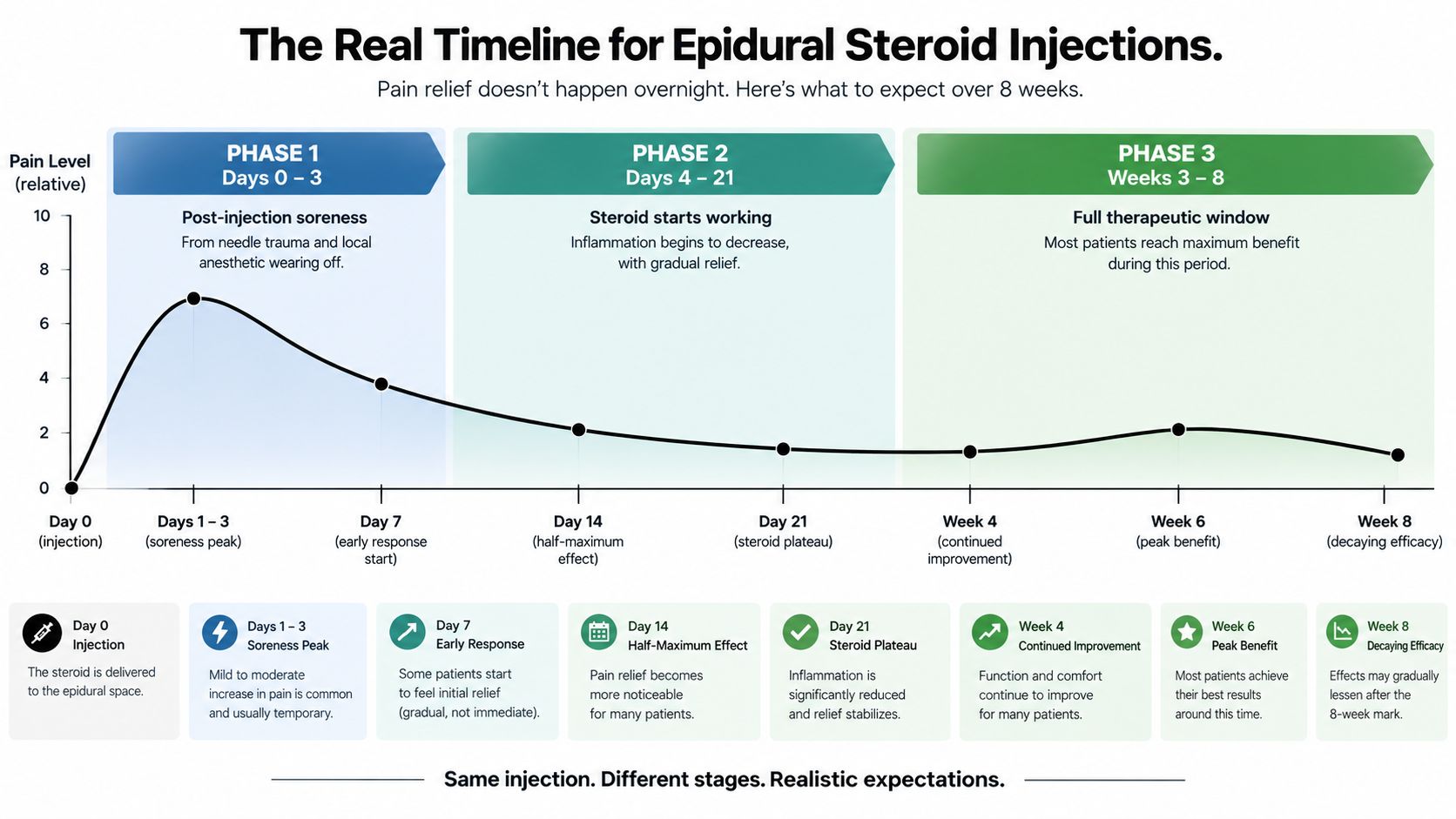
Use this epidural steroid injection recovery guide for practical post-procedure guidance, then judge the outcome from your own symptom record. A practical rule of thumb: if the second week passes with no meaningful change in pain distribution, function, or medication use, the injection has not worked as a therapeutic trial. That result does not close the evaluation. It directs the next decision.
Why an Epidural Steroid Injection May Not Work for You
A failed epidural steroid injection is useful information. It tells you the pain source may not be the inflamed nerve root you were targeting, so the next step is to refine the diagnosis instead of treating the result as a dead end.
Start with the pain pattern. If your MRI shows a disc bulge but your symptoms feel more like facet pain or sacroiliac pain, the injection was aimed at the wrong generator. Buttock-dominant pain, pain that worsens with extension or rotation, and pain without a steady neurologic pattern should push the exam beyond the epidural space.
Postsurgical anatomy is another common reason. Scar tissue can change how medication spreads around a nerve root after prior spine surgery. A cohort study found that prior spine surgery reduced the odds of treatment success, with an adjusted odds ratio of 0.30 and a 95% confidence interval of 0.11 to 0.80, and it also identified severe central canal stenosis as a poor response pattern (TFESI cohort study).
The pattern usually points toward the next test
Severe narrowing can overpower the medication. If bone, disc material, or thickened tissue is compressing the nerve, the steroid may calm inflammation without relieving the mechanical pressure. In that setting, a weak response is a clue that decompression deserves attention.
Multilevel disease creates a different problem. If your symptoms span more than one dermatome, or the MRI shows several plausible levels, a single targeted injection may miss part of the pain generator. That is a targeting issue, not proof that every epidural approach will fail.
Technique matters too. Image-guided transforaminal and interlaminar injections are chosen to reach specific anatomy, but spread can still fall short if the contrast does not track where it should. Review the procedural images and the steroid injection process before you decide on another injection.
| Reason ESI Under-Delivers | Clinical Clue | Next Diagnostic Move |
|---|---|---|
| Pain generator is a facet or sacroiliac joint | Pain map does not match the nerve-root pattern | Focused examination and a targeted diagnostic block |
| Postsurgical scar tissue | Symptoms persist despite an appropriate target and prior surgery | Review postsurgical imaging and consider a different approach |
| Severe central or foraminal stenosis | Leg symptoms worsen with standing or walking and imaging shows marked narrowing | Reassess compression and discuss decompression options |
| Multilevel disease | Symptoms cross multiple nerve distributions | Reevaluate all clinically relevant levels |
| Targeting or spread was inadequate | Contrast pattern did not reach the suspected nerve root | Review the procedural images before repeating anything |
A poor response should narrow the differential, not trigger a routine repeat injection. If the first epidural did not help, the next move is a cleaner diagnosis and a better target.
What to Bring to Your Follow-Up Visit
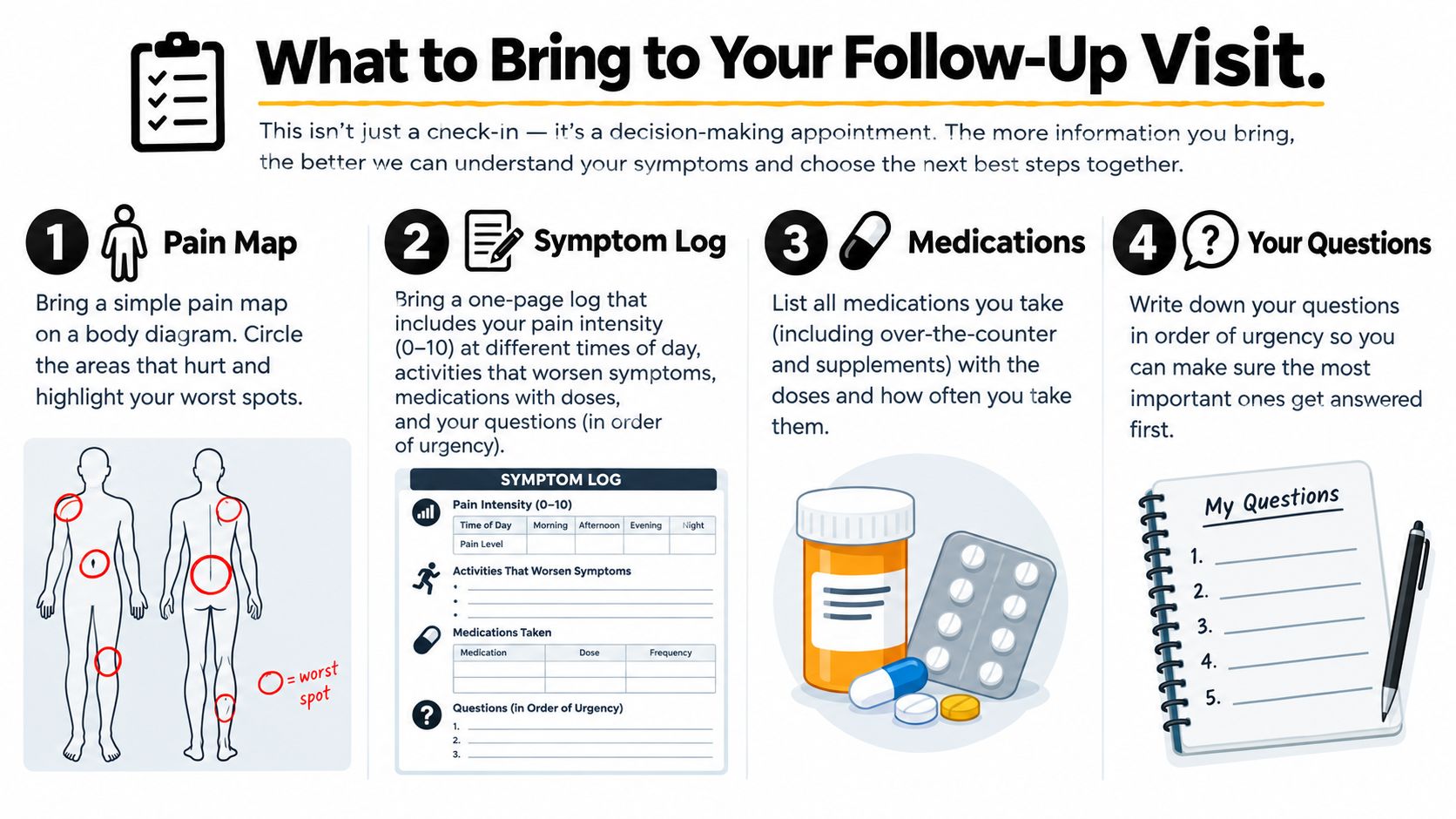
Treat follow-up as a decision appointment, not a routine check-in. Your clinician needs to know what changed, when it changed, and whether the change affected your daily life.
Bring a pain map
Draw a simple body outline and circle the worst areas. Mark burning, aching, numbness, tingling, and weakness separately. A line showing where pain travels can reveal whether your symptoms still follow the suspected nerve-root distribution.
Don't rely on memory. Pain often feels global after several difficult days, but a map preserves the details that determine whether the target remains plausible.
Bring a one-page symptom log
Record the prior two weeks in a compact format:
- Pain behavior: Note what happens when you sit, stand, walk, bend, cough, or sleep.
- Function: Record walking tolerance, sleep interruption, work limitations, and tasks you can or can't complete.
- Medication use: List what you've taken, including anti-inflammatory medication and rescue medication.
- Neurologic changes: Write down any new numbness, weakness, foot slapping, balance trouble, or bowel and bladder changes.
- Self-care attempts: Include ice, heat, activity changes, and any prescribed rehabilitation work.
The number on a pain scale matters less than the trend and the function attached to it. A lower pain score that doesn't help you walk or sleep may not represent a successful therapeutic response.
Ask questions that force a decision
Use direct questions:
- Was the injectate confirmed near the correct nerve root on the procedure images?
- Does my pain map match the MRI finding?
- Does the partial relief suggest the level was right but the treatment was too limited?
- Would a different level or approach test a different diagnosis?
- What response would justify a second injection?
- If there was no response, what will we investigate instead?
- What is the timeline for the next decision?
Before you leave, ask for a clear plan. You should know what to monitor, when to call, and what happens if the next step doesn't improve function.
Options to Explore When an ESI Falls Short
A failed epidural steroid injection is not just a dead end. It is a clue. The next step should match the pain generator most likely driving your symptoms, based on your response pattern, exam, imaging, and the structure that fits best.
Repeat only when the first injection taught you something useful
A second epidural makes sense when the first one gave meaningful relief, even if it wore off too soon. That pattern points to the right level, but a treatment effect that did not last. A German Spine Society guideline recommends repeating treatment only after a previously positive response, when symptoms return or the first improvement is not enough (German Spine Society guidance).
If you had no meaningful response, repeating the same injection at the same target is usually weak reasoning. Recheck the diagnosis, or test a different level, route, or intervention.
Match the tool to the structure
Facet pain calls for a different path. Medial branch blocks and radiofrequency ablation fit suspected facet-mediated pain. A diagnostic medial branch block comes first. If that block points to the facet joints, radiofrequency ablation can treat the nerves carrying those pain signals.
Spinal cord stimulation fits persistent neuropathic radicular pain, especially after surgery or when symptoms keep going despite a structural workup. It changes pain signaling. It does not remove a disc bulge or open a narrowed canal.
MILD can help selected patients with lumbar spinal stenosis, especially when thickened ligament is part of the narrowing and walking is the main problem. It is not a broad fix for every back or leg pain complaint.
PRP and other regenerative options may come up for selected degenerative conditions. The right call depends on the tissue involved, the diagnosis, and the overall plan. These treatments should not be sold as a guaranteed repair.
For a closer comparison of injection approaches for nerve pain, see the best injection for nerve pain guide.
Structured physical therapy, activity changes, and sensible weight-bearing adjustments still matter. They can improve tolerance and help the chosen procedure work better. They are not a substitute for getting the diagnosis right, and they should not be used to avoid addressing a clear mechanical problem.
If you are weighing these options, Midwest Pain & Wellness in Chicago Ridge coordinates image-guided injections, radiofrequency ablation, stimulation procedures, minimally invasive lumbar decompression, PRP, and coordinated pain care for patients across the Chicago Ridge, Palos Heights, Palos Hills, Evergreen Park, and Hickory Hills area.
| Option | Best For | Typical Response Window | Key Caveat |
|---|---|---|---|
| Response-based repeat ESI | Meaningful but temporary relief from the first injection | Short-term reassessment after the repeat procedure | A zero-response first injection argues against repeating the same target |
| Medial branch block followed by RFA | Confirmed facet-mediated pain | Diagnostic response followed by treatment reassessment | RFA does not treat true nerve-root compression |
| Spinal cord stimulation | Refractory neuropathic radicular pain, including some postsurgical cases | Trial period before any permanent decision | It modulates pain signaling and does not remove structural compression |
| MILD | Selected lumbar spinal stenosis with walking-related symptoms | Gradual functional reassessment | Patient selection and anatomy are critical |
| PRP or other regenerative care | Selected degenerative conditions | Variable and diagnosis-dependent | Evidence and candidacy vary |
| Physical therapy and activity modification | Deconditioning, movement limitation, and recovery support | Progressive functional gains | It must be matched to the diagnosis and current tolerance |
Warning Signs That Mean Call the Clinic Now
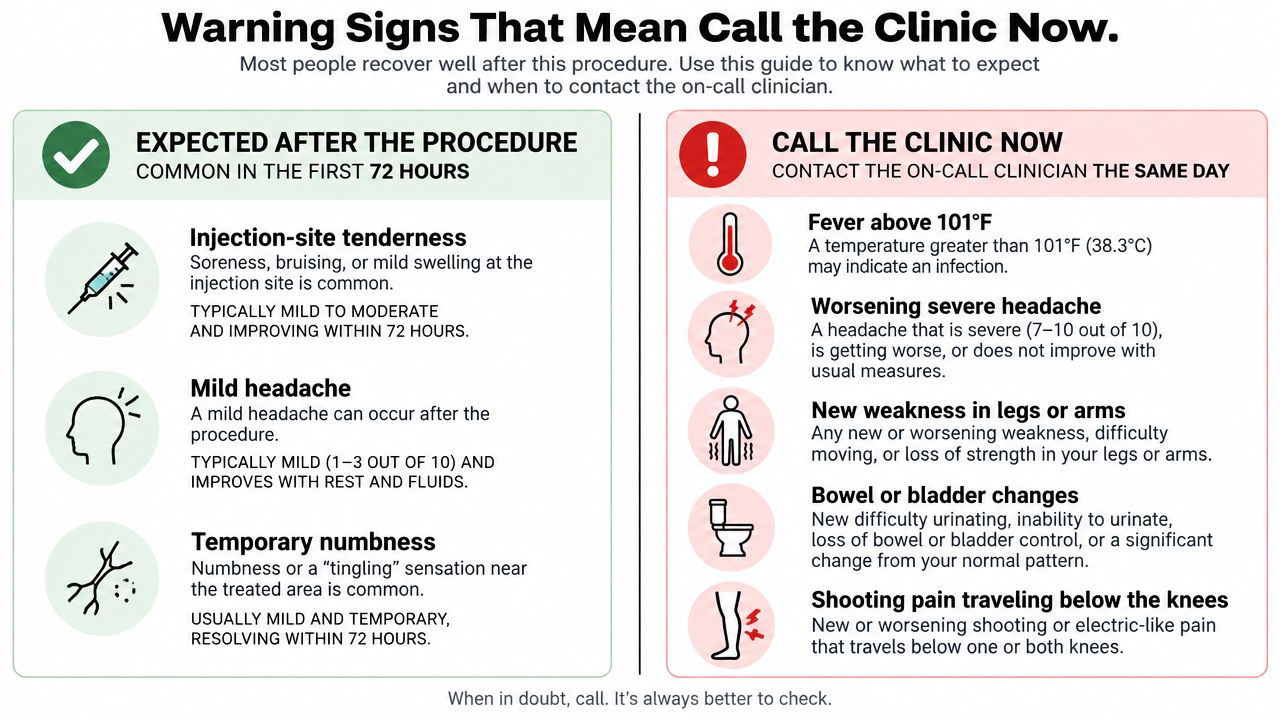
Some symptoms fit ordinary post-procedure recovery. Others require same-day medical attention. Don't wait for a scheduled appointment if your neurologic function is changing.
Injection-site soreness, brief numbness while local anesthetic wears off, mild flushing, and temporary sleep disturbance can occur after an epidural. These symptoms should generally improve rather than intensify. A headache can have several causes, but a severe headache that becomes worse when you sit or stand deserves a call because it can occur after a dural puncture.
Call the clinic or answering service promptly for
- Progressive weakness: New or rapidly worsening weakness in the leg, foot, arm, or hand needs prompt evaluation.
- Bowel or bladder changes: New incontinence, inability to urinate, or urinary retention can signal serious nerve compression.
- Saddle numbness: Numbness around the groin or inner thighs is an emergency warning sign.
- Fever with back pain: A fever above 100.4°F with increasing back pain after an injection needs same-day medical review.
- Severe uncontrolled pain: Pain that keeps escalating despite prescribed medication shouldn't be managed at home.
- Positional severe headache: A severe headache that worsens upright may indicate a spinal fluid leak.
The medical reason for urgency is simple. Rare complications include infection, epidural hematoma, nerve injury, and catastrophic ischemic events (StatPearls review of ESI complications). A published study reported 103 minor complications, with a rate of 2.4% per injection and a 95% confidence interval of 2.0% to 2.9% (Pain Medicine complications study).
If you suspect cauda equina compression, an epidural hematoma, infection, or rapidly progressing weakness, call the clinic's after-hours service or go to an emergency department. Don't drive yourself if weakness or severe pain makes that unsafe.
A Clear Plan for Your Next Conversation
A failed injection doesn't close the door on relief. It narrows the search, especially when you document the response accurately and compare it with your examination and imaging.
Bring four answers:
- How long did any improvement last? Separate immediate numbness from later relief.
- Where is the pain now? Map the remaining pain, tingling, numbness, and weakness.
- What function still matters most? Name the walk, work task, sleep goal, or daily activity you want to recover.
- Which procedure matches the dominant pain generator? Ask whether the next step is a different diagnostic block, a response-based repeat injection, RFA, stimulation, decompression, regenerative care, or another evaluation.
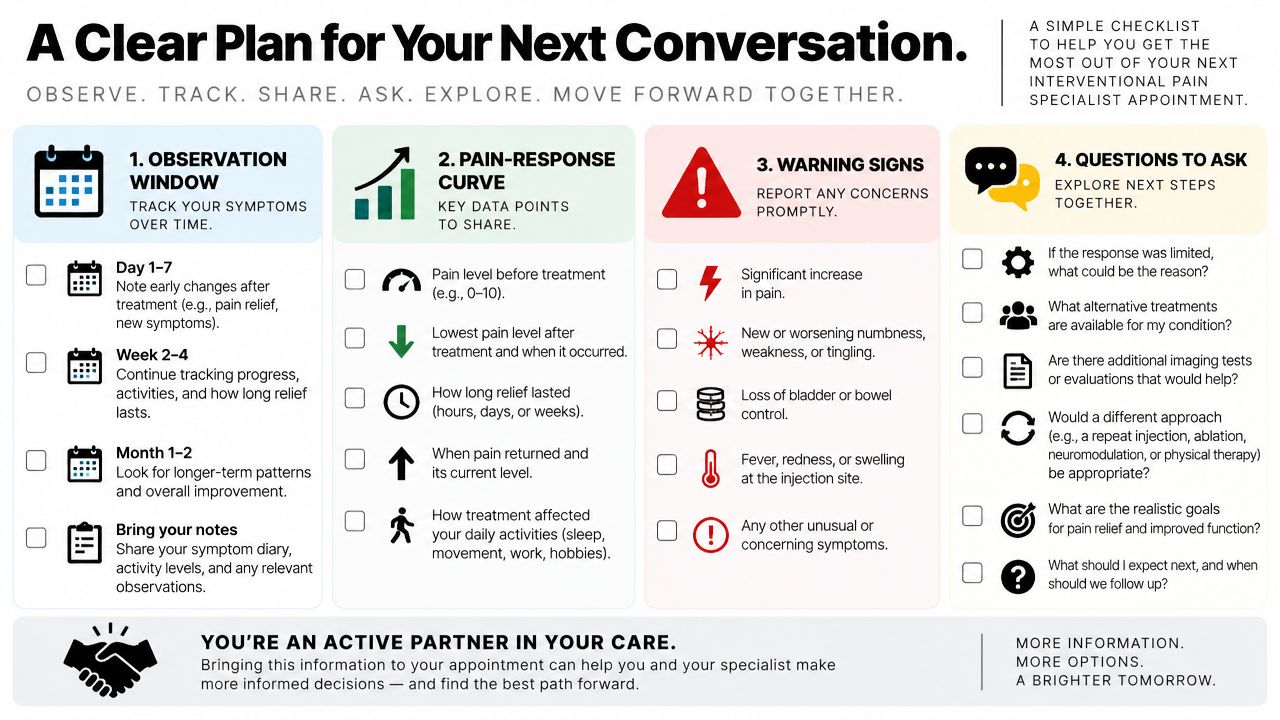
Open the appointment with a clear statement: “The injection didn't change my symptoms enough to improve my function. Here's where the pain remains, how long any relief lasted, and what I want to be able to do next.” That gives your interventional pain specialist a usable decision point, whether you're in Chicago Ridge, Palos Heights, Palos Hills, Evergreen Park, Hickory Hills, or another Illinois community.
If your epidural steroid injection didn't provide meaningful relief, Midwest Pain & Wellness can review your symptoms, imaging, prior procedure response, and possible next-step treatments through an individualized interventional pain consultation. Visit Midwest Pain & Wellness to discuss a targeted plan for nerve, spine, postsurgical, or chronic pain.