You had surgery because you wanted your life back. You wanted to sit through dinner without shifting every few minutes, sleep without waking from a jolt of pain, and stop planning your day around how long you could stand or walk.
Now the incision has healed, but the pain hasn't. For some people, it feels exactly like the old pain. For others, it becomes a different problem altogether. Burning down the leg. Numbness in the foot. A deep ache across the low back that makes even small tasks feel heavy. That experience is frustrating, isolating, and more common than many patients realize.
Failed back surgery syndrome is a real medical diagnosis, not a personal failure and not proof that your pain is "just something you have to live with." It affects between 10% and 40% of patients undergoing back surgery according to this review discussing persistent pain after back surgery. If you've also been dealing with a work injury history, questions about benefits, or a case that was closed before your pain was fully resolved, practical legal guidance on reopening a closed workers' comp claim can be useful alongside medical care.
Persistent post-surgical pain needs a fresh evaluation, not guesswork. Many patients start by learning more about postoperative pain and when it may signal a longer-term issue. Once the cause is identified, treatment can become much more targeted and much less discouraging.
Understanding Your Pain After Surgery
A typical story goes like this. Someone has lumbar surgery, gets through the first recovery phase, and expects each week to feel better than the last. Instead, progress stalls. Then the pain returns, or never really leaves. The result is confusion more than anything else. If the surgery happened, why does daily life still feel limited?
That pattern doesn't automatically mean the operation was done "wrong." It means the body and spine may still have an active pain generator that hasn't been fully identified or controlled.
Why this diagnosis matters
The term failed back surgery syndrome describes persistent or recurrent pain after spine surgery. The name is unfortunate because many patients hear it as a judgment. It isn't. It's the label clinicians use when pain continues after a procedure that was supposed to relieve it.
Pain after spine surgery deserves investigation, not dismissal.
For patients in Illinois communities like Orland Park, Alsip, Oak Lawn, and nearby suburbs around Chicago Ridge, the most helpful mindset is this: the surgery is part of your history, but it doesn't get the final word on your future. A better treatment path usually starts when someone steps back and asks a different question. Not "Why didn't surgery work?" but "What structure is generating pain now?"
What patients often feel
People with post-surgical spine pain often describe a mix of problems rather than one simple symptom:
- Persistent low back pain that makes standing, walking, or getting out of a chair harder than expected
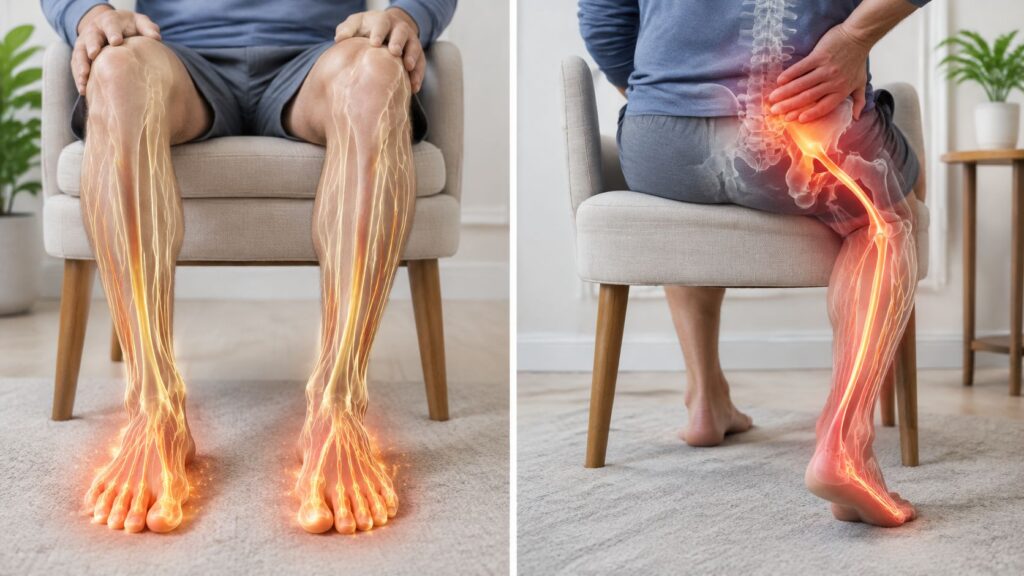
- Radiating leg symptoms such as burning, tingling, or numbness
- Mechanical pain that flares with position changes, bending, or longer activity
- Emotional exhaustion from hearing that more time, more medication, or more surgery might be the only options
That combination is exactly why a targeted pain management evaluation matters. Hope doesn't come from pretending the pain is minor. It comes from identifying the underlying source and treating it with precision.
What Is Failed Back Surgery Syndrome
A useful way to think about failed back surgery syndrome is to compare it to a house repair. If a contractor fixes one visible problem but misses a second hidden issue behind the wall, the homeowner still ends up with damage. The original repair may have addressed something real, but it didn't solve the full problem.
The spine can behave the same way.
What the diagnosis actually means
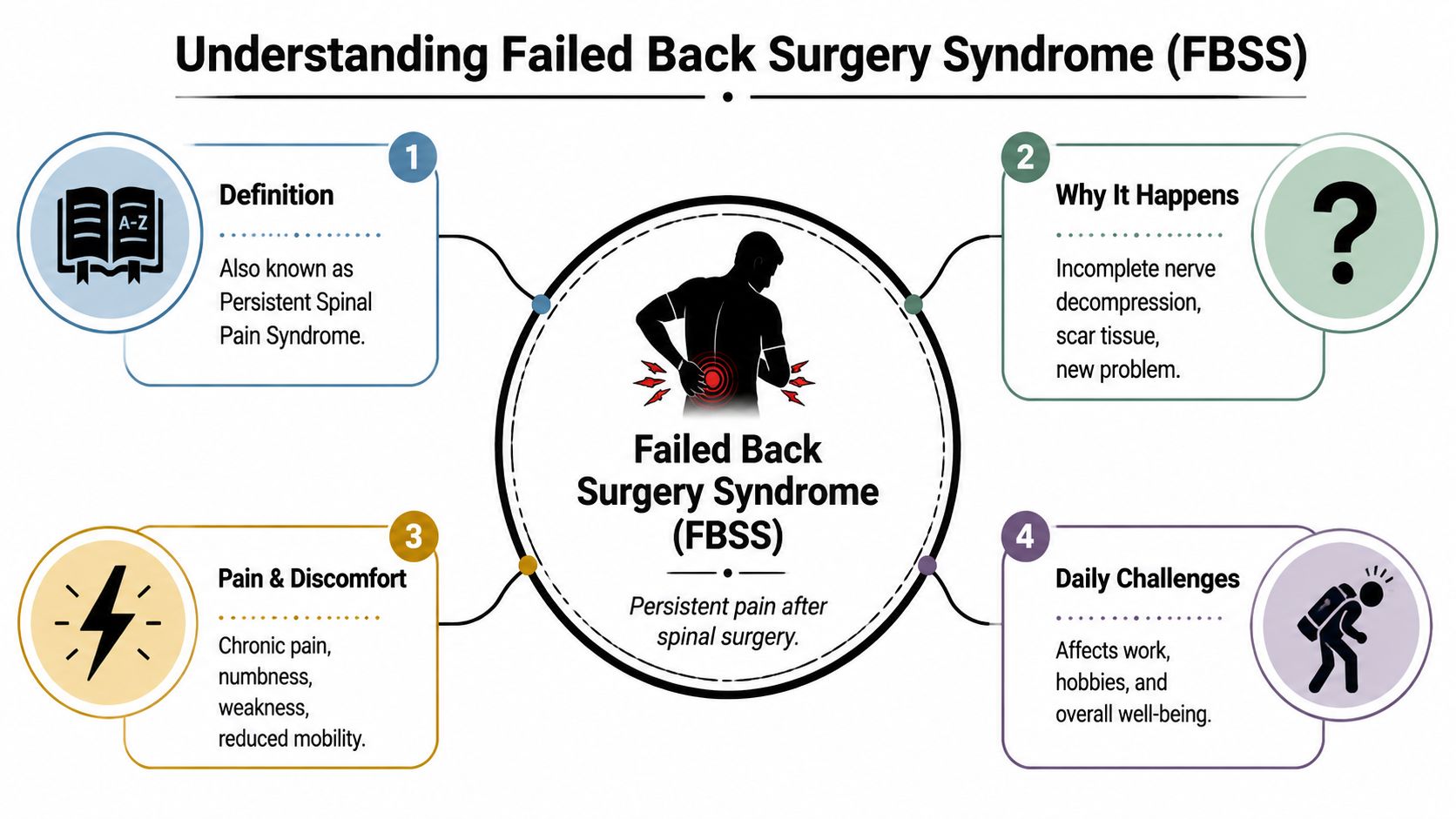
Failed back surgery syndrome is also increasingly called Persistent Spinal Pain Syndrome. The newer term is helpful because it focuses on what the patient is experiencing now, rather than reducing the issue to a single past event.
The diagnosis doesn't mean there is no cause. In fact, epidural fibrosis, incomplete neural decompression, and recurrent disc herniation are recognized physical causes of failed back surgery syndrome according to this clinical discussion of FBSS treatment.
Common reasons pain continues
Some causes are structural. Others are inflammatory or nerve-related. Many patients have more than one.
Scar tissue around a nerve
After surgery, healing tissue can form around irritated nerve roots. This is often called epidural fibrosis. Scar tissue itself isn't always painful, but when it tethers or irritates a nerve, symptoms can persist.
Incomplete decompression
Sometimes the original procedure reduces pressure but doesn't fully free the nerve in the lateral recess or neural foramen. A patient may feel partial improvement at first, then continued leg pain because the nerve is still compressed.
Recurrent disc herniation
A disc problem can return at the same level or develop nearby. In that situation, the pain may feel familiar, especially if the same nerve root is involved.
Instability or overload in nearby structures
Some patients develop pain from facet joints, the sacroiliac joint, or adjacent segments that begin carrying more stress after surgery. This is one reason low back pain after surgery doesn't always mean the disc is the current problem.
Symptoms patients recognize
The symptom pattern varies, but common complaints include:
- Back pain that never fully settles
- Leg pain that shoots, burns, or travels below the knee
- Numbness or tingling
- Weakness or a heavy feeling in the leg
- Reduced mobility and loss of confidence with movement
Clinical reality: When pain persists after surgery, the most important question isn't whether the surgery "counted." It's which structure is hurting now.
What this diagnosis does not mean
It doesn't mean the pain is imaginary. It doesn't mean you failed rehabilitation. It doesn't mean opioids or repeat surgery are your only remaining choices.
It means the evaluation has to become more specific. Once the true pain source is identified, treatment can move away from trial and error.
The Path to a Clear Diagnosis
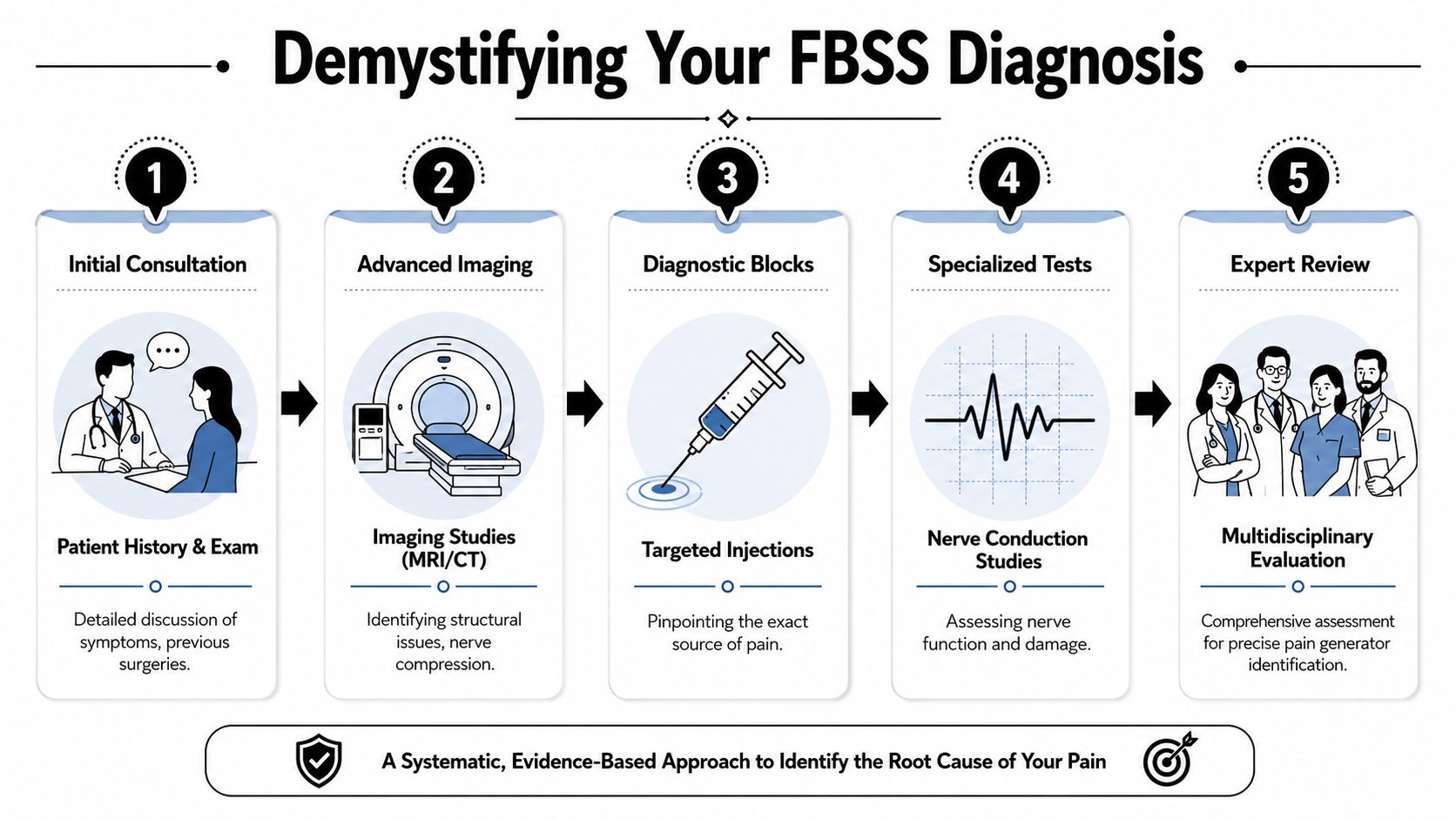
Good FBSS care starts with detective work. Not rushed assumptions. Not a reflex recommendation for another surgery. The goal is to identify the pain generator, meaning the exact structure or nerve pathway producing symptoms today.
The first visit should answer better questions
A focused evaluation usually starts with details that many patients haven't been asked in a while:
- Where is the pain now. Low back, buttock, groin, thigh, calf, foot
- What does it feel like. Burning, aching, pressure, electric, numb
- When does it worsen. Walking, sitting, extension, twisting, transitions
- What surgery was done. Decompression, fusion, discectomy, hardware placement
- What changed afterward. Immediate relief, no relief, temporary improvement, new symptoms
Those details matter because pain patterns often point toward different structures. Leg-dominant burning pain raises different concerns than pain centered over the low back or sacroiliac region.
Imaging helps, but it isn't the whole answer
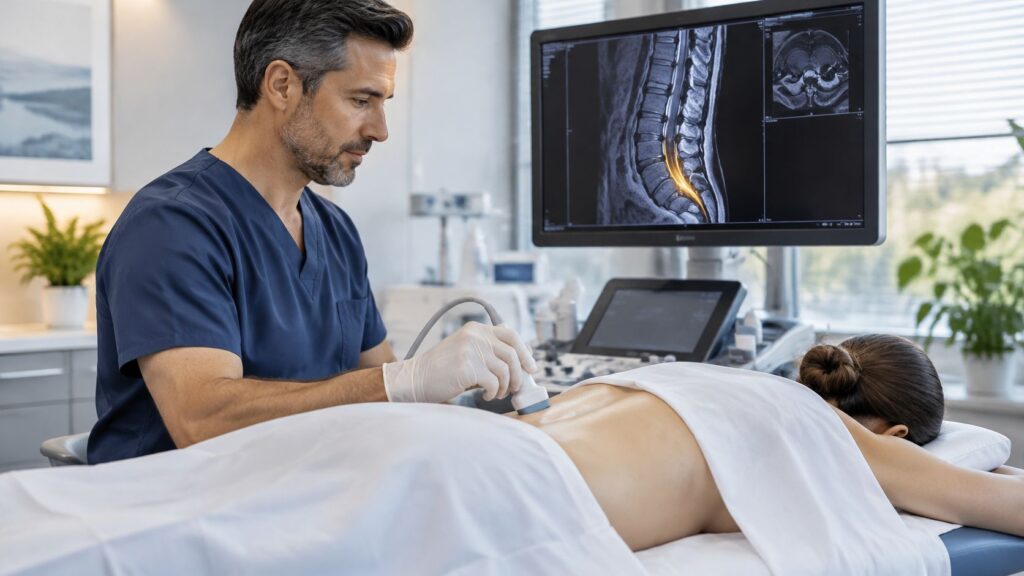
MRI and CT scans can show recurrent herniation, residual narrowing, scar tissue, hardware position, or other structural changes. But imaging by itself doesn't always prove what's causing pain. Many scans show abnormalities that don't match a patient's symptoms. That's why image review should always be paired with the physical exam and symptom history.
A careful exam also checks strength, sensation, reflexes, gait, and loading patterns. Facet pain behaves differently from nerve root pain. Sacroiliac pain behaves differently from central stenosis.
Targeted blocks turn suspicion into evidence
Interventional pain medicine becomes especially valuable. Diagnostic precision in FBSS relies on targeted nerve blocks. Dual medial branch blocks identify facet joint arthropathy, and transforaminal epidural blocks help confirm foraminal stenosis and specific root involvement, as outlined in this clinical review on FBSS diagnosis and management.
In practical terms, these procedures work like highly selective tests:
- Medial branch blocks help determine whether facet joints are the source of low back pain.
- Transforaminal epidural or selective nerve root blocks help confirm which nerve root is inflamed or compressed.
- Sacroiliac joint injections can clarify whether pain is coming from the SI joint rather than the lumbar spine itself.
A diagnostic injection isn't only a treatment. It's also a map.
Why precise diagnosis changes outcomes
When treatment follows a confirmed diagnosis, care becomes more efficient. A patient with facet-mediated pain may benefit from radiofrequency treatment rather than another epidural. A patient with persistent nerve root inflammation may need a different approach entirely. A patient with mixed pain may need a staged plan.
That precision matters because failed back surgery syndrome isn't one condition with one fix. It's a category of post-surgical pain states that demands a structured, evidence-based workup.
Evidence-Based Treatments Beyond Repeat Surgery
Many patients arrive thinking the choice is either "live with it" or "go back to surgery." That's usually too narrow. There are several evidence-based options between those extremes, and the right one depends on the confirmed pain generator.
Another reason this matters is function. A discussion of return-to-work outcomes reported that back surgery had a 74% failure rate in return-to-work terms, with 26% of patients returning to work after two years compared with 67% of similar patients who did not have surgery in the analysis summarized here. That doesn't mean surgery is never appropriate. It does mean repeat surgery shouldn't be automatic.
Patients managing prolonged pain often also need broader support with medications, monitoring, and long-term health coordination. For some, it helps to find chronic disease support options that fit alongside a pain care plan.
What tends to work better than reflex re-operation
Some treatments reduce inflammation. Some interrupt pain signaling. Others address a specific joint or nerve source. The point is matching the method to the mechanism.
Patients can also review chronic back pain treatment options to understand how these therapies fit into a broader plan.
| Treatment | Primary Goal | How It Works | Ideal for Pain From… |
|---|---|---|---|
| Epidural steroid injection | Calm inflamed nerve tissue | Delivers anti-inflammatory medication near an irritated nerve root | Radicular pain, nerve irritation, post-surgical inflammation |
| Medial branch block | Confirm or temporarily ease facet-related pain | Numbs the small nerves that supply the facet joints | Facet joint pain after altered spinal mechanics |
| Sacroiliac joint injection | Identify and reduce SI-driven pain | Places medication into or around the SI joint under imaging guidance | Buttock and low back pain from SI dysfunction |
| Radiofrequency ablation | Provide longer relief after a successful diagnostic block | Uses controlled heat to disrupt pain-carrying nerve fibers | Confirmed facet or selected sacroiliac pain |
| Adhesiolysis | Address scar-related nerve irritation in selected cases | Targets epidural adhesions that may be tethering or irritating nerves | Epidural fibrosis with persistent radicular symptoms |
| Regenerative injections in select cases | Support painful joint or soft tissue structures when appropriate | Uses biologic injectates for carefully chosen pain sources | Certain joint or supportive tissue pain patterns |
| Neuromodulation | Modify pain signaling without major repeat surgery | Uses electrical stimulation to change how pain signals are perceived | Persistent neuropathic pain after surgery |
How I think about trade-offs in practice
A patient with clear nerve root irritation and leg-dominant pain may respond well to an epidural approach. A patient with extension-based low back pain after fusion often turns out to have facet loading. Someone with buttock pain when rising from a chair may have a sacroiliac component that was never addressed.
RFA deserves special mention because it is often misunderstood. It doesn't repair the spine. It treats confirmed joint-mediated pain by interrupting the small nerves transmitting those signals. In the right patient, that can be a meaningful shift away from constant medication use.
What usually doesn't help enough on its own
- Escalating opioids without a clear plan often dulls pain without improving function.
- Blind repeat injections without a diagnostic reason can prolong frustration.
- Repeat surgery without a defined mechanical target exposes patients to more scar tissue, more recovery time, and often less predictable relief.
- Waiting too long to get a specialist evaluation can allow pain patterns to become more entrenched.
A practical test: If a treatment can't explain which pain generator it's targeting, it may not be specific enough.
Used properly, interventional pain management isn't a last resort. It's a logical next step when the first operation didn't resolve the whole problem.
Advanced Options for Lasting Pain Relief
Some patients need more than inflammation control or joint-targeted procedures. They need a treatment that addresses how pain signals travel, or a minimally invasive way to relieve persistent pressure without another large spine operation.

Spinal cord stimulation at the right time
Spinal cord stimulation, or SCS, is often described as a pacemaker for pain. Small electrical impulses are delivered to change how pain signals are processed before they fully register in the brain. It doesn't erase the underlying history of surgery, but it can reduce persistent neuropathic pain in the right patient.
Timing matters. Early referral to neuromodulation centers within 6 months of failed surgery increases SCS success rates by 35%, while delaying beyond 12 months reduces efficacy by 50%, according to this published discussion on neuromodulation timing.
That matters because many people are told to wait until every other option has been exhausted. In reality, a prolonged delay can work against them.
Why a trial matters
One of the strongest features of neuromodulation is that it can be tested before permanent implantation. A temporary trial allows the patient and physician to judge whether stimulation meaningfully reduces pain and improves function.
That trial-first approach is one reason SCS is different from a major revision surgery. It gives patients data about their own response before making a longer-term decision. For some individuals with focal neuropathic pain patterns, dorsal root ganglion stimulation may also be part of the neuromodulation conversation.
Minimally invasive decompression for selected patients
Not every patient with failed back surgery syndrome needs signal modulation. Some still have a pressure problem. When symptoms align with ongoing stenosis or ligament-related crowding, minimally invasive decompression approaches may offer relief with less tissue disruption than traditional open surgery.
Examples include procedures designed to create more space for nerves through a very small access point. In the right setting, that can improve walking tolerance, reduce neurogenic leg symptoms, and avoid another large fusion-type operation.
The right advanced option depends on the pain pattern
A simple framework helps:
- Neuropathic leg pain with no clear re-operation target may point toward SCS.
- Focal, anatomically specific pain patterns may call for targeted neuromodulation strategies.
- Persistent symptoms from ongoing narrowing may fit minimally invasive decompression better than medication escalation.
- Mixed pain states often require combination planning rather than a single procedure.
Families caring for someone with long-standing pain after surgery sometimes need support too, especially when function has declined over time. In that setting, educational resources about palliative care for family caregivers can help families understand supportive care principles while the patient pursues active pain treatment.
Advanced pain care works best when it is introduced at the right time, for the right anatomy, with realistic goals.
This is the part many patients never hear early enough. Interventional pain management is not a fallback after everything else fails. For many forms of failed back surgery syndrome, it is the next evidence-based move.
Your Next Step Toward Relief in Illinois
If you're living with post-surgical back or leg pain in Oak Lawn, Palos Hills, Palos Heights, Worth, Bridgeview, Hickory Hills, Alsip, Burbank, Evergreen Park, or Orland Park, you don't need to accept persistent pain as the price of having had spine surgery.
The next step should feel manageable. Start with a focused evaluation. Review the surgery you had, the symptoms you have now, the images you already own, and the treatments you've tried. Then build a plan that follows a simple sequence: assess the pain generator, recommend the most appropriate option, and treat with precision.
Dr. Yaw Donkoh is a double board-certified interventional pain specialist in Illinois who treats spine, nerve, and post-surgical pain with an opioid-sparing approach. In this setting, that means looking beyond repeated prescriptions and beyond reflex re-operation. It means using careful history, imaging review, diagnostic blocks, and targeted procedures to match treatment to the source of pain.
Midwest Pain & Wellness is one option for that kind of evaluation and treatment planning. The clinic provides interventional pain management for adults in the Chicago Ridge area and surrounding suburbs, including patients dealing with persistent pain after surgery.
You don't need to walk into the first appointment with all the answers. Bring your records if you have them. Bring your questions. Bring a clear description of what hurts, what worsens it, and what you're no longer able to do. That's enough to begin.
If pain is still controlling your life after back surgery, schedule a consultation with Midwest Pain & Wellness. A clear diagnosis can open the door to targeted, opioid-sparing treatment options and a practical path forward.