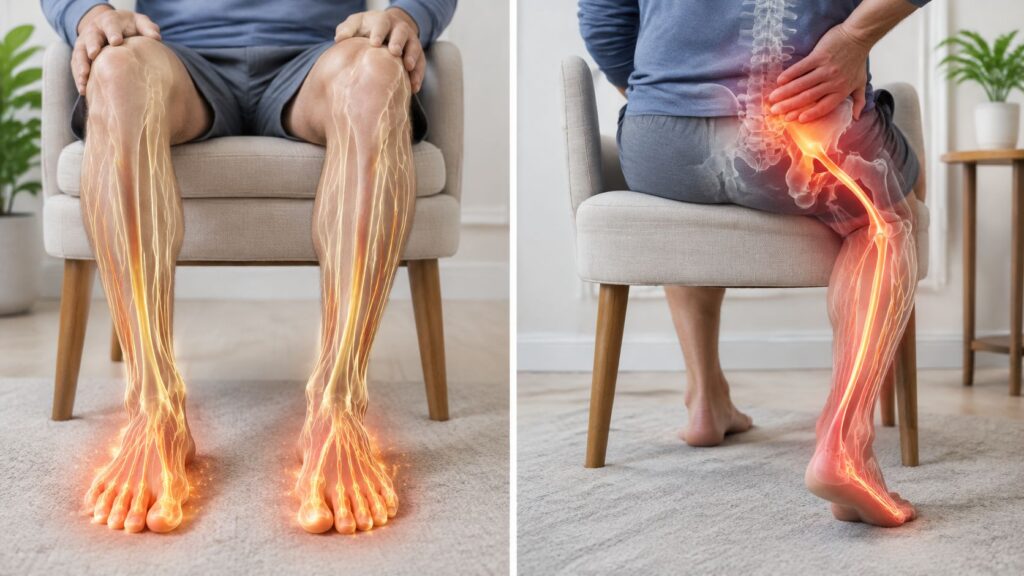
Many individuals want frozen shoulder treatment to be simple. They want a stretch routine, a few visits, and a promise that time will handle the rest. The problem is that frozen shoulder does not reliably disappear on its own, and waiting can leave people stuck with pain and stiffness far longer than they expected.
Frozen shoulder, also called adhesive capsulitis, is common enough to matter in everyday practice, with major reviews estimating a 2% to 5% prevalence in the general population NCBI Bookshelf. It shows up most often between 40 and 60 years old, with a typical mean onset around 55 years NCBI Bookshelf. In a clinical guideline, 20% of patients later developed similar symptoms in the opposite shoulder, and 14% had both shoulders involved at the same time NCBI Bookshelf. That is why a passive, one-size-fits-all approach is usually the wrong move.
Why Frozen Shoulder Demands More Than Watchful Waiting
The old advice was to wait it out. That sounds reasonable until you look at the long-term data. One outcome study reported that although symptoms often improve, 50% of patients still had pain or stiffness at a mean of 7 years, and a prospective cohort found only 39% achieved full recovery after 5 to 10 years of follow-up Frozen Shoulder Review. That does not mean everyone needs a procedure, but it does mean frozen shoulder is not a condition to ignore.
What the numbers mean in real life
The clinical pattern matters as much as the diagnosis. Frozen shoulder tends to cluster in middle age, and the same guideline that reported the prevalence figures also noted that conservative treatment is successful in up to 90% of patients NCBI Bookshelf. Those two facts can sound contradictory until you separate success with structured care from slow improvement with no plan. Most patients do improve without surgery, but improvement is not the same thing as hoping pain and motion return on their own.
Practical rule: if the shoulder is getting tighter, sleep is getting worse, and daily tasks keep shrinking, the problem is no longer just “wait and see.”
What makes this condition tricky is the burden it creates before it resolves. Dressing, reaching into a back pocket, washing hair, or lifting an arm overhead can become slow, guarded tasks for months. In clinic, I look at frozen shoulder as a staged problem that needs staged decisions, not a single generic answer.
Who tends to need active treatment
The highest incidence sits in middle age, and the condition often affects function long enough to justify a treatment plan rather than passive observation NCBI Bookshelf. People also need to know that bilateral involvement is real. If one shoulder has already frozen, the other shoulder is not automatically safe.
The right question is not, “Will this ever get better?” The better question is, “What stage am I in, and what should be done now to prevent months of unnecessary pain and stiffness?”
Understanding the Three Stages of Adhesive Capsulitis
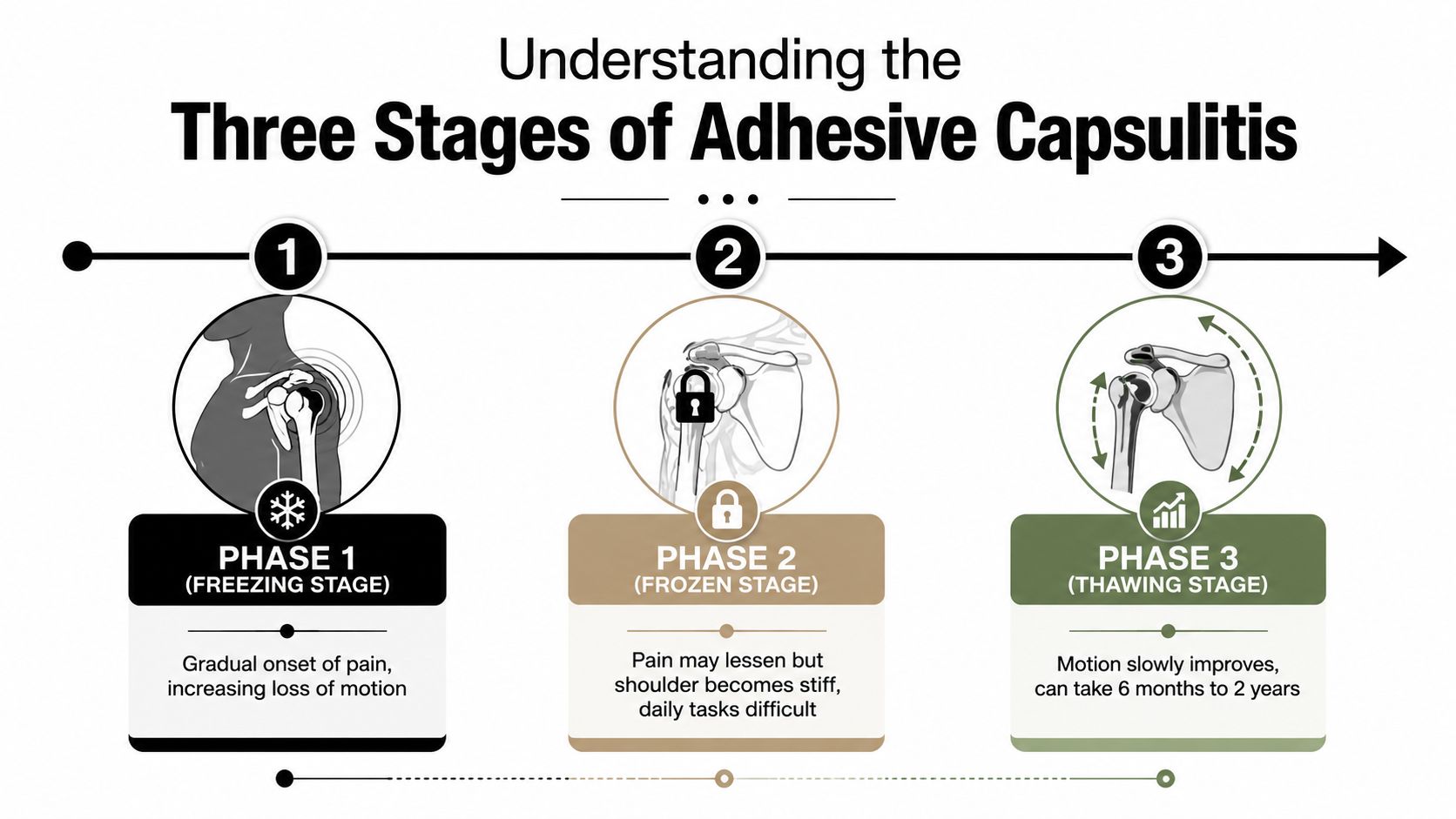
Frozen shoulder moves through three clinical phases, and treatment works differently in each one. The terms matter because people often hear “do stretches” without being told whether they are still in the painful inflammatory stage or already in the stiff, less reactive stage. A treatment that helps one phase can aggravate another.
The freezing stage
This is the painful phase. The shoulder starts to hurt more, and motion becomes increasingly limited. Night pain is common, and the joint can feel irritated by movements that used to be easy. At this point, the limiting factor is usually pain, not just stiffness.
That is why aggressive mobilization can backfire early. A structured clinical guideline recommends a phase-specific rehabilitation strategy, and in the freezing stage it prioritizes pain-relieving physical therapy while avoiding aggressive mobilization because it can worsen inflammation Conservative Care Guideline. Home activity still matters, but it has to stay within a tolerable range.
The frozen stage
Pain may ease somewhat, but stiffness becomes the headline symptom. Reaching overhead, fastening a seat belt, or putting on a jacket can feel blocked rather than just sore. Many people realize the shoulder is not “just tight,” it is mechanically restricted.
At this stage, the goal shifts toward restoring motion without provoking a flare. Patients often do better when the plan is steady and measured, not forceful.
The thawing stage
Motion slowly improves. Recovery can be slow, but this is the phase where function gradually comes back if the shoulder is given the right amount of loading and movement. The same guideline used in the recovery literature notes that conservative care is successful in up to 90% of patients when it is properly staged NCBI Bookshelf.
Recovery is usually not dramatic from one week to the next. It tends to be gradual, then noticeable, then frustratingly slow again before it finally turns the corner.
Conservative Treatment Options and What the Evidence Shows
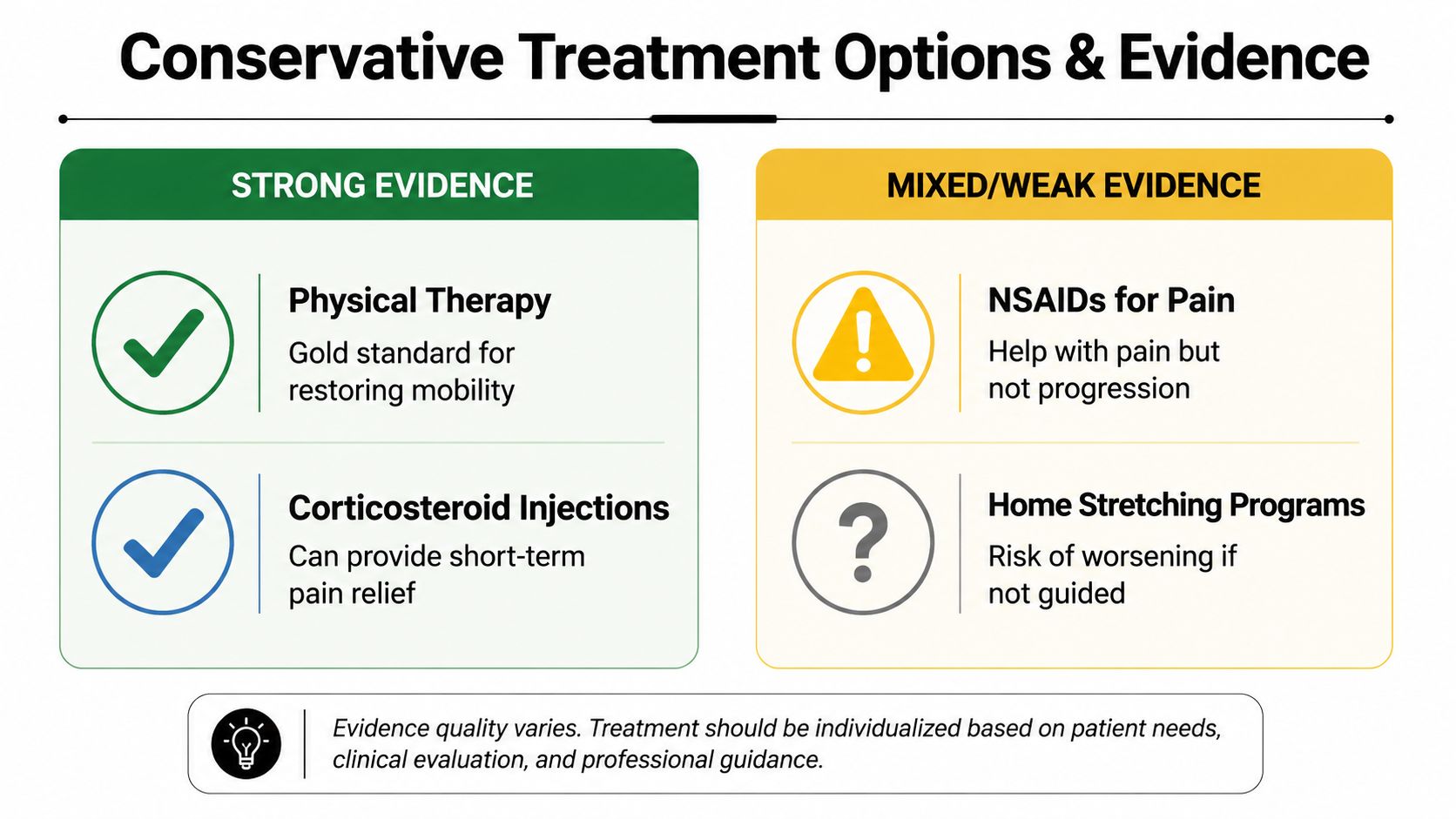
Conservative care is still where treatment usually starts, but the evidence is not equal across every option. The best short-term support is for intra-articular corticosteroid injection, especially early, when pain is the main reason the shoulder will not move. A meta-analysis in JAMA Network Open found that steroid injection performed better than other nonsurgical options, with benefit lasting for months in many patients. The same review also found a stronger early effect than other treatments over the first several weeks.
Where conservative care is strongest
A staged rehab plan is the foundation. Clinical guidance recommends 3 to 4 home exercise sessions per day of 10 to 15 minutes each, with active-assisted range-of-motion work in the freezing stage and no aggressive stretching early on Conservative Care Guideline. Regular movement helps, but it has to stay within a range the shoulder can tolerate. Push too hard and the joint often answers with more pain, less motion, and more guarding.
Physical therapy alone is less convincing when it is treated like a cure-all. Older reviews found little to no benefit for physiotherapy by itself, and the broader literature still leaves gaps around education, home exercise, and self-management programs Conservative Care Review. That does not make PT useless. It means the plan has to match the stage of the condition, the pain level, and how much loading the shoulder can handle without flaring.
What often helps, but does not change the disease itself
NSAIDs can reduce pain, but they do not appear to change the course of frozen shoulder. Heat, ultrasound, and electrical stimulation are often offered, yet the evidence for those modalities is weak or inconsistent. That gap matters in real life, because a patient can spend weeks feeling treated without seeing meaningful change.
Clinical bottom line: if pain is the main barrier, an early injection can make rehab possible. If stiffness is the main barrier, motion work should become the focus, but not so forceful that it drives the joint into another inflammatory flare.
I look at conservative care as a staged decision, not a slogan. If pain stays high, function keeps slipping, and the shoulder remains stuck despite a plan that is being followed, it is time to discuss escalation instead of repeating the same measures. For patients in the Chicago Ridge area who want coordinated rehab support, this rehabilitation and pain management approach shows how stage-based care should be organized.
When to Consider Interventional Procedures
Procedures belong in the discussion when conservative care has not moved the needle, not as the first reflex. The major randomized UK FROST trial compared 201 patients assigned to manipulation under anesthesia, 203 to arthroscopic capsular release, and 99 to physiotherapy. At 12 months, none of the three approaches was clinically superior on the Oxford Shoulder Score, and the differences between groups were small Frozen Shoulder Review. That tells us something important. Procedures can help selected patients, but they are not magic.
Comparing the main escalation options
| Procedure | Best For | Typical Timing | Recovery Considerations |
|---|---|---|---|
| Hydrodilation | Persistent stiffness when a less invasive option is preferred | Usually after early conservative care has not helped | Can be used as a bridge before surgery, recovery is often quicker than operative release |
| Manipulation under anesthesia | Marked stiffness that has not improved with structured care | Reserved for cases that fail conservative treatment | Requires post-procedure motion work to maintain gains |
| Arthroscopic capsular release | Severe, persistent restriction with functional loss | Generally after 6 to 9 months of conservative care failure Conservative Care Guideline | More invasive, with a longer recovery conversation |
The decision is not just about how tight the shoulder feels. It also depends on pain level, stage, work demands, sleep disruption, and whether the joint still tolerates rehabilitation. The common thread is timing. Major reviews note that invasive options such as manipulation under anesthesia or capsular release are usually reserved for cases that fail 6 to 9 months of conservative care Conservative Care Guideline.
What I consider before escalation
If the shoulder is still in a very painful freezing phase, forcing a procedure too early can be the wrong trade. If the shoulder is already locked down and conservative care has stalled, then escalation becomes more reasonable. That is where image-guided evaluation and procedural planning matter.
For patients weighing those choices, this suprascapular nerve block resource is useful because it fits into the broader conversation about pain control and procedural care without pretending every case needs surgery.
Regenerative and Emerging Therapy Options
Patients increasingly ask about regenerative care because they want options that feel less invasive than surgery and more durable than a quick fix. The evidence is still evolving, but PRP has some data worth discussing. A 2021 systematic review and network meta-analysis of 31 studies found that among early-stage treatments, intra-articular PRP improved pain and function versus physical therapy at 12 weeks, and it was the only option in that analysis showing range-of-motion benefit over physical therapy Frozen Shoulder Review. That is promising, but it is not the same as proving long-term superiority across all patients.
Where PRP fits and where it does not
PRP may belong in a conversation when the patient wants a biologic option and understands the current evidence is still narrower than for corticosteroid injection. It is not a universal substitute for a stage-based plan. It also should not be presented as a guaranteed way to avoid later procedures.
Cell-based products and marketed stem cell or exosome therapies require extra caution. A lot of the enthusiasm around regenerative medicine runs ahead of the evidence, especially when companies make broad claims about tissue repair or pain relief. The safer stance is simple. If a product is being sold as a cure, the patient should ask for published human evidence that matches the diagnosis, the stage, and the outcome being promised.
Ask a direct question. What problem is this treatment supposed to solve, pain, motion, or both, and what is the evidence that it changes the course of frozen shoulder?
That question matters because frozen shoulder treatment is stage-sensitive. A biologic option that sounds exciting may still be less useful than a targeted injection when pain is blocking rehab. For a broader overview of how regenerative medicine is approached in pain care, this regenerative medicine and tissue engineering page offers a practical framework for separating evidence-supported care from marketing language.
Comprehensive Care at Midwest Pain and Wellness
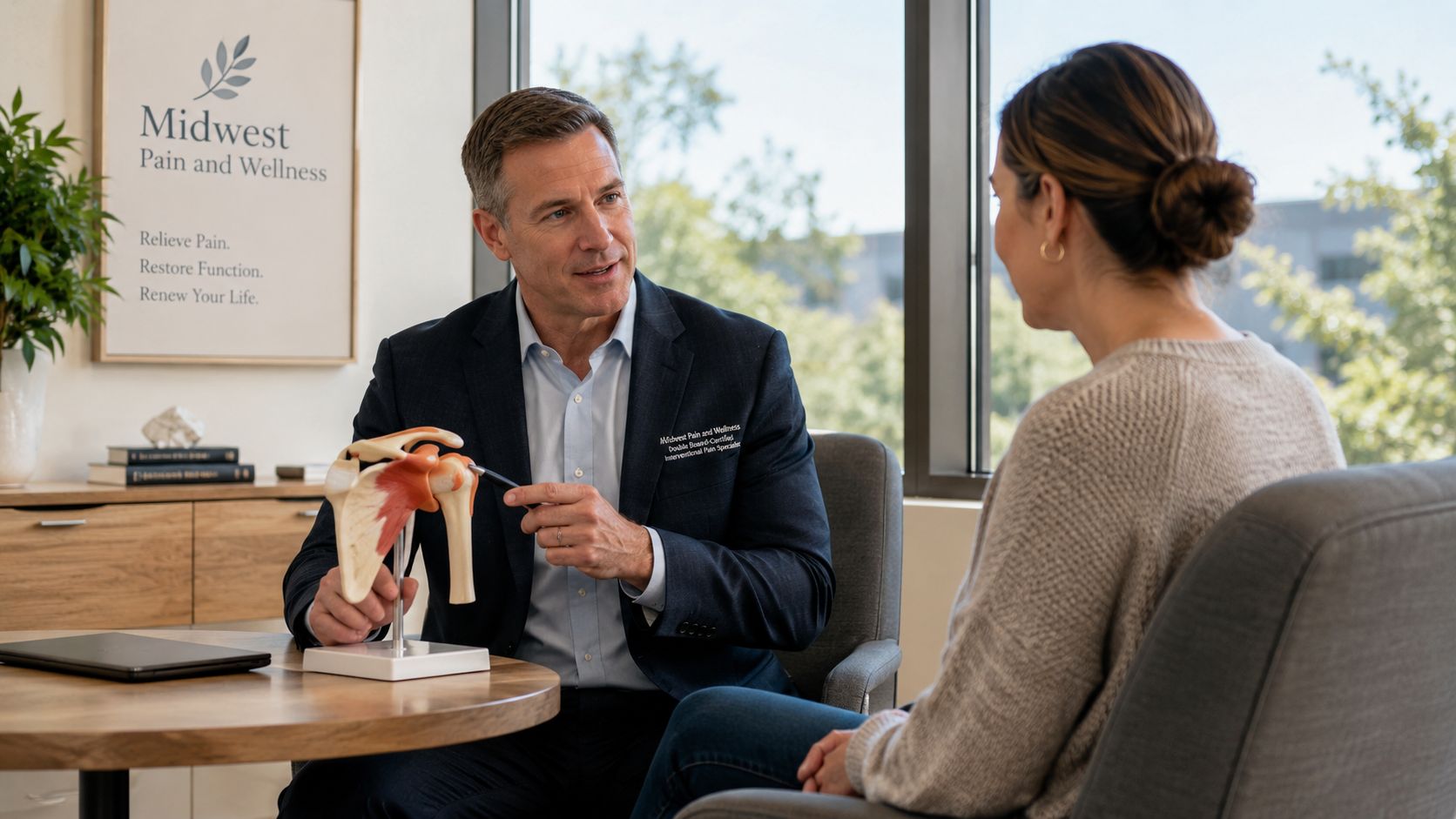
A frustrated patient usually does not need another vague stretch handout. They need someone who can sort out pain, stiffness, timing, and the next best step without bouncing them between disconnected offices. At Midwest Pain & Wellness in Chicago Ridge, Illinois, Dr. Yaw Donkoh brings that kind of procedural and clinical structure to frozen shoulder care. The practice is led by a double board-certified interventional pain specialist, and the approach is designed to stay opioid-sparing while still being active and decisive.
What the visit usually looks like
The first step is a careful assessment of pain pattern, range of motion, and symptom stage. The next step is matching that picture to the least invasive treatment that can still move the case forward. The third step is coordination, with primary care, surgeons, and rehabilitation therapists when that helps the patient get better faster.
That matters because frozen shoulder often sits at the intersection of pain control and mobility recovery. A clinic built around interventional pain care can offer image-guided injections when appropriate, coordinate rehab, and escalate to advanced procedures only when conservative treatment has stopped working.
Who the clinic serves
The practice supports patients from Oak Lawn, Palos Hills, Palos Heights, Worth, Bridgeview, Hickory Hills, Alsip, Burbank, Evergreen Park, and Orland Park. It also supports workers' compensation and personal injury cases, which is important for patients whose shoulder problem started after an accident or on the job. That kind of case often needs documentation, timing, and treatment coordination, not just symptom suppression.
For people who want a single place to discuss options without being rushed toward surgery or left to “just stretch it out,” that coordinated model can make the next decision much clearer.
Recovery Timelines and When to Seek Specialist Evaluation
Recovery from frozen shoulder is usually measured in months, not days. The most useful expectation is that the first change is often pain relief, then motion improvement, then function, and only later a more complete return to activity. The exact pace depends on stage, how long the shoulder has been symptomatic, and whether treatment matches the problem.
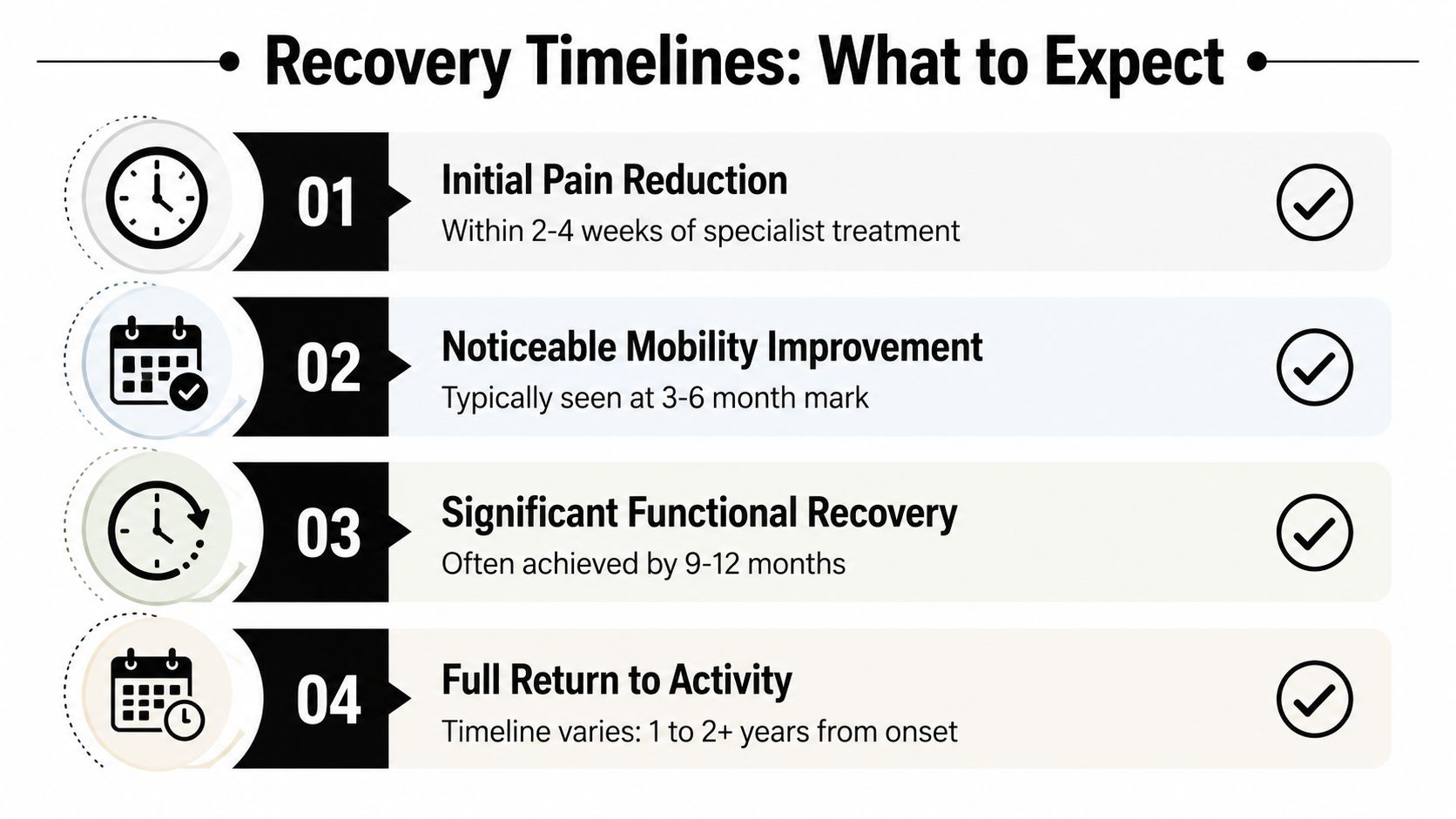
Milestones that usually matter
- Initial pain reduction: If specialist treatment is working, pain often starts easing within the first few weeks.
- Noticeable mobility improvement: Motion changes are commonly seen over the following months, not overnight.
- Significant functional recovery: Daily tasks usually come back gradually as stiffness softens.
- Full return to activity: This can still take a long time, and bilateral involvement can make recovery feel even slower.
The bilateral issue deserves attention. A guideline reported that 20% of patients later develop similar symptoms in the opposite shoulder, and 14% may have simultaneous bilateral involvement NCBI Bookshelf. That does not mean both shoulders will freeze, but it does mean patients should watch the other side and protect overall function during recovery.
Red flags that mean it is time to escalate
If pain stays severe, sleep keeps worsening, motion keeps shrinking, or the shoulder is not responding after a real staged plan, that is the moment to seek specialist evaluation. The same goes for people who cannot tolerate rehabilitation because pain is too high, or those whose function is dropping at work or at home. Conservative care is often effective, but it should still be moving in the right direction.
When frozen shoulder starts affecting both shoulders or refuses to improve after months of consistent care, I recommend a specialist review rather than more guessing. A pain and wellness clinic can help sort out whether an injection, a procedural option, or a more customized rehabilitation plan is the right next move.
If your shoulder is stiff, painful, and not improving the way you were told it would, Midwest Pain & Wellness can help you sort out the stage you're in and what to do next. Visit Midwest Pain & Wellness to get a focused evaluation and a treatment plan built around real frozen shoulder care, not guesswork.