Understanding Chronic Back and Neck Pain Relief in Chicago Ridge
Medial branch block Chicago Ridge is a minimally invasive diagnostic and therapeutic procedure that helps identify and treat chronic neck and back pain originating from the facet joints in your spine. If you’re experiencing persistent pain that worsens with movement or twisting, this procedure could provide the answers—and relief—you’ve been seeking.
Quick Facts About Medial Branch Blocks in Chicago Ridge:
- What it is: An injection of local anesthetic near the medial branch nerves that supply your facet joints
- Purpose: Confirms if facet joints are causing your pain (diagnostic) and provides temporary relief (therapeutic)
- Duration: 15-30 minutes outpatient procedure
- Success rate: Over 80% of patients experience substantial pain relief
- Next steps: If successful, may lead to radiofrequency ablation (RFA) for 6-12 months of relief
- Recovery: Most patients resume normal activities the next day
Research shows that 80% of Americans will experience back pain at some point in their lives. For many, that pain becomes chronic—making everyday tasks feel exhausting. The pain often comes from facet joints, the small joints connecting your vertebrae that can become inflamed due to arthritis, injury, or mechanical stress.
A medial branch block offers a precise way to diagnose the source of your pain. By temporarily numbing the nerves that carry pain signals from specific facet joints to your brain, your doctor can determine if those joints are the culprit. If you experience significant relief during those first few hours after the injection, you’ve identified the problem—and opened the door to longer-term treatment options like radiofrequency ablation.
The procedure is performed under fluoroscopy (live X-ray) guidance for accuracy and uses only local anesthetic, making it a safe, opioid-free approach to pain management.
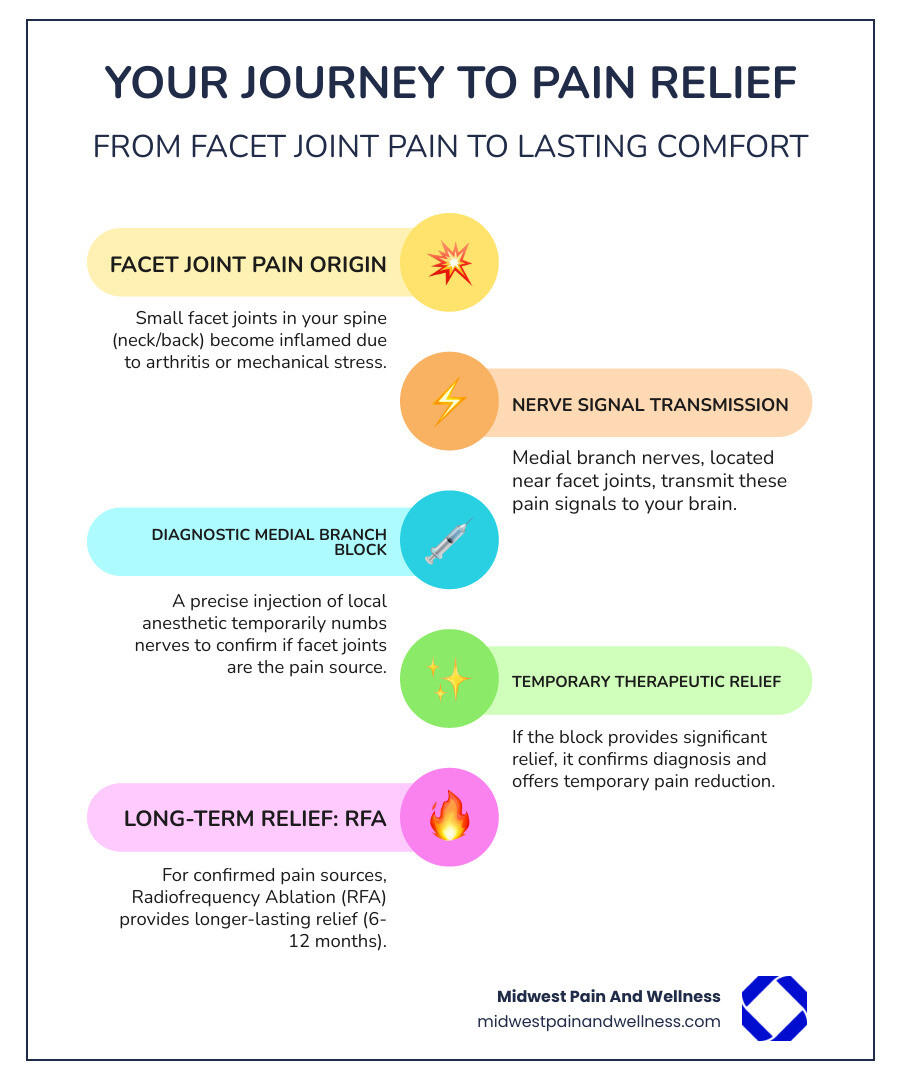
Understanding Facet Joint Pain and Medial Branch Blocks
To understand a medial branch block, we need to look at our spinal anatomy. Our spine is made of vertebrae connected by small, flat joints known as facet joints. These joints allow the spine to bend and move, providing flexibility and stability.
Like any joint, facet joints can suffer from wear, inflammation, or injury, causing them to send pain signals. These signals travel to the brain via medial branch nerves. If your facet joints are irritated from arthritis, mechanical stress, or degenerative spine disease, these are the nerves transmitting the pain.
Facet joint arthritis, also known as spondylosis, is a common culprit of chronic back and neck pain. It’s often a result of the natural aging process, but can also affect very active young people in sports due to repetitive stress. When these joints are inflamed, they can cause pain that radiates into the arm, leg, back, or neck, and can even contribute to conditions like Spinal Stenosis, Degenerative Spine Disease (Neck, Mid-Back, Low Back).
So, how does a medial branch block fit into this picture? It’s a precise injection designed to target these medial branch nerves. But it’s not the only injection that helps with facet joint pain. You might also hear about facet joint injections. Let’s look at how they compare:
| Feature | Medial Branch Block | Facet Joint Injection |
|---|---|---|
| Purpose | Diagnostic: Injects anesthetic near medial branch nerves. If pain is relieved, it confirms facet joints as the source. | Therapeutic/Diagnostic: Injects anesthetic and steroid directly into the facet joint. Less specific for diagnosing nerve-mediated pain. |
| Target | Targets the medial branch nerves outside the joint. | Targets the facet joint capsule itself. |
| Predictive Value for RFA | High. A positive block strongly predicts success for Radiofrequency Ablation (RFA). | Variable. Does not predict RFA success as accurately. |
| Primary Goal | Primarily diagnostic, with temporary therapeutic relief. | Primarily therapeutic, with some diagnostic value. |
A medial branch block is a key diagnostic tool. If the injection significantly reduces your pain, it confirms the facet joints are the problem, which is crucial for planning long-term treatment. The block also provides temporary therapeutic relief, creating a window for you to engage in physical therapy or other rehabilitative activities that were previously too painful.
For more detailed information on injections like these, you can explore our comprehensive guide on Facet Joint Injections Chicago: Complete Guide.
Conditions Treated with a medial branch block in Chicago Ridge
In Chicago Ridge, our patients often come to us with persistent discomfort that impacts their daily lives. A medial branch block can be a game-changer for several specific conditions:
- Chronic Neck Pain: Pain from arthritis in the cervical facet joints, often worsening with neck movement.
- Chronic Low Back Pain: Widespread pain commonly caused by facet joint issues in the lumbar spine.
- Facet Syndrome: Pain originating from the facet joints, presenting as a dull ache that worsens with certain movements or prolonged standing.
- Pain from Mechanical Stress: Inflammation and pain caused by repetitive movements, poor posture, or sudden stress on facet joints.
- Degenerative Spine Disease: Chronic pain and stiffness from age-related degeneration of the facet joints.
- Pain that Worsens with Twisting or Bending: A classic symptom of facet joint pain, as these movements directly pressure the joints.
If you’re dealing with any of these conditions and traditional treatments haven’t provided lasting relief, a medial branch block could be the next logical step. For general information about how nerve blocks can help manage various types of pain, you can visit our page on Nerve Block for Pain.
Who is a Good Candidate for This Procedure?
Determining if a medial branch block Chicago Ridge is right for you involves a thorough evaluation. Generally, you might be a good candidate if you:
- Have suspected facet joint pain: Your pain worsens with twisting, bending backward, or prolonged standing, and is localized to your back or neck.
- Have failed conservative treatments: Approaches like physical therapy, oral medications, or chiropractic care have not provided significant or lasting relief.
- Are seeking an alternative to daily pain medication: You are looking for an opioid-free pathway to pain relief.
- Need a definitive diagnosis: The source of your pain is unclear, and a diagnosis is needed to guide further, more permanent treatments.
Our goal is to uncover the root cause and provide effective, long-term solutions. If you’re exploring options for managing persistent discomfort, learning more about Chronic Pain Treatment can be very helpful.
Your Medial Branch Block Chicago Ridge Procedure: Step-by-Step
Undergoing a medical procedure can be daunting, but a medial branch block Chicago Ridge is a straightforward, minimally invasive outpatient procedure. We guide you through every step with care and comfort.
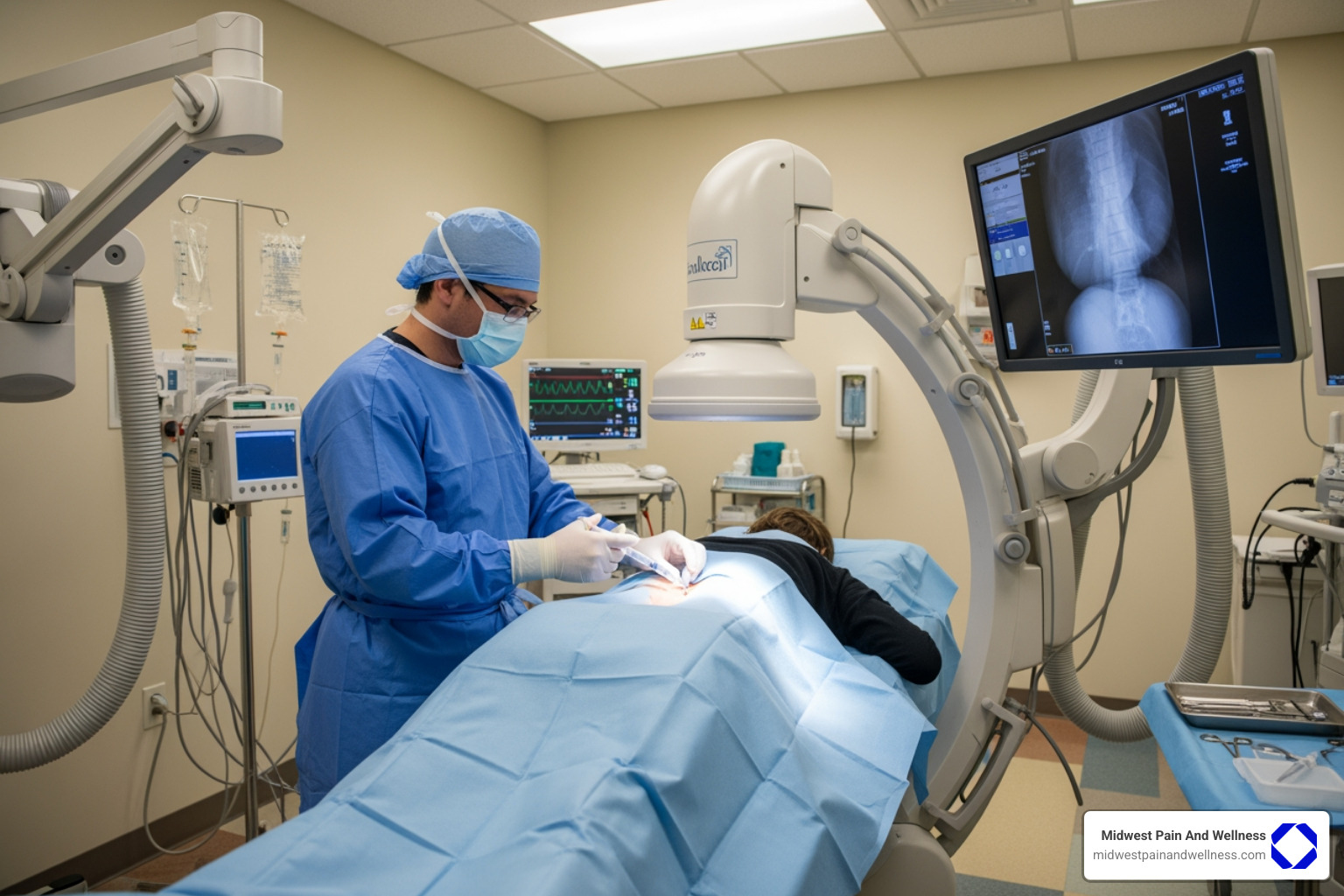
The procedure is quick, about 15-30 minutes, plus a short observation period. We prioritize your comfort with local anesthetic and offer sedation for anxiety. It’s a targeted injection with no incisions or stitches, designed to get you back to feeling better.
How the Procedure is Performed
Our approach is meticulous and patient-focused, ensuring both safety and accuracy. Here’s what you can expect:
- Patient Positioning: You’ll lie comfortably on your stomach on a procedure table so our team can access the injection site.
- Sterilizing the Area: The skin on your back or neck is thoroughly cleaned with an antiseptic solution to prevent infection.
- Numbing the Skin: A local anesthetic is used to numb the skin and tissue. You may feel a brief sting that quickly fades.
- Fluoroscopy (Live X-ray) Guidance for Precision: We use fluoroscopy (live X-ray) to guide the needle precisely to the medial branch nerves, ensuring accuracy and safety.
- Contrast Dye Injection: A small amount of contrast dye is injected to confirm on the live X-ray that the needle is in the optimal position.
- Injecting Anesthetic and Corticosteroid: A mixture of local anesthetic and sometimes a corticosteroid is slowly injected over the targeted nerves. You may feel some pressure.
- Targeting Multiple Levels if Needed: Depending on your pain pattern, we may perform injections at several spinal levels during the same procedure.
Our commitment to using advanced techniques like fluoroscopy guidance is part of our comprehensive approach to Treatment Procedures, ensuring the highest level of care for our patients in Chicago Ridge.
What to Expect: During and After the Block
Knowing what to expect can ease any anxieties. Here’s a rundown of your experience:
- Minimal Discomfort During Injection: With local anesthetic, most patients feel only mild pressure, not sharp pain. Sedation is available to help you relax.
- Short Observation Period (30 minutes): We’ll monitor you in a recovery area for about 30 minutes post-injection to ensure you’re feeling well.
- Arranging for a Driver: You must have someone drive you home, especially if you received sedation. Do not drive on the day of your injection.
- Post-Procedural Care: We provide at-home care instructions. Temporary soreness at the injection site is common and can be eased with ice packs.
- Using a Pain Diary: We recommend keeping a pain diary for the first 6-12 hours. Noting the level and duration of pain relief is critical for assessing the block’s diagnostic success.
- Resuming Normal Activities the Next Day: Take it easy on the day of the procedure. Most patients can resume light activities the next day but should avoid vigorous activity for 24 hours. You can typically resume medications after 4-6 hours, as advised by our team.
Our patient-focused approach extends beyond the procedure itself, ensuring you have all the support you need for a smooth recovery, even for complex situations like Workers Compensation Chicago Ridge.
Benefits, Outcomes, and Next Steps
A medial branch block Chicago Ridge can be a significant step toward a life with less pain, positively impacting our patients’ quality of life.

The benefits extend beyond just temporary pain relief:
- Diagnostic Clarity: It provides clear diagnostic information, confirming if facet joints are the source of your pain. This allows for a truly targeted treatment plan.
- Temporary Pain Relief: The block offers therapeutic relief, improving your comfort and allowing you to participate in physical therapy or enjoy daily activities.
- Reduced Need for Oral Pain Medications: Successful relief can reduce or eliminate the need for daily oral pain medications, supporting our opioid-free approach.
- Low Risk and Minimally Invasive: This outpatient procedure is minimally invasive with low risk, no incisions, and a fast recovery.
Success Rates and Duration of Relief
Medial branch blocks have a high success rate. Research indicates that over 80% of patients experience substantial relief from these blocks for neck or back pain, making it an excellent diagnostic tool.
The duration of relief varies. Diagnostically, significant pain reduction for a few hours is enough to confirm the pain source. Therapeutically, relief can last from a few weeks to several months, with large studies showing an average duration of 3 months. Understanding the evidence for such procedures is important, as outlined in resources like Evidence and coverage vary by indication.
From Block to Ablation: The Role of Radiofrequency Ablation (RFA)
If your medial branch block Chicago Ridge provides significant temporary relief, it confirms we’ve found the pain source. This opens the door to a longer-lasting treatment: Radiofrequency Ablation (RFA), also known as a rhizotomy or neurotomy.
What is Radiofrequency Ablation (RFA) or Rhizotomy?
RFA uses radio wave heat to create a lesion on the medial branch nerves. This disrupts their ability to send pain signals from the facet joints to the brain for an extended period.
How a Successful MBB Predicts RFA Success:
The block acts as a “test drive” for RFA. If numbing the nerves provides significant pain relief, it strongly predicts that RFA will also be successful. This diagnostic step is crucial.
RFA Provides Longer-Lasting Relief (6-12 months or more):
RFA provides pain relief that lasts much longer than a block, often for 6-12 months, or even longer. This extended relief can dramatically improve your quality of life.
The RFA Procedure Overview:
Similar to the block, RFA is a minimally invasive outpatient procedure performed under fluoroscopy. A special needle applies radiofrequency energy to heat the nerve. The procedure takes 45 to 90 minutes.
While we focus on medial branch blocks, a full spectrum of minimally invasive options is available in Chicago Ridge, including the Minimally Invasive Lumbar Decompression (MILD Procedure) in Chicago Ridge. Other advanced therapies, like temporary Peripheral Nerve Stimulation (PNS), are also options for certain chronic pain conditions, as detailed in resources like this one on FDA-cleared for up to 60 days of use for relief of acute or chronic pain.
Frequently Asked Questions about Medial Branch Blocks
We know you’ll have questions, and we’re here to answer them. Here are some of the most common inquiries we receive about medial branch block Chicago Ridge procedures:
How painful is a medial branch block?
We understand this concern, and a medial branch block should not be a painful experience. We use a local anesthetic to numb the injection site, so you might only feel a brief sting that quickly fades. During the injection, you may feel pressure but typically no sharp pain. For patients who are particularly anxious, we offer light sedation for comfort. Our goal is always to make your experience as pleasant and pain-free as possible.
How often can you have a medial branch block?
The frequency depends on the purpose. A diagnostic block is often a one-time event before considering a more definitive treatment like RFA. For therapeutic relief, blocks can be repeated, but we generally recommend no more than three in a six-month period, evaluated on a case-by-case basis. The goal is not long-term reliance on blocks. A successful block is a strong indicator that you would benefit from RFA, which offers much longer-lasting relief and is the preferred next step.
Is a medial branch block covered by insurance?
Yes, most insurance plans, including Medicare, cover medically necessary medial branch blocks. This usually requires a history of chronic pain where conservative treatments have failed. Prior authorization may be required by your insurance provider. Our dedicated team at Midwest Pain And Wellness will work with you to verify your benefits and handle the necessary authorization paperwork to minimize financial stress. For more general inquiries, please visit our FAQ page.
Your Partner in Pain Relief in the Chicago Area
When it comes to managing chronic pain, choosing the right medical team is paramount. At Midwest Pain And Wellness, we are your dedicated partners on the journey to a pain-free life. We provide comprehensive, opioid-free pain management using current, effective therapies. Our double board-certified doctors, including Dr. Donkoh, use a multi-modal, interventional approach, collaborating with other practitioners to create custom care plans for long-term relief.
We understand that every patient’s pain is unique, so we avoid one-size-fits-all solutions. Our philosophy is to accurately diagnose the pain source and then develop a personalized strategy for effective, sustainable relief. You can learn more about our commitment and our lead physician on the About Dr. Donkoh page.
Finding the Right Specialist for a medial branch block in Chicago Ridge
Choosing the right specialist for your medial branch block Chicago Ridge is a critical decision. Here’s what sets us apart:
- Experience with Fluoroscopy-Guided Injections: Our specialists have extensive experience performing injections under fluoroscopy (live X-ray) guidance, ensuring accurate needle placement and optimal results.
- Double Board-Certification: Our physicians are double board-certified, reflecting a deeper understanding of complex pain conditions and a higher standard of care.
- Collaborative Approach with Other Practitioners: We actively collaborate with physical therapists, chiropractors, and other healthcare professionals to ensure your care plan is comprehensive.
- Focus on Long-Term Functional Improvement: We aim for long-term relief that allows you to regain function, improve your quality of life, and reduce your reliance on medication.
Our team provides the highest quality of care, combining expertise with a compassionate approach. Get to know the professionals who will be guiding your pain management journey on our Our Team page.
Take the Next Step Towards a Pain-Free Life
If chronic neck or back pain is holding you back, a medial branch block Chicago Ridge could be the diagnostic and therapeutic breakthrough you need. This precise, minimally invasive procedure can pinpoint your pain source and open the door to lasting relief.
Don’t let chronic pain control your life. We invite you to schedule a consultation with our expert team at Midwest Pain And Wellness. We’ll evaluate your condition and discuss whether a medial branch block is the right step for you. Our goal is to help you get back to doing the things you love, pain-free. We’re ready to create your personalized path to relief. Schedule your consultation for Pain Injections in Chicago today and take the first step towards a healthier, happier you.