A nerve block injection is a targeted procedure that places local anesthetic, often with anti-inflammatory medicine such as a steroid, near a specific nerve or group of nerves to interrupt pain signals. It's also used to help diagnose the source of pain, and at a local pain clinic like Midwest Pain & Wellness in Chicago Ridge, it's a common minimally invasive, opioid-sparing option for patients who need more than pills alone.
If you're reading this from Oak Lawn, Palos Hills, Orland Park, or another nearby Illinois community, there's a good chance pain has started to shape your day around what you can't do. Maybe getting out of bed takes planning. Maybe sitting through work, driving, sleeping, or walking through the grocery store has become harder than it should be. Often, the initial inquiry isn't for an injection. It's for relief.
That's where confusion often starts. Patients hear the phrase nerve block and picture something extreme or mysterious. In reality, the idea is straightforward. A clinician targets the nerve pathway most likely responsible for your pain and delivers medication exactly where it's needed, instead of relying only on medication that circulates through your whole body.
For some people, that means a short-lived but meaningful drop in pain. For others, it answers an important question: Is this the nerve causing the problem? That distinction matters, because the result of the injection often helps shape the next step in treatment, not just the current one.
Finding Relief from Persistent Pain
Persistent pain usually becomes a problem long before someone asks about an injection. In Chicago Ridge, Oak Lawn, and Orland Park, I often meet patients after weeks or months of trying to rest, stretch, change how they sleep, or rely on medication that dulls the pain without explaining it. By that point, the question is not just, "How do I hurt less?" It is, "What is driving this, and what do we do next?"
That is the practical value of a nerve block. It can help in three different ways. It may confirm whether a specific nerve or joint-related pain pathway is the source of symptoms. It may provide temporary relief that makes daily activity, sleep, or physical therapy more manageable. In the right situation, it can also serve as a bridge to longer-lasting treatment if the response shows we are targeting the right structure.
Targeted care matters because persistent pain is not all the same. Pain from a pinched nerve, inflamed facet joint, irritated sacroiliac joint, or post-surgical nerve pathway can feel similar to a patient, but the treatment plan should not be guesswork. A nerve block gives more useful information than increasing systemic medication, especially for patients who want an opioid-sparing approach.
That trade-off is worth understanding. Relief from a nerve block may be brief, and brief relief can still be a very helpful result. If pain drops in the expected pattern after the injection, that response helps guide the next step with much more confidence.
Patients trying to understand how to relieve nerve pain often expect a single treatment to solve everything. In practice, the better goal is a clear treatment path. Sometimes that starts with an injection that answers a diagnostic question. Sometimes it creates a window of relief so you can move better, sleep better, and participate in rehab with less pain guarding.
A few points often help patients feel more at ease:
- Nerve blocks are commonly used in outpatient pain care.
- They are used for more than surgical anesthesia. Chronic back, neck, joint, and nerve-related pain are common reasons to consider them.
- A temporary result does not mean the procedure failed. It may give the exact information needed to choose the next treatment wisely.
For many patients near Palos Heights, Bridgeview, and Worth, that clarity is the first real step toward relief.
How Nerve Block Injections Interrupt Pain Signals
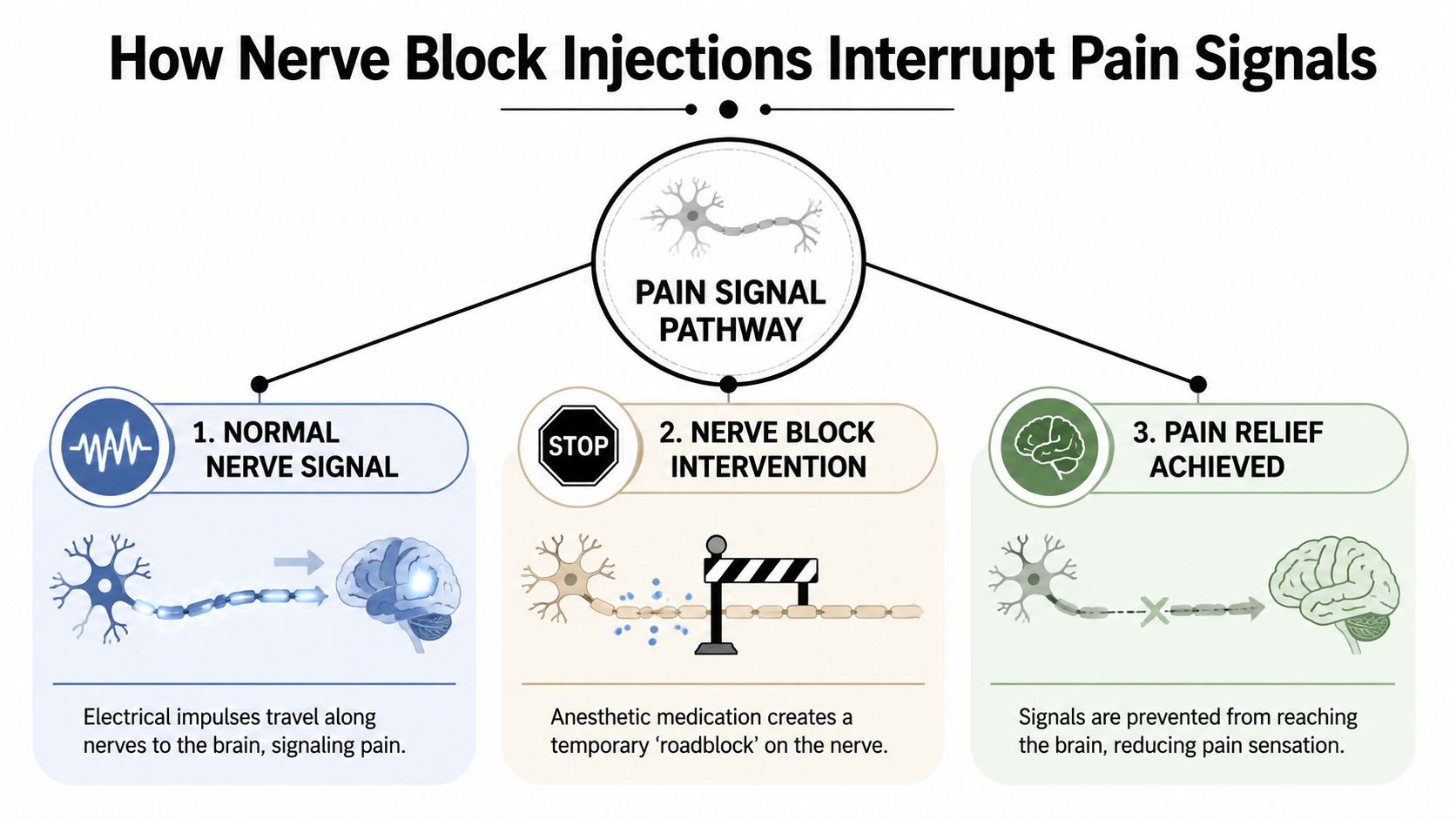
Pain travels along nerves like traffic moving down a highway. When a nerve becomes irritated, compressed, or inflamed, it keeps sending signals upward. Your brain reads those signals as pain, burning, aching, or numbness. A nerve block works by placing medication close to that pathway and temporarily slowing or interrupting the signal.
That's the simplest answer to what is a nerve block injection. It's a directed roadblock for pain signals.
What the anesthetic does
The local anesthetic is the fast-acting part. Its job is to numb the target area around the nerve so the pain signal is interrupted. In image-guided practice, clinicians commonly use ultrasound or fluoroscopy to place the needle accurately near a specific peripheral nerve, nerve root, or joint-related pain pathway, as outlined in UCSF Health's description of nerve blocks.
This is why some patients feel relief quickly. It doesn't mean the underlying condition has vanished. It means the nerve communication has been quieted for a period of time.
What the anti-inflammatory medicine does
If steroid medication is included, it serves a different purpose. It doesn't just numb. It aims to reduce inflammation around the irritated nerve or tissue. That matters when swelling or chemical irritation is helping drive the pain.
A useful way to think about it is this:
| Component | Main job | What patients may notice |
|---|---|---|
| Local anesthetic | Temporarily interrupts pain signaling | Faster numbness or early relief |
| Steroid | Reduces inflammation around the target | Relief that may develop later and last longer |
When a block works well, the short-term quieting of the nerve can also make movement easier. That can help patients tolerate walking, stretching, or rehab work that pain had been blocking.
The goal isn't only to mask pain. It's to calm the irritated pathway enough that the body and the broader treatment plan have a chance to work.
What doesn't work as well
Nerve blocks are less satisfying when the pain pattern is vague, widespread, or driven by several structures at once. They're also not magic. If a patient expects one injection to erase years of spine degeneration, that expectation usually needs adjustment. The best outcomes come when the block is matched to the right pain pattern and used as one piece of a broader plan.
Common Types of Nerve Blocks for Lasting Relief
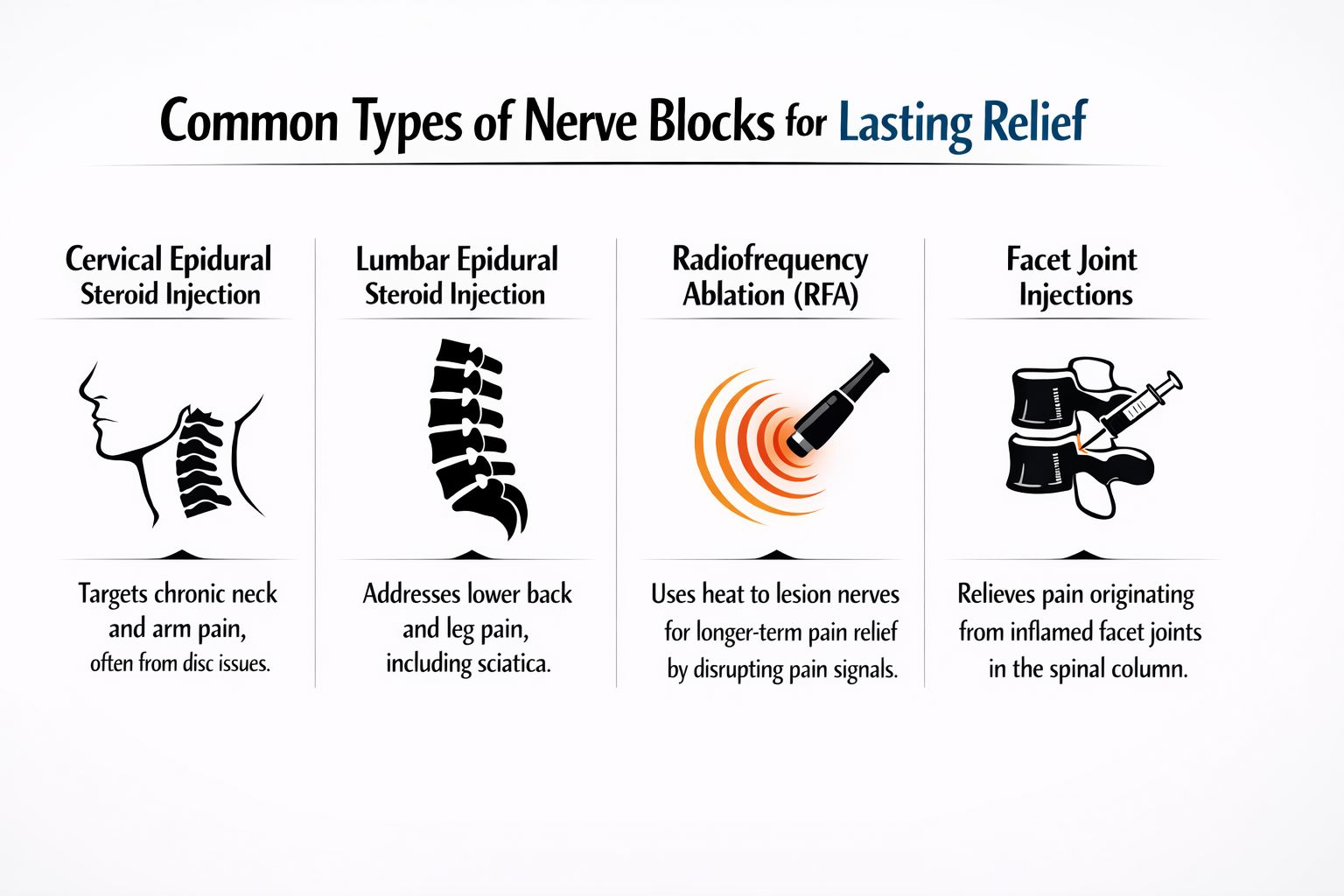
The right block depends on the pain pattern. “Nerve block injection” is an umbrella term for several targeted procedures, and each one is chosen for a different reason. In clinic, I match the injection to the structure most likely causing the pain, because back pain, leg pain, joint pain, and nerve pain do not respond the same way.
Epidural steroid injections
Epidural steroid injections are often used when pain begins in the spine and travels into an arm or leg. Patients may call it sciatica, or describe burning, tingling, shooting pain, or numbness that follows a clear path down a limb. The medication is placed near an irritated spinal nerve root to reduce inflammation and settle that irritated pathway.
If you want a clearer picture of how an epidural injection works, the main point is simple. It is usually better suited for radiating nerve pain than for general low back tightness or muscle soreness.
Facet joint and medial branch blocks
Facet joints are small joints along the spine that can become arthritic, inflamed, or mechanically irritated. That pain is usually more local. Patients often report stiffness, soreness with standing, pain when looking up, or discomfort with twisting and extension.
A medial branch block targets the small nerves that carry pain from those joints. In many cases, this type of block is used to confirm whether the facet joints are the source of the pain. That matters because a positive response may point to a longer-lasting next step, while a poor response helps us avoid repeating the wrong treatment.
Sacroiliac joint injections
The sacroiliac, or SI, joint sits where the spine meets the pelvis. Pain from this area can feel like low back pain, but the pattern is often lower and more one-sided, with aching into the buttock or upper leg. It is commonly mistaken for a lumbar disc or nerve root problem.
Patients from Orland Park, Oak Lawn, and nearby communities often describe one specific spot and put a hand right over it. That history, combined with the exam, helps separate SI joint pain from spine-driven pain. The distinction changes the target and often changes the treatment plan.
Peripheral nerve blocks
Peripheral nerve blocks focus on nerves outside the spine. These are useful when symptoms follow a known nerve distribution in the shoulder, arm, knee, foot, or another focused area.
They can serve more than one role:
- Diagnostic: to confirm whether one specific nerve is responsible for the pain
- Therapeutic: to calm irritation and improve function for a period of time
- Bridge care: to create enough relief for physical therapy, recovery after an injury, or a lower-opioid treatment plan
This is one reason nerve blocks can feel confusing at first. The same category of injection may help identify the pain generator, provide temporary relief, or help someone move toward a longer-lasting option.
A good nerve block starts with pattern recognition. Where the pain travels, what triggers it, and what the exam shows help determine the right target.
The point of naming the type
Patients often ask which nerve block they need. The answer usually comes after the evaluation, not before it. At Midwest Pain & Wellness, the focus is on identifying the likely pain generator and choosing the least invasive option that fits the problem, whether that is a diagnostic block, a therapeutic injection, or a step toward longer-term relief with fewer opioids.
The Purpose of Your Nerve Block Diagnostic vs Therapeutic
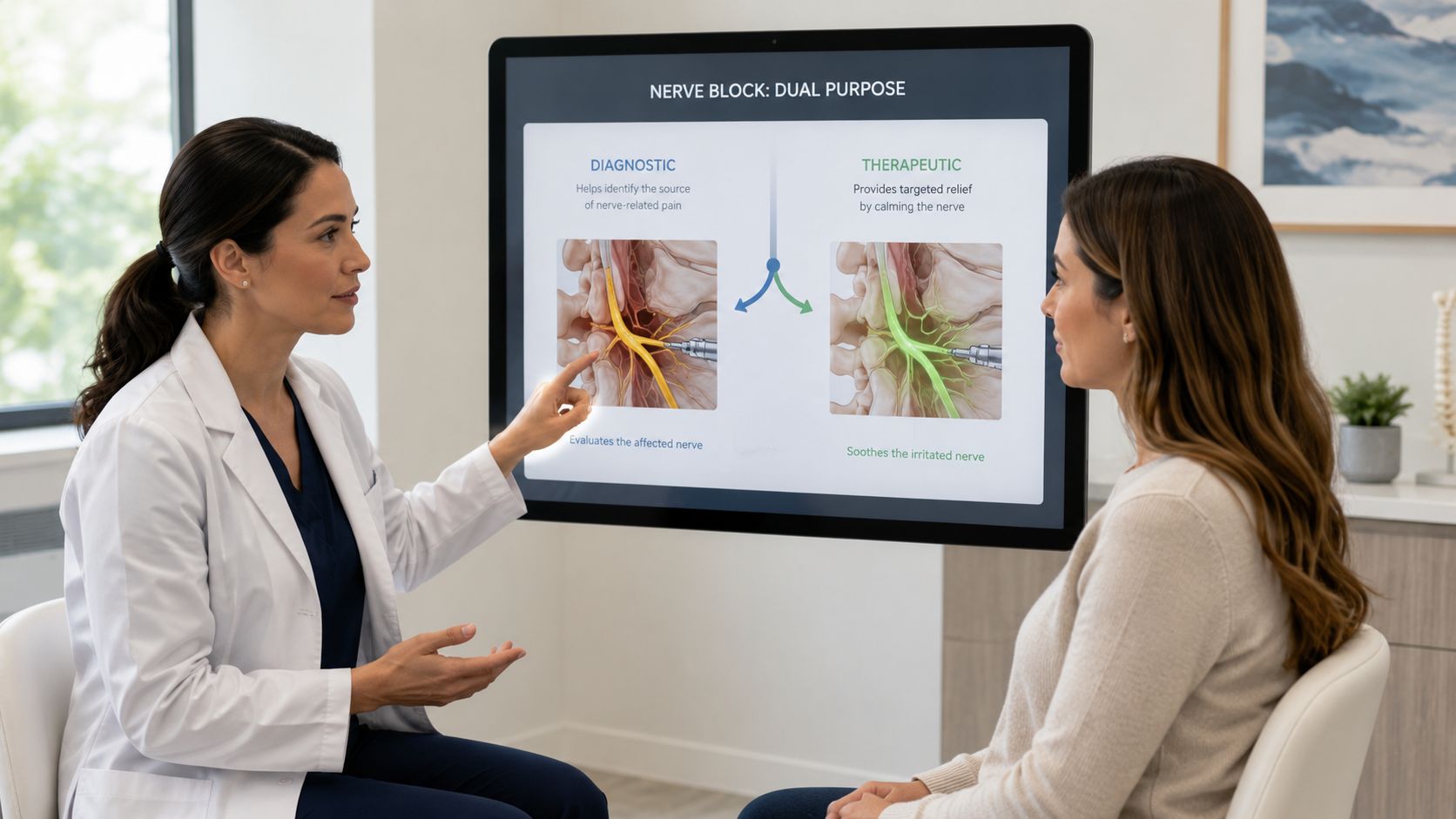
One of the biggest misunderstandings about nerve blocks is assuming they're all meant to do the same thing. They're not. The same injection technique can be used with very different goals, and understanding that changes how you judge the result.
Diagnostic blocks
A diagnostic block answers a location question. If a clinician strongly suspects one nerve, one joint, or one branch of a nerve is causing the pain, a small targeted injection can test that suspicion.
If the pain drops substantially but only temporarily, that result can be extremely useful. As explained in this patient education document on nerve blocks, significant but temporary relief supports the targeted nerve as the pain generator and may justify moving to a longer-acting option such as radiofrequency ablation.
That means a block can be “successful” even if it doesn't last.
Therapeutic blocks
A therapeutic block is intended to reduce pain and calm inflammation. Patients usually focus on this role because it's the most intuitive. The hope is relief that lasts long enough to improve function, sleep, daily activity, and tolerance for rehab.
Still, there's a trade-off. Some patients get only short benefit. Others get a more meaningful window of improvement. That variability doesn't always mean the procedure was wrong. It may reflect the condition being treated, how inflamed the area is, or whether several pain sources are involved.
Prognostic blocks
A prognostic block helps predict whether a longer-lasting procedure is worth considering. This matters most in spine pain care.
For example:
- If a medial branch block helps in the expected pattern, that may suggest the patient could benefit from radiofrequency ablation.
- If a nerve-targeted block changes nothing, it may push the workup toward a different structure.
- If relief is partial, the clinician may need to sort out whether there are multiple pain generators.
Don't judge a nerve block only by how long it lasts. Sometimes its most important value is the information it gives.
What the result means for your plan
Patients in Alsip, Burbank, or Orland Park often want a simple answer after an injection: Did it work or not? The better question is, What did we learn?
That's how treatment plans become smarter. A block that briefly turns the pain off can point the way toward the next step. A block that doesn't help can be just as informative, because it tells us where not to keep chasing.
What to Expect During Your Nerve Block Procedure
A lot of patients from Chicago Ridge, Orland Park, and Oak Lawn arrive with the same concern: "What happens once I get in the room?" The procedure day is usually more straightforward than people expect. In most cases, a nerve block is done as an outpatient visit, and the injection itself is relatively brief. The exact timing depends on the area being treated, whether imaging is needed, and whether the block is being used to answer a diagnostic question or provide short-term treatment.

Before the injection
The visit starts with a focused review. We confirm where your pain is, how it behaves, what medications you take, and whether anything has changed since the procedure was scheduled. That includes allergies, blood thinners, prior reactions to injections, and any recent illness.
Preparation is not identical for every block. Some patients can eat and drink normally. Others need specific instructions based on the body area, the medication being used, or whether light sedation is planned. The goal is accurate treatment with as little disruption as possible.
During the procedure
Once you are positioned, the skin is cleaned and the target area is marked. Many nerve blocks are done with fluoroscopy or ultrasound so the medication is placed where it is intended, not only where it hurts. That matters, especially when the block is being used to confirm whether a specific nerve or joint is causing the pain.
The steps are usually simple:
- Positioning to make the target area easy to reach.
- Skin preparation to lower infection risk.
- Imaging guidance when it improves accuracy and safety.
- Careful needle placement near the nerve or pain pathway being treated.
- Injection of medication once the position is confirmed.
Patients usually feel pressure, a pinch, or a brief reproduction of their usual pain. Some feel warmth or mild tingling. Severe pain during the procedure is not the goal, and the team should know right away if something feels off.
If you are comparing spinal procedures, this overview of a facet joint injection procedure can help explain how one targeted injection differs from another.
After the injection
Most patients stay for a short observation period, then go home with instructions. Those instructions usually cover activity for the rest of the day, when to restart usual routines, and what symptoms deserve a phone call.
A few early changes are common:
- Temporary numbness or heaviness. This can happen when the anesthetic starts working.
- Mild soreness at the injection site. That is common and does not by itself mean the block failed.
- A response that changes over time. Some patients notice immediate numbness, then later improvement or return of pain as the numbing medicine wears off.
This part matters. For a diagnostic block, your pain diary over the next several hours can be as useful as the injection itself. For a therapeutic block, we also watch for whether the relief lasts long enough to improve walking, sleep, exercise, or physical therapy. That is how the procedure fits into the bigger treatment plan, not as a standalone event, but as a step that helps clarify what comes next.
Weighing the Benefits and Potential Risks
A nerve block can do something oral pain medicine often cannot. It can focus on one suspected pain pathway without exposing the rest of the body to the same level of medication effect. That matters for patients who want relief but also want a plan that protects clear thinking, daily function, and long-term options.
In practice, I frame the benefit in three parts. A block may help confirm the source of pain, give short-term relief, and create a window to move into the next step of treatment with better direction. For some patients in Chicago Ridge, Orland Park, and Oak Lawn, that next step is physical therapy with less pain. For others, it helps us decide whether a repeat block, a different target, or a longer-lasting procedure makes sense.
The upside is usually strongest when the pain pattern, exam, and imaging point to a specific structure. In that setting, a nerve block can offer:
- Targeted treatment: The injection is placed near the nerve or pain generator most likely responsible for symptoms.
- Diagnostic value: A meaningful but temporary response can support the working diagnosis and keep us from guessing.
- Functional improvement: Even limited relief can help with walking, sleep, exercise, and rehabilitation.
- An opioid-sparing option: Some patients are able to rely less on systemic pain medicine while we work through a more precise treatment plan.
There are limits, and patients deserve to hear them clearly. Relief may last hours, days, weeks, or sometimes not happen at all. A short response does not always mean failure. It may still tell us we found the right pain source, which is useful if the larger goal is a longer-lasting option. A poor response can also be helpful because it pushes the evaluation in a different direction before months are lost on the wrong treatment.
Risks are usually low, but they are real. The more common issues are temporary numbness, heaviness, soreness at the injection site, or brief weakness depending on the nerve being treated. Bleeding, infection, allergic reaction, and nerve irritation are discussed before the procedure because they are recognized procedural risks, even though they are uncommon. Rarely, a patient can have a more significant nerve injury or medication-related complication.
Here is the practical way to look at it:
| Potential issue | What it means in practice |
|---|---|
| Temporary numbness, tingling, or heaviness | Often expected for a short time after the anesthetic reaches the target nerve |
| Injection-site soreness | Usually mild and short-lived |
| Bleeding or infection | Uncommon, but part of standard consent for any injection procedure |
| Nerve irritation or injury | Rare, but important to discuss before treatment |
| Short-lived or incomplete relief | A limitation of the procedure, and sometimes still useful diagnostic information |
The decision is not whether risk exists. It is whether a focused procedural risk, used selectively and at the right time, makes sense compared with ongoing uncontrolled pain, reduced activity, poor sleep, or escalating use of systemic medication.
That balance is different for every patient. A healthy younger adult with a very specific pain pattern may accept one set of trade-offs. An older adult on blood thinners, or someone with diabetes, infection risk, or several overlapping pain generators, may need a more careful plan or a different approach. Good pain care is not about chasing injections. It is about choosing the right tool for the right job, with a clear reason for doing it.
Your Questions Answered and Next Steps for Care
Patients usually end with practical questions, and they're good ones.
Will it hurt? You may feel pressure, a pinch, or brief discomfort, but the procedure is usually well-tolerated. Anxiety is often worse than the injection itself.
What if the first block helps only briefly? That can still be useful. A short-lived response may confirm the pain source and help guide whether a different type of block, a repeat strategy, or a longer-acting option makes sense.
What if it doesn't help? Then the conversation shifts. A nonresponse can tell your clinician that the suspected nerve or joint may not be the main problem. That's not wasted effort. It's information that prevents months of guessing.
If you live in Chicago Ridge, Oak Lawn, Palos Hills, Palos Heights, Worth, Bridgeview, Hickory Hills, Alsip, Burbank, Evergreen Park, or Orland Park, the next step is a proper evaluation. The goal isn't to chase injections. It's to match the right treatment to the right diagnosis and help you move forward with a plan that makes sense for your pain, your function, and your daily life.
If you're ready to talk through your symptoms with a pain specialist, schedule a consultation with Midwest Pain & Wellness. Dr. Yaw Donkoh and the team provide interventional, opioid-sparing pain care in Chicago Ridge for patients across the surrounding Illinois communities who want a clearer diagnosis and a practical path toward relief.