A rear-end crash often feels manageable in the moment. You exchange information, drive home, and tell yourself you're sore but probably fine. Then the next morning your neck tightens, turning your head hurts, and a headache starts climbing from the base of your skull.
That pattern is common with whiplash. The injury can declare itself hours later, after adrenaline fades and inflamed soft tissue starts to stiffen. For many people in Chicago Ridge and nearby Illinois communities, the first questions are simple and urgent: What happened to my neck, what should I do today, and when is this no longer something to “wait out”?
The Shock of Impact Your First Questions About Whiplash
A typical whiplash story starts the same way. Someone in Oak Lawn, Palos Hills, or Orland Park gets hit from behind at a stoplight. The car damage may look minor. Their neck doesn't seem terrible right away. By evening, they feel soreness across the shoulders, tightness when checking blind spots, and a strange sense that the pain is spreading.
That delayed reaction doesn't mean the injury is minor or imagined. It means the neck went through a sudden acceleration and deceleration event, and the irritated joints, muscles, ligaments, and nerves are starting to react. Whiplash isn't just “a stiff neck.” It can affect sleep, work, concentration, driving, and confidence in moving normally again.
Many patients also wonder why they feel worse the day after the crash than they did at the scene. The short answer is that soft tissue injury often evolves before it settles. Inflammation rises. Protective muscle spasm sets in. Normal motion starts to feel threatening, so people move less, and that stiffness can build quickly.
If you're trying to understand the early pattern of neck pain after a car accident, that resource gives a useful patient-friendly overview of why symptoms can lag behind the collision itself.
Practical rule: If neck pain, headache, arm symptoms, dizziness, or restricted motion show up after a collision, take them seriously early. Waiting too long often makes recovery more complicated.
People in Palos Heights, Worth, and surrounding Illinois suburbs often ask one more important question: should they rest completely, or should they keep moving? The answer depends on severity, neurological symptoms, and whether a more serious injury needs to be ruled out. But for most uncomplicated cases, the right path is neither total bed rest nor pushing through pain. It's structured, cautious activity with the right medical guidance.
Understanding Whiplash Causes Symptoms and Diagnosis
Whiplash is a whiplash-associated disorder, often shortened to WAD. The mechanism is simple to describe and frustrating to live through. The head and neck are thrown backward and forward quickly, like the cracking motion of a whip. That force can strain muscles, irritate facet joints, stress discs and ligaments, and in some patients trigger nerve-related pain.
What whiplash can feel like
The symptom list is broader than generally expected. Neck pain is common, but it's rarely the whole picture.
- Neck stiffness and reduced motion that makes turning, looking down, or sleeping difficult
- Headaches, especially pain that starts near the base of the skull
- Upper back, shoulder, or arm pain after the collision
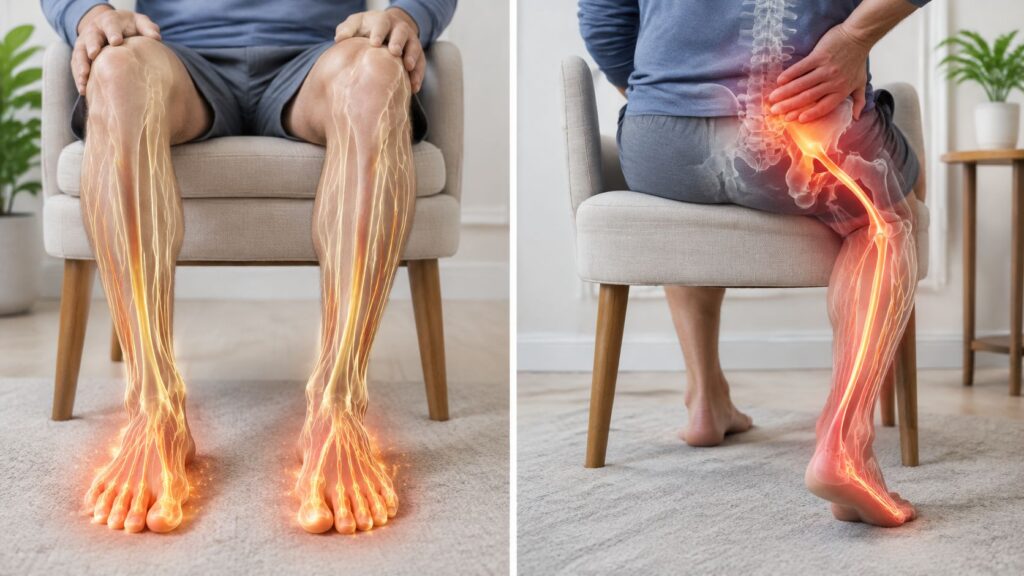
- Tingling, numbness, or radiating discomfort that may suggest nerve irritation
- Dizziness or balance disturbance
- Jaw discomfort or facial tension
- Fatigue and poor sleep
- Trouble concentrating, often described as brain fog
- Pain with driving, desk work, or lifting even when those activities seemed easy before
Some patients also worry about whether they may have had both a neck injury and a head injury. If that's a concern, this explanation of understanding whiplash and concussion helps clarify how the two can overlap and how they differ.
A nerve-related component can change treatment priorities. If burning, shooting, or electrical pain starts to dominate the picture, it helps to understand how specialists think about relieving nerve pain in the neck and upper extremities.
How a pain specialist evaluates it
A thorough evaluation starts with the crash itself. Direction of impact matters. So does whether symptoms began immediately or later, what movements aggravate pain, and whether there are red flags such as arm weakness, significant numbness, gait problems, or bowel and bladder changes.
The physical exam usually focuses on several things at once:
- Range of motion to see which directions reproduce pain
- Tender areas over muscles, joints, and supporting tissues
- Neurological findings such as reflexes, strength, and sensory changes
- Provocative patterns that suggest facet joint pain, disc irritation, or nerve involvement
- Posture and guarding, because many patients unconsciously brace the neck after trauma
When imaging matters
Not every whiplash injury needs advanced imaging on day one. Imaging is most useful when the history or exam raises concern for fracture, instability, disc herniation with nerve compression, or another structural problem that changes immediate management.
A practical way to think about it is this:
| Situation | What a clinician is trying to rule out |
|---|---|
| Severe pain after trauma | Fracture, instability, or major structural injury |
| Arm weakness or significant numbness | Nerve root compression or more serious neurological involvement |
| Persistent pain that doesn't follow a typical recovery pattern | Disc, facet, ligament, or other pain generator that needs targeted treatment |
A good whiplash evaluation doesn't stop at “your X-ray is normal.” Many painful whiplash injuries are driven by structures that require careful clinical correlation, not just a quick scan review.
Patients from Bridgeview and Hickory Hills often arrive after being advised to wait. Sometimes that's reasonable for a mild case. Sometimes it delays appropriate care. The key is not to overreact, but also not to miss the point where standard soreness becomes a more defined pain problem.
First Steps to Recovery Immediate Care and Conservative Treatments
A common early whiplash scenario is straightforward on paper but harder in real life. A patient leaves the crash with a normal initial workup, wakes up the next morning with marked neck stiffness, and wonders whether to rest completely, wear a collar, or try to push through. The right first steps can reduce guarding and help recovery stay on track. The wrong ones can reinforce pain and delay return to normal function.
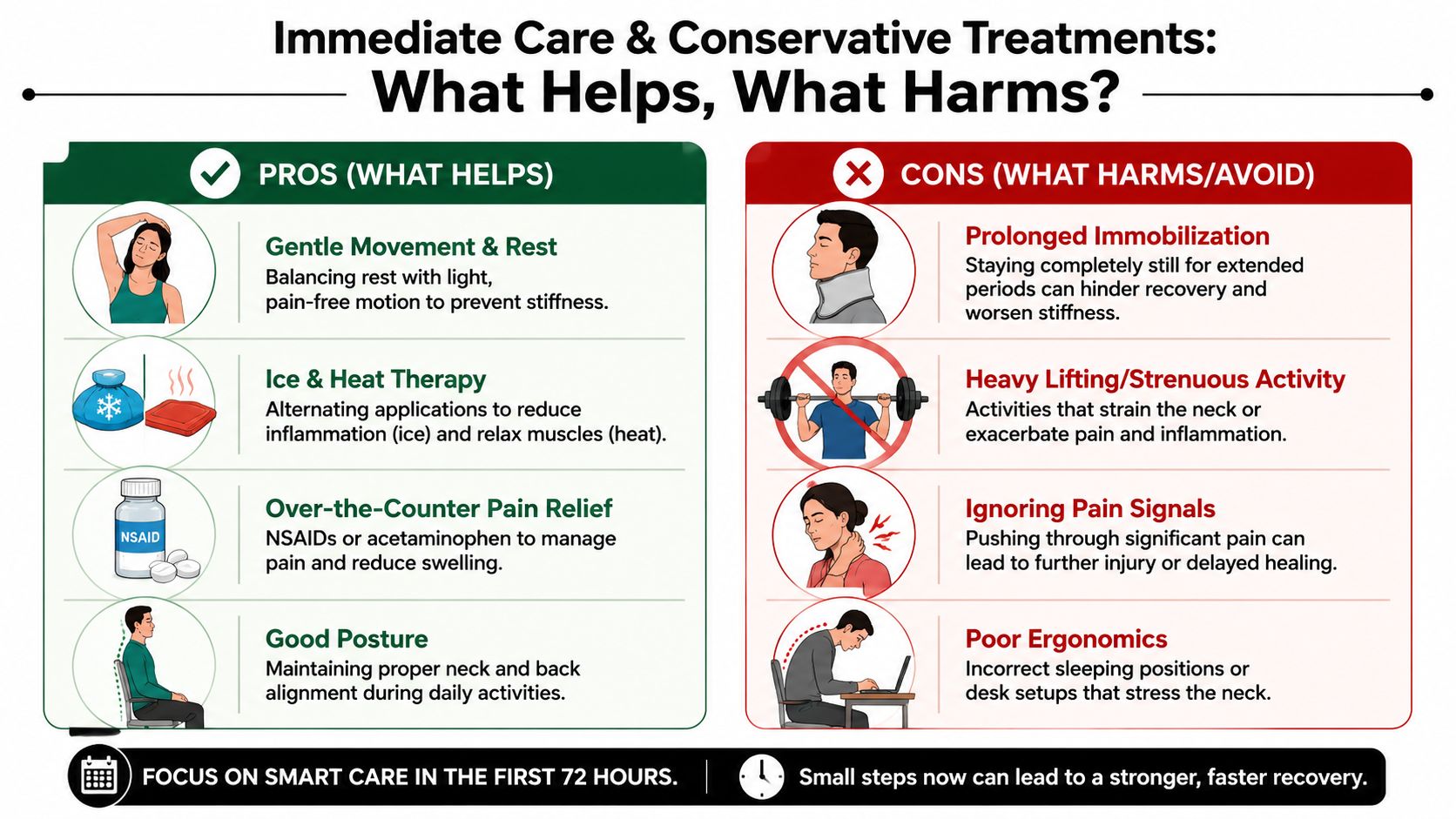
For acute whiplash-associated disorders, early return to usual activity within tolerance and guided neck movement generally lead to better recovery than prolonged immobilization. A review in the Mayo Clinic Proceedings61368-8/fulltext) notes that soft collars are not recommended for routine ongoing use because they can promote inactivity and stiffness.
What to do in the first few days
Early care should lower pain enough to keep the neck from becoming progressively more guarded. Patients usually do best with a measured approach that protects the injured area without shutting everything down.
- Use gentle, tolerable neck motion. Short bouts of controlled movement often prevent the rapid loss of motion that follows complete inactivity.
- Use ice or heat based on the symptom pattern. Ice is often more helpful early when soreness feels inflamed. Heat is often more helpful once muscle tightness and spasm become the main problem.
- Use over-the-counter pain relief carefully, if medically appropriate. The goal is function. Better sleep, easier daily movement, and enough symptom control to participate in recovery.
- Limit aggravating positions and loads. Long drives, overhead work, heavy lifting, and long hours looking down at a phone can all keep symptoms active.
- Get urgent care if red flags appear. Progressive arm weakness, worsening numbness, loss of balance, severe headache, or escalating pain after trauma deserve prompt reassessment.
A collar may still have a short-term role in selected cases, but it should not become the treatment plan.
The role of conservative care
Conservative treatment is the first active phase of care. It works best when each part has a purpose and when progress is reassessed instead of assumed.
| Conservative option | What it's meant to do | Common limitation |
|---|---|---|
| Targeted rehabilitation | Restore motion, reduce protective muscle guarding, and improve function | Some patients hit a plateau because pain remains too reactive |
| Manual therapy in selected cases | Improve mobility and reduce muscle and joint restriction | Relief may fade if the main pain source is still active |
| Short-term medication use | Reduce pain enough to support sleep and activity | Ongoing use rarely solves the underlying problem |
| Home exercise and posture work | Maintain gains between visits and reduce deconditioning | Progress depends on symptom tolerance and consistency |
The key decision point is response over time. If pain and function improve steadily over the first few weeks, conservative care is doing its job. If the patient cannot turn the head, sleep normally, drive comfortably, or progress in therapy despite good effort, the plan needs to be reconsidered.
That is often when I advise patients to stop asking whether they should "give it more time" and start asking why recovery has stalled. Some persistent cases involve ongoing facet-mediated pain, disc-related pain, or myofascial irritation that needs more specific evaluation. In selected patients, regenerative options may also become part of that discussion, including PRP treatment for neck pain when the clinical picture supports it.
Patients in Oak Lawn, Alsip, and Burbank often come in after doing many of the right things but not getting the expected result. That does not mean they failed treatment. It usually means the next decision matters more than repeating the same low-yield plan.
When Pain Persists Advanced Whiplash Injury Treatment Options
Persistent whiplash pain is where generic advice starts to fail. If symptoms remain despite appropriate rehabilitation and simple analgesics, the question changes from “How do I rest this?” to “What structure is still driving the pain?”
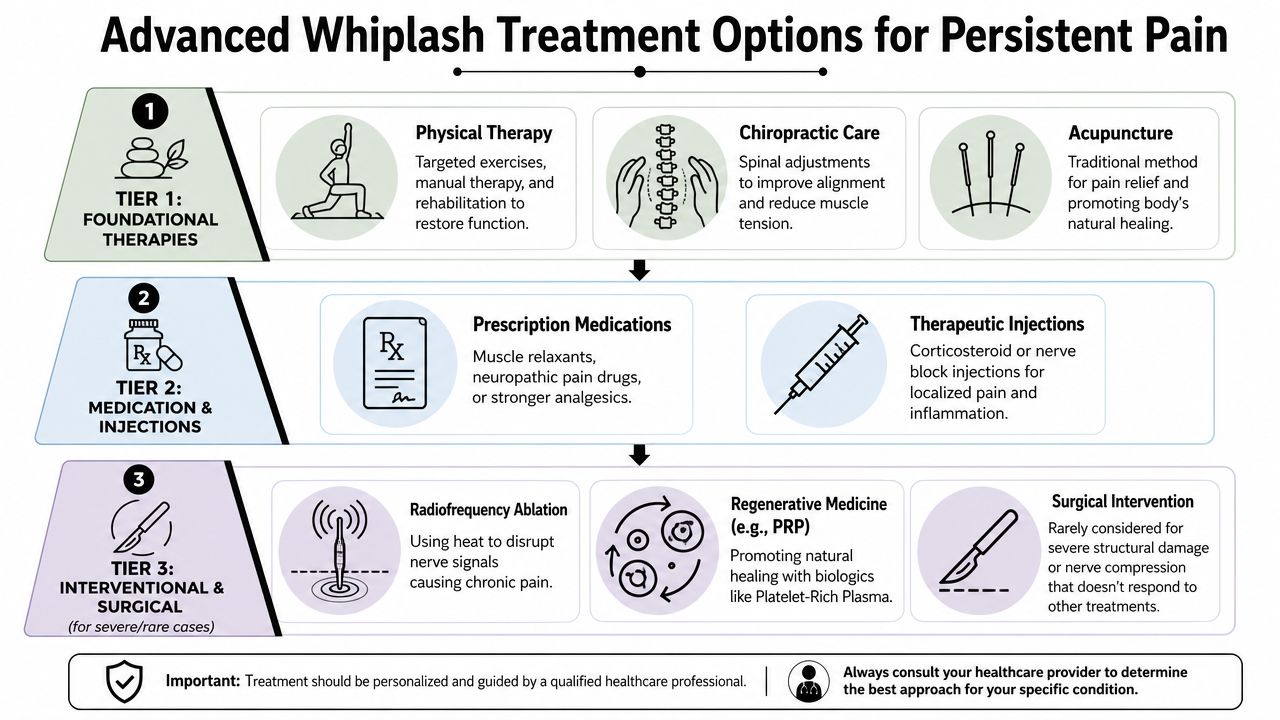
For chronic whiplash-associated disorders that haven't responded to physical therapy and analgesics, cervical radiofrequency neurotomy has become a benchmark intervention, with a 70% patient improvement rate based on measures such as Neck Disability Index and cervical range of motion, according to the clinical guidance summarized in the Journal of Orthopaedic & Sports Physical Therapy.
That matters because long-term medication use has limits. The same source notes that in chronic cervical strain, ongoing NSAID use raises concern because of gastrointestinal and renal complications and lacks evidence of long-term benefit.
Diagnostic procedures before treatment procedures
One of the biggest misconceptions in pain management is that injections are all the same. They're not. Some are primarily diagnostic. Some are therapeutic. The sequence matters.
For example, if the history and exam suggest facet-mediated neck pain, a specialist may consider medial branch blocks. These are targeted, image-guided injections used to test whether the small nerves serving the painful facet joints are responsible for the symptoms. If they are, then radiofrequency treatment becomes a rational next step rather than a guess.
A persistent radicular pattern may point in another direction. If pain radiates into the arm with features more consistent with disc-related inflammation or nerve root irritation, a cervical epidural steroid injection may be more appropriate than a facet-based procedure.
What advanced options are designed to do
Different procedures solve different problems.
- Medial branch blocks help confirm whether the cervical facet joints are the pain source.
- Cervical radiofrequency neurotomy or ablation interrupts pain signaling from the targeted medial branch nerves when facet pain has been established.
- Epidural steroid injections aim to calm inflammation around irritated nerve roots.
- Trigger point or targeted soft tissue injections may help selected patients whose pain is dominated by persistent muscle spasm.
- Regenerative approaches such as PRP may be considered in carefully selected cases where tissue healing support is part of the strategy. Patients interested in that option can learn more about PRP for neck pain.
A practical decision framework looks like this:
| Symptom pattern | What a specialist may suspect | Likely next step |
|---|---|---|
| Localized neck pain with painful extension and rotation | Facet joint pain | Diagnostic medial branch blocks |
| Arm pain, tingling, or nerve irritation pattern | Disc or nerve root involvement | Imaging review and possible epidural injection |
| Rehab limited by focal muscle spasm | Secondary myofascial pain | Targeted muscle-focused treatment |
| Persistent pain with functional decline despite standard care | Chronic pain generator not fully addressed | Interventional evaluation |
Persistent pain after whiplash shouldn't automatically lead to stronger medication. It should lead to better diagnosis.
Who should think about escalation
Escalating care doesn't mean conservative treatment failed in a simplistic sense. It means the case needs another layer of precision. Referral to an interventional pain specialist is reasonable when:
- Pain remains function-limiting despite appropriate early treatment
- Sleep, work, or driving stay significantly impaired
- Progress has plateaued even though the patient is participating in care
- Symptoms suggest a defined procedural target, such as facet pain or nerve root inflammation
- Medication use is drifting longer than it should
The strongest argument for advanced whiplash injury treatment is not “more treatment.” It's better-matched treatment. When the procedure fits the pain generator, patients often regain the ability to participate in exercise, return to work, and move without relying on escalating medication.
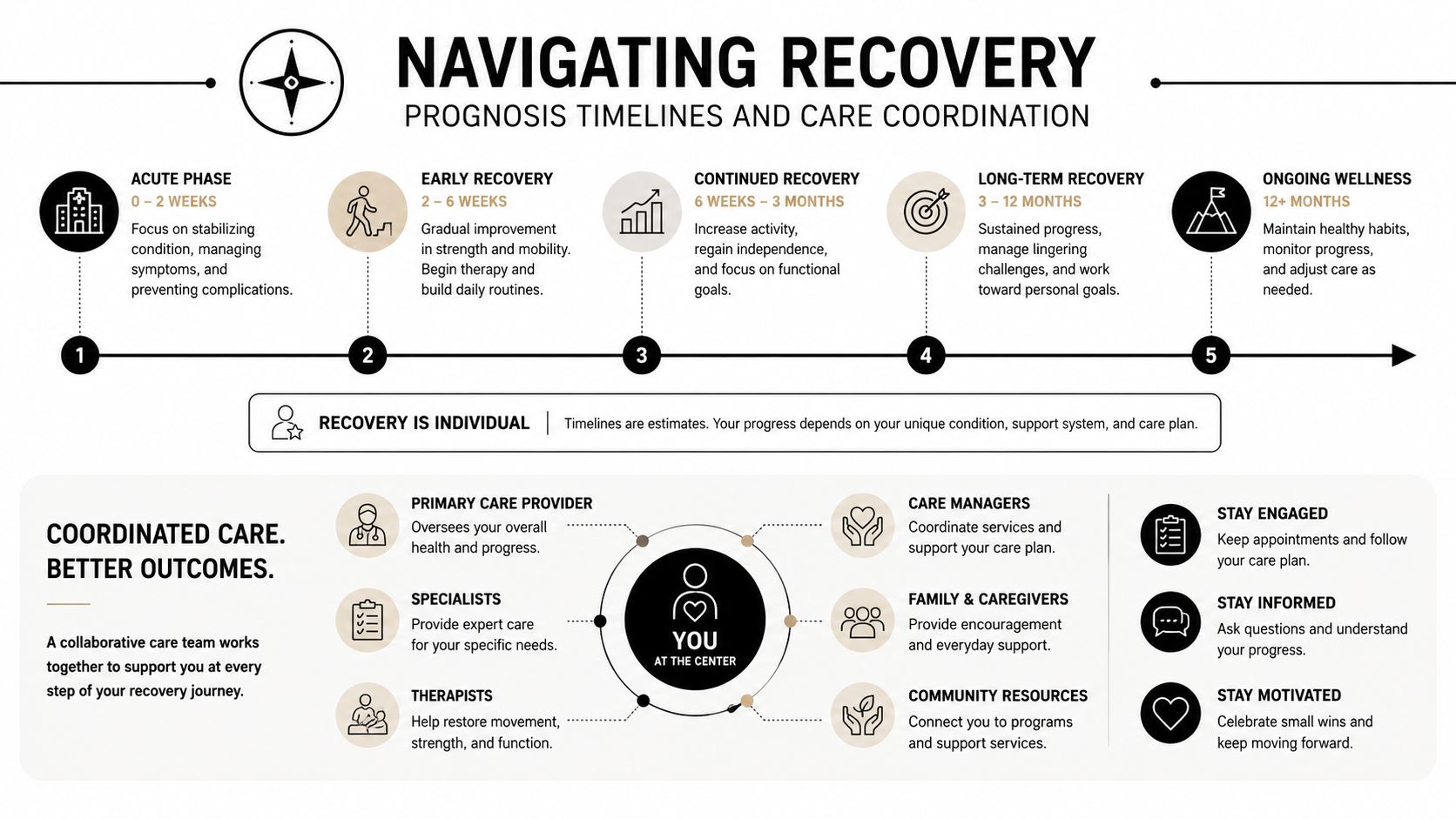
Navigating Recovery Prognosis Timelines and Care Coordination
A patient is rear-ended on Monday, told at urgent care that it should settle down soon, and by week six still cannot turn fully to check a blind spot, sleep through the night, or sit at a desk without pain climbing by afternoon. That is the point when prognosis stops being a simple question about time and becomes a question about whether the recovery plan still fits the injury.
Whiplash recovery is uneven. Some patients improve steadily with early movement, reassurance, and a well-structured home program. Others make partial gains, then plateau. A smaller group develops symptoms that persist far beyond the expected window, and those cases need closer follow-up, clearer documentation, and a physician willing to reassess the diagnosis instead of repeating the same advice.
Whiplash often improves. Chronic cases are still common enough that they deserve early attention once the pattern changes.
Why some patients don't follow the expected timeline
Persistent pain after whiplash usually has more than one driver. I commonly see a mix of cervical facet irritation, disc pain, muscle guarding, poor sleep, fear of movement, and delayed access to the right level of care. If those factors are not separated and treated on purpose, patients can spend months in treatment without making meaningful functional gains.
At that stage, more time alone is not a plan. Healing tissue benefits from time. A pain source that has not been identified does not.
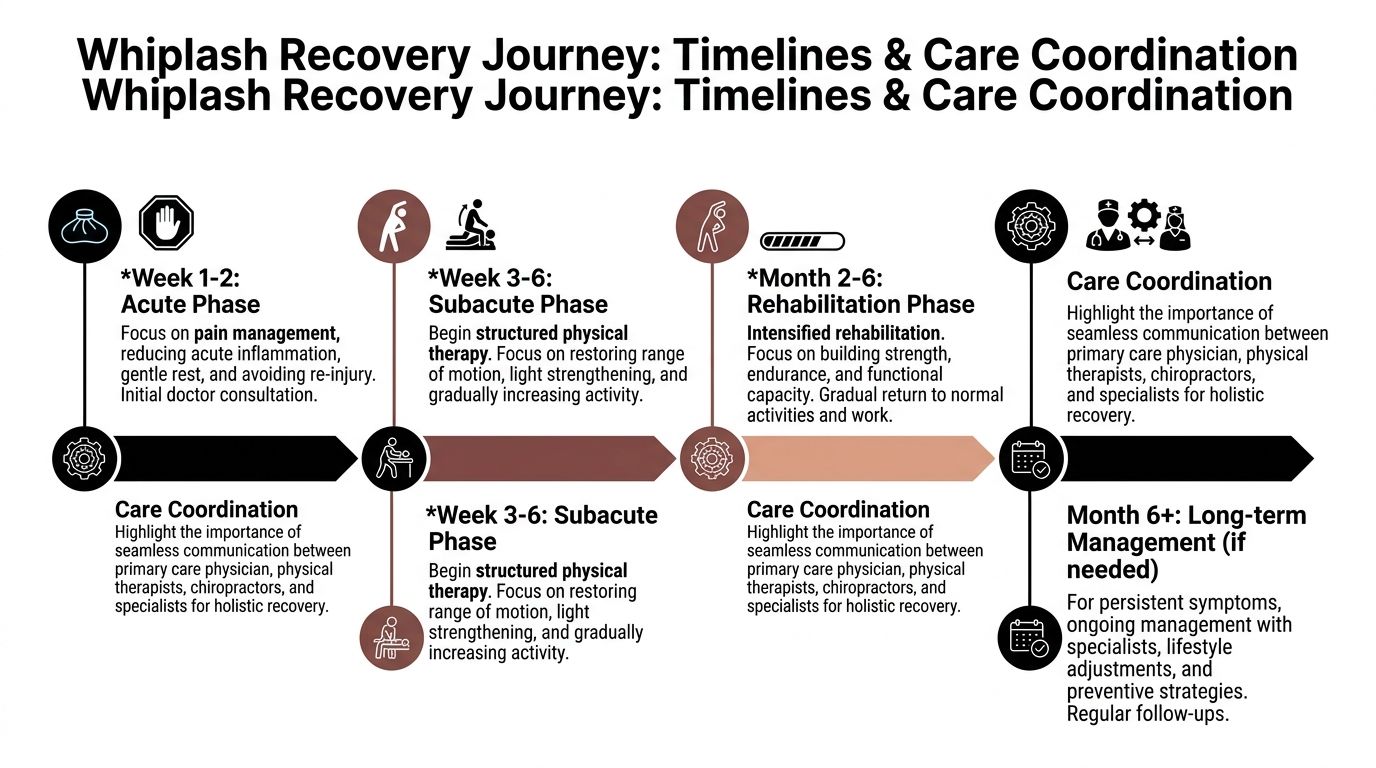
The recovery course usually shifts through several practical checkpoints:
- Early phase. Control pain enough to keep the neck moving safely and avoid unnecessary immobilization.
- Rehab phase. Build range of motion, driving tolerance, work tolerance, and confidence with daily activity.
- Reassessment phase. If progress stalls, recheck the diagnosis and look for a defined pain generator.
- Longer-term management phase. Coordinate treatment around function, not just symptom flares, when pain becomes persistent.
The key decision point is not whether symptoms still exist. It is whether the patient is still improving. Mild residual soreness with steady gains is different from pain that keeps blocking work, sleep, exercise, or driving. That distinction often determines whether standard care should continue or whether specialist evaluation is warranted.
Coordinating care when claims and paperwork are involved
Whiplash care often becomes harder because the medical issues are only part of the problem. Patients may also be dealing with auto insurance paperwork, workers' compensation rules, job restrictions, referral delays, and requests for records while trying to attend therapy and recover.
Poor coordination slows treatment. It can also create conflicting recommendations that confuse the patient and interrupt progress.
In practice, good coordination usually includes:
| Part of the process | Why it matters |
|---|---|
| Clear clinical documentation | Tracks symptoms, physical findings, function, and treatment response over time |
| Communication across providers | Keeps therapy, imaging, primary care, and specialty treatment aligned |
| Work status guidance | Matches restrictions to actual function and updates them as recovery changes |
| Timely referral decisions | Prevents long delays when the patient is no longer progressing with basic care |
Patients trying to sort out who should take over care often benefit from guidance on how to find a specialist doctor after an accident, especially when early visits have produced fragmented advice instead of a clear plan.
Patients in Alsip, Evergreen Park, and Bridgeview often tell us the same thing. One clinician says rest. Another says push through therapy. The insurer asks for forms, while the patient is still trying to figure out why turning the head or sitting at work causes a flare. A single physician overseeing the full picture can reduce those mixed messages and keep treatment tied to function, exam findings, and response over time.
A realistic view of prognosis
Patients usually want a firm timeline. After a crash, that is understandable.
An honest answer is more useful than an optimistic one. Many cases improve over weeks to a few months, but some do not follow that path. Prognosis depends less on the label "whiplash" and more on what symptoms persist, whether function is returning, and whether the treatment plan is being adjusted when progress stops.
I tell patients to watch for trajectory. If pain is gradually easing and activity is expanding, the course is usually acceptable even if recovery is incomplete. If the same limitations are still present week after week, or the patient is relying on repeated urgent care visits, extended medication use, and vague reassurance, the plan needs to change.
For chronic cases, the goal becomes more specific. Reduce the pain generator where possible, restore tolerable movement, protect sleep and work capacity, and prevent short-term injury management from turning into long-term disability. That is where careful follow-up and coordinated specialty care make the biggest difference.
Your Path to Lasting Relief Partnering With a Pain Specialist
The best whiplash injury treatment follows a stepped-care model. Start with a careful evaluation. Use sensible early management. Build function with conservative care when that fits the case. Escalate when the pattern of pain says the patient needs more than time, home measures, and medication.
That escalation point is where a pain specialist adds real value. Not by replacing every other provider, and not by rushing into procedures, but by identifying what hasn't healed normally and why. In chronic whiplash, durable progress often comes from matching treatment to the pain source and using opioid-sparing options that help patients move again.
A useful historical lesson comes from a landmark 1992 study on Pulsed ElectroMagnetic Therapy, which showed meaningful short-term benefit for acute whiplash but diminishing effect by 12 weeks, supporting the idea that early relief often needs broader follow-through to produce lasting recovery, as described in this review of noninvasive treatment evidence for whiplash.
That principle still holds. Short-term symptom reduction is helpful. It just isn't the same as complete recovery.
When specialist care becomes the right next step
A referral becomes reasonable when the case stops behaving like uncomplicated soreness. Common signs include:
- Pain that keeps interfering with sleep, work, or driving
- Repeated flares despite reasonable conservative care
- Radiating symptoms, numbness, or a more complex pain pattern
- Reliance on medication without meaningful functional improvement
- A plateau that leaves the patient stuck rather than steadily recovering
For people in Oak Lawn, Palos Heights, Worth, Hickory Hills, Burbank, and Orland Park, specialist care should feel like a clarifying step, not a last resort born of frustration.
The right specialist doesn't just ask where it hurts. They ask what structure is causing it, what has already been tried, and what treatment can restore function without creating a new dependency.
If you've been trying to decide whether your neck pain still belongs in the “give it time” category, it may help to review how to find a specialist doctor when standard care no longer answers the problem.
The goal is simple. Reduce pain. Restore movement. Protect quality of life. Do it with precision, not guesswork.
If you're dealing with ongoing whiplash symptoms in Chicago Ridge, Oak Lawn, Palos Hills, Palos Heights, Worth, Bridgeview, Hickory Hills, Alsip, Burbank, Evergreen Park, or Orland Park, Midwest Pain & Wellness offers thorough evaluation and opioid-sparing treatment for neck, spine, and nerve pain after injury. When conservative care hasn't been enough, a focused assessment can help determine whether targeted injections, radiofrequency treatment, regenerative options, or coordinated multimodal care are the right next step.