92.6% of adults with cervical stenosis in a large retrospective cohort were successfully managed without surgery, and only 7.4% ultimately moved on to anterior cervical discectomy and fusion after conservative care failed (PM&R KnowledgeNow on cervical stenosis). That's the part many patients never hear first. The key question usually isn't whether surgery exists, it's when non-surgical care is enough, when injections can help, and when it's time to push for a surgical opinion.
Most Cervical Stenosis Patients Never Need Surgery
The first thing I tell patients is simple, cervical stenosis treatment usually starts conservatively. That isn't a delay tactic, it's the standard pathway for mild-to-moderate disease when there's no clear spinal cord injury, severe compression, or rapidly worsening neurologic change. The evidence behind that approach is reassuring, because many patients improve enough to stay out of the operating room initially (PM&R KnowledgeNow on cervical stenosis).
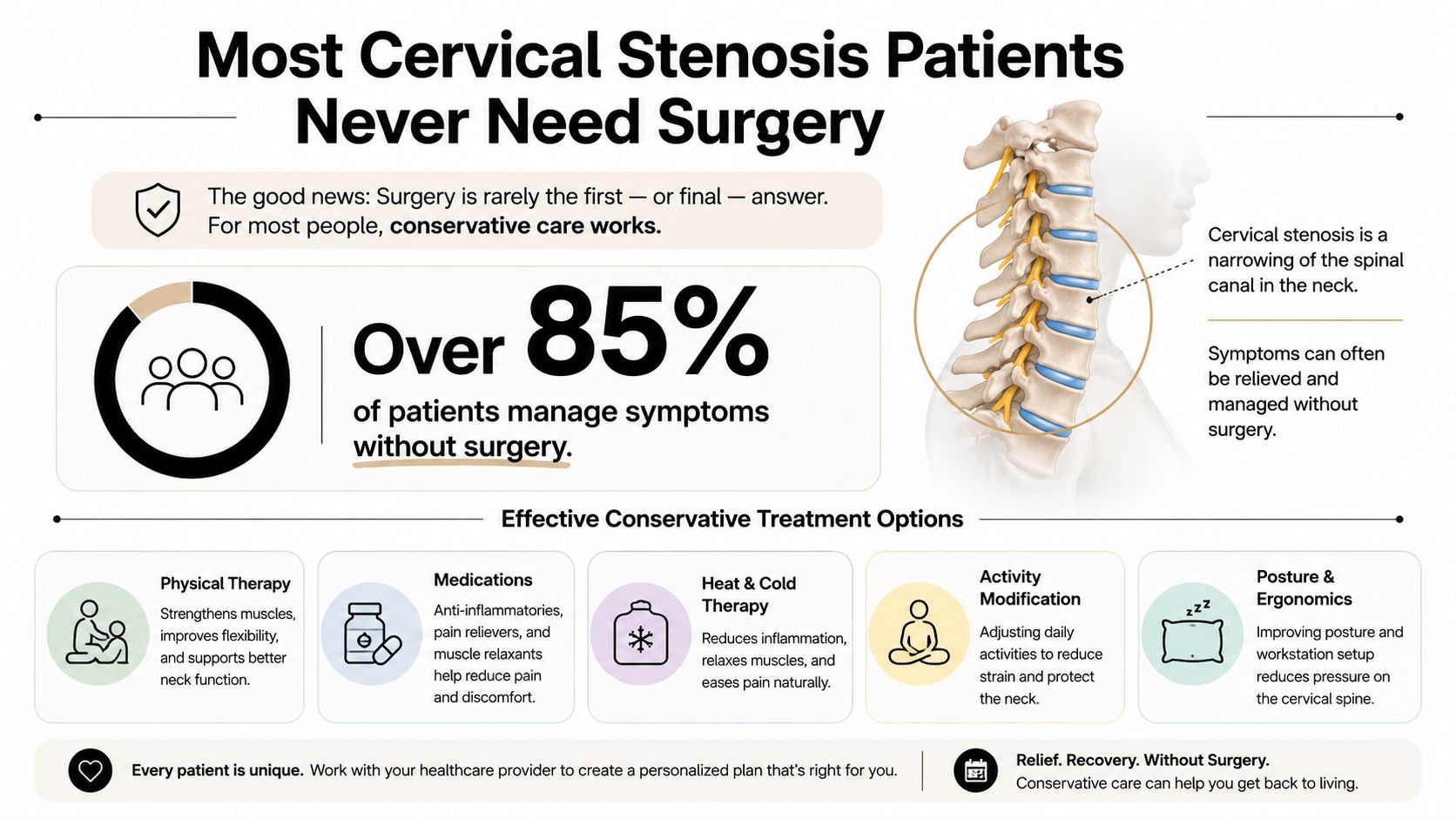
A practical way to think about treatment is a ladder. The lowest rungs are activity changes, medication, structured exercise, and image-guided pain procedures. Surgery sits higher up the ladder and belongs there when the neck is threatening function, not just hurting.
For people in Oak Lawn, Palos Hills, Palos Heights, Worth, Bridgeview, Hickory Hills, Alsip, Burbank, Evergreen Park, and Orland Park, that stepwise approach is available close to Chicago Ridge through a pain and wellness clinic, not just a hospital hallway. A useful patient resource on non-surgical options is spinal stenosis treatment without surgery.
Practical rule: if symptoms are manageable and neurologic function is stable, conservative care deserves a real trial before anyone rushes to the operating room.
That trial should be structured. Early cervical stenosis with mild-to-moderate cord compression is often followed with physical therapy and serial neurologic exams every 6 months so subtle myelopathy doesn't get missed (PM&R KnowledgeNow on cervical stenosis). In clinic, that means tracking pain, strength, hand function, gait, and balance over time instead of chasing each flare as if it were the whole story.
Understanding Cervical Stenosis and Your Symptoms
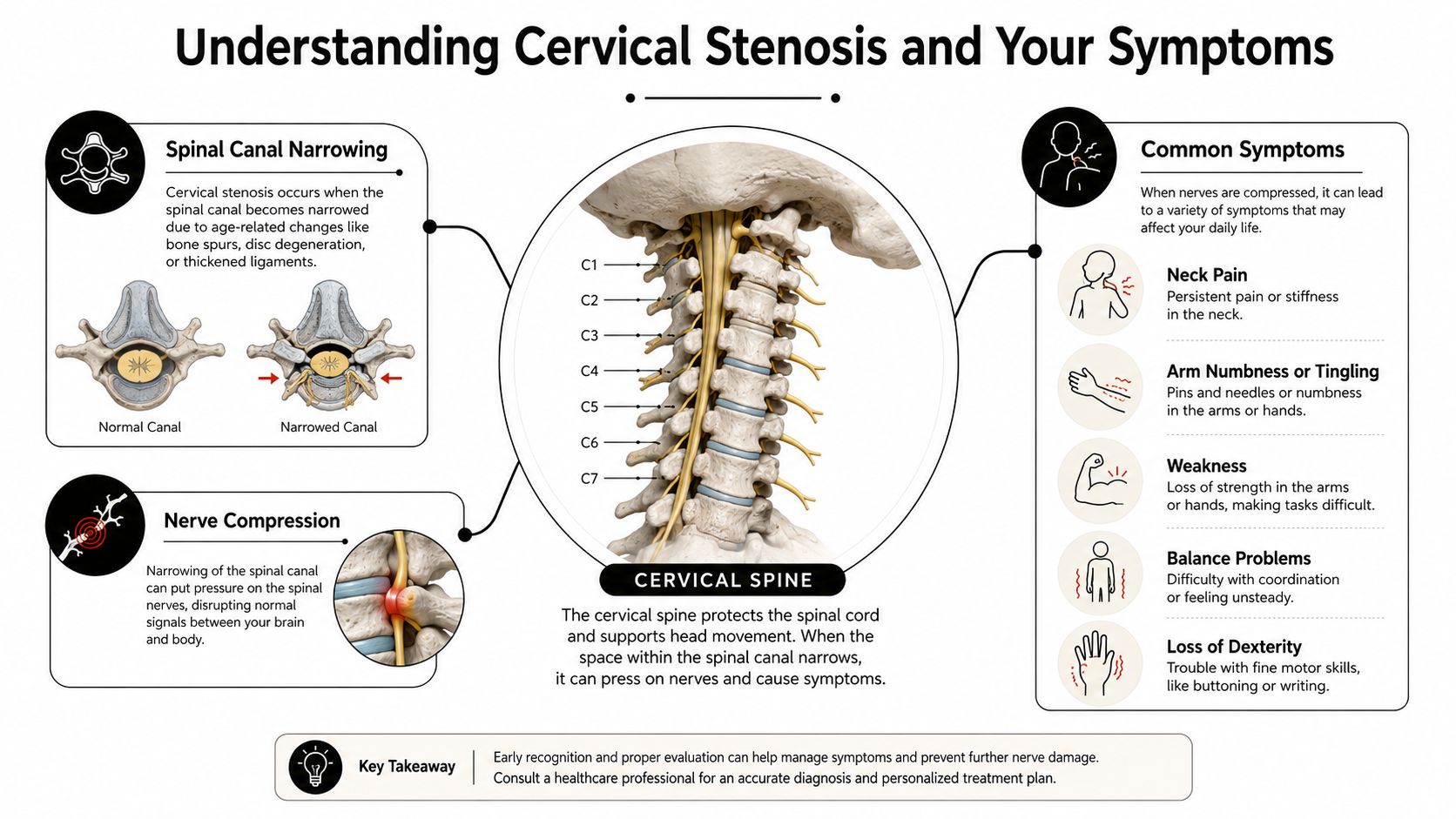
Cervical stenosis happens when the spinal canal in the neck narrows and crowds the structures inside it. The result can be pressure on a nerve root, which leads to radiculopathy, or on the spinal cord, which raises concern for myelopathy (Merck Manual on cervical spinal stenosis).
Radiculopathy versus myelopathy
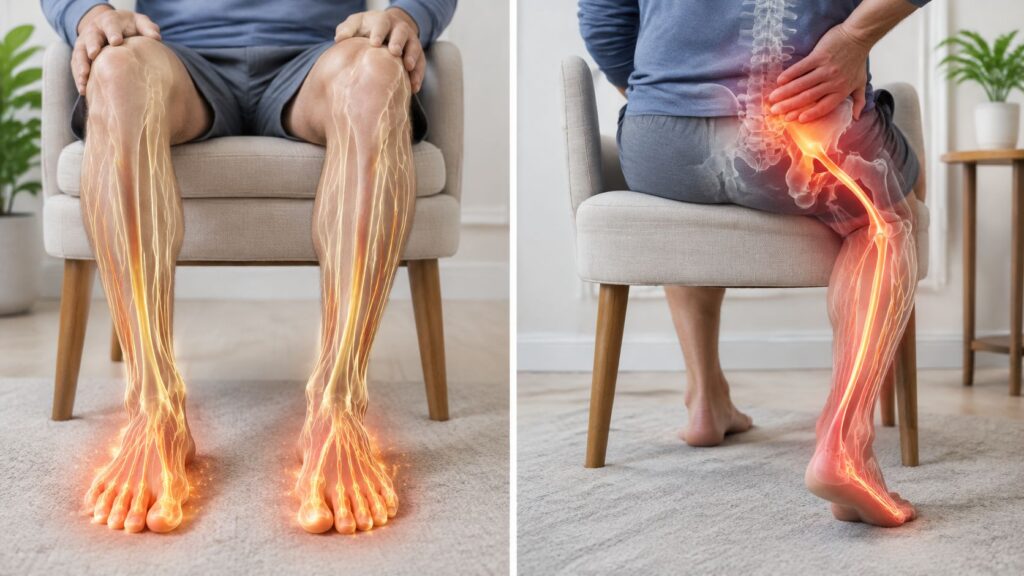
Radiculopathy usually causes arm pain, tingling, numbness, or weakness that follows a nerve pattern. Patients often describe pain that starts in the neck and travels into the shoulder, arm, or hand. That can be severe, but it does not automatically mean the spinal cord is involved.
Myelopathy is different. It points to spinal cord compression, and that can affect balance, coordination, hand dexterity, walking, and sometimes bowel or bladder control (Emory Healthcare on cervical stenosis myelopathy). When a person begins dropping objects, tripping more often, or noticing clumsy hands, the urgency changes.
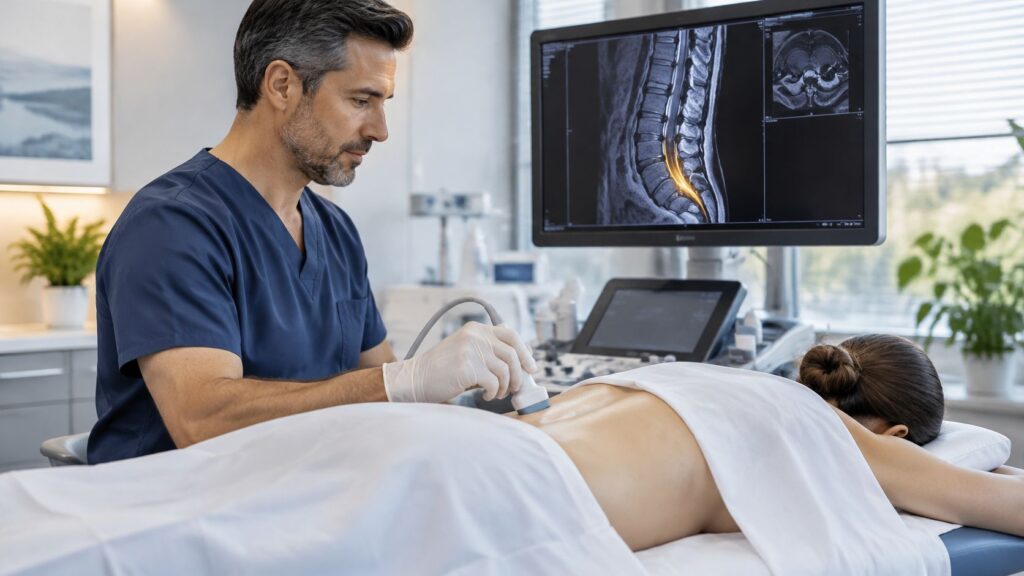
A careful workup usually includes MRI, sometimes CT myelography, and serial neurologic exams to see whether symptoms are stable or changing. In a pain clinic, I want to know not just what hurts, but whether strength, gait, or hand function is shifting over time.
My clinical rule: pain alone can be watched longer than pain with weakness, balance trouble, or hand clumsiness.
If you are sorting out the diagnosis before choosing a treatment path, a clear patient-facing overview is how cervical spinal stenosis is diagnosed. That conversation matters because treatment follows the symptom pattern, not just the scan.
Conservative Management as Your First Line of Defense
A non-surgical plan works best when it is active and specific. In cervical stenosis, I want patients to treat the neck as a system that needs symptom control, movement planning, and mechanical unloading at the same time, rather than waiting for pain to settle on its own.
What conservative care actually includes
A practical plan usually combines physical therapy, anti-inflammatory and analgesic medication, epidural steroid injections, activity modification, and ergonomic changes. The therapy focus is typically on cervical stabilization, posture retraining, and selective traction when it fits the symptom pattern. The goal is to lower mechanical irritation and improve daily function, not to stretch the stenosis away. For a clear overview of how a nerve block fits into that broader plan, see what a nerve block injection is.
Medication should stay opioid-sparing whenever possible. NSAIDs can help with pain and inflammation, neuropathic agents such as gabapentin may help nerve-related symptoms, and short courses of oral steroids are sometimes used for flares. The trade-off with long-term opioids is poor for chronic spine care, since they do not address the compression problem and can create new risks without fixing the source.
A realistic medication and activity plan
The most useful conservative plans are detailed, not generic. I often look at whether the patient needs scheduled NSAID use for a short period, a neuropathic medication at night to blunt burning or tingling, or a brief steroid taper when inflammation is clearly driving a flare. Those choices depend on the symptom pattern, other medical conditions, and how well the patient tolerates each option. If medication is used well, it should support movement and sleep, not become the whole treatment.
Ergonomics matter more than many patients expect. A monitor that sits too low, a chair that encourages forward-head posture, repeated overhead work, and sleep positions that keep the neck irritated can all keep symptoms simmering. Small changes such as monitor height, pillow choice, lifting mechanics, and pacing tasks through the day often reduce strain enough to make therapy more effective.
A realistic timeline
Durable improvement does not happen overnight. A conservative trial needs enough time for exercise, medication, and behavior changes to work together, and that usually means several weeks of steady treatment before you know whether the plan is paying off.
Conservative care works best when patients treat it like a program, not a single appointment.
A patient who improves slowly over several weeks is still improving. That gradual trend is exactly why the plan has to be judged over time, with attention to pain, sleep, activity tolerance, and whether any weakness, balance trouble, or hand function changes are showing up. If symptoms keep building despite solid adherence, that is the point to reconsider the next step rather than repeating the same plan.
Interventional Pain Therapies That Bridge the Gap
When conservative care helps but doesn't carry a patient far enough, interventional pain treatments can bridge the gap. These procedures don't erase stenosis, but they can calm pain enough to keep a person active while the rest of the plan is unfolding.
| Procedure | Target | Typical Relief Duration | Best For |
|---|---|---|---|
| Cervical epidural steroid injection | Nerve root inflammation | Temporary relief, often used as a bridge | Arm pain, tingling, nerve irritation |
| Cervical medial branch block | Facet joint pain pathway | Short-term diagnostic relief | Suspected facet-mediated neck pain |
| Radiofrequency ablation | Pain signals from facet joints | Longer-lasting relief than a block alone | Confirmed facet pain after diagnostic blocks |
| Peripheral nerve stimulation | Select pain pathways | Varies by patient | Persistent pain that hasn't responded to simpler care |
| Spinal cord stimulation | Neuromodulation of pain signaling | Varies by patient | Select refractory cases after careful screening |
A cervical epidural steroid injection is often the first interventional step when symptoms look like nerve root inflammation. A medial branch block is different, because it's mainly a diagnostic test to see whether the facet joints are driving the pain. If the block is clearly helpful, radiofrequency ablation can sometimes provide a more durable result by interrupting the pain transmission route.
If you want a simple explanation of how these injections are used in practice, what a nerve block injection is is a good place to start.
What patients should expect
These procedures are typically done with image guidance so the medication goes where it's intended. Recovery is usually brief, though the goal is not instant cure. The point is to gain enough relief to move, sleep, and participate in rehab more effectively.
Important trade-off: injections can reduce pain, but they don't reverse spinal cord compression.
That distinction matters. Injections are most useful when symptoms are painful but the neurologic picture is still stable. They're a bridge, not a finish line, and that's exactly how I frame them in a pain and wellness setting.
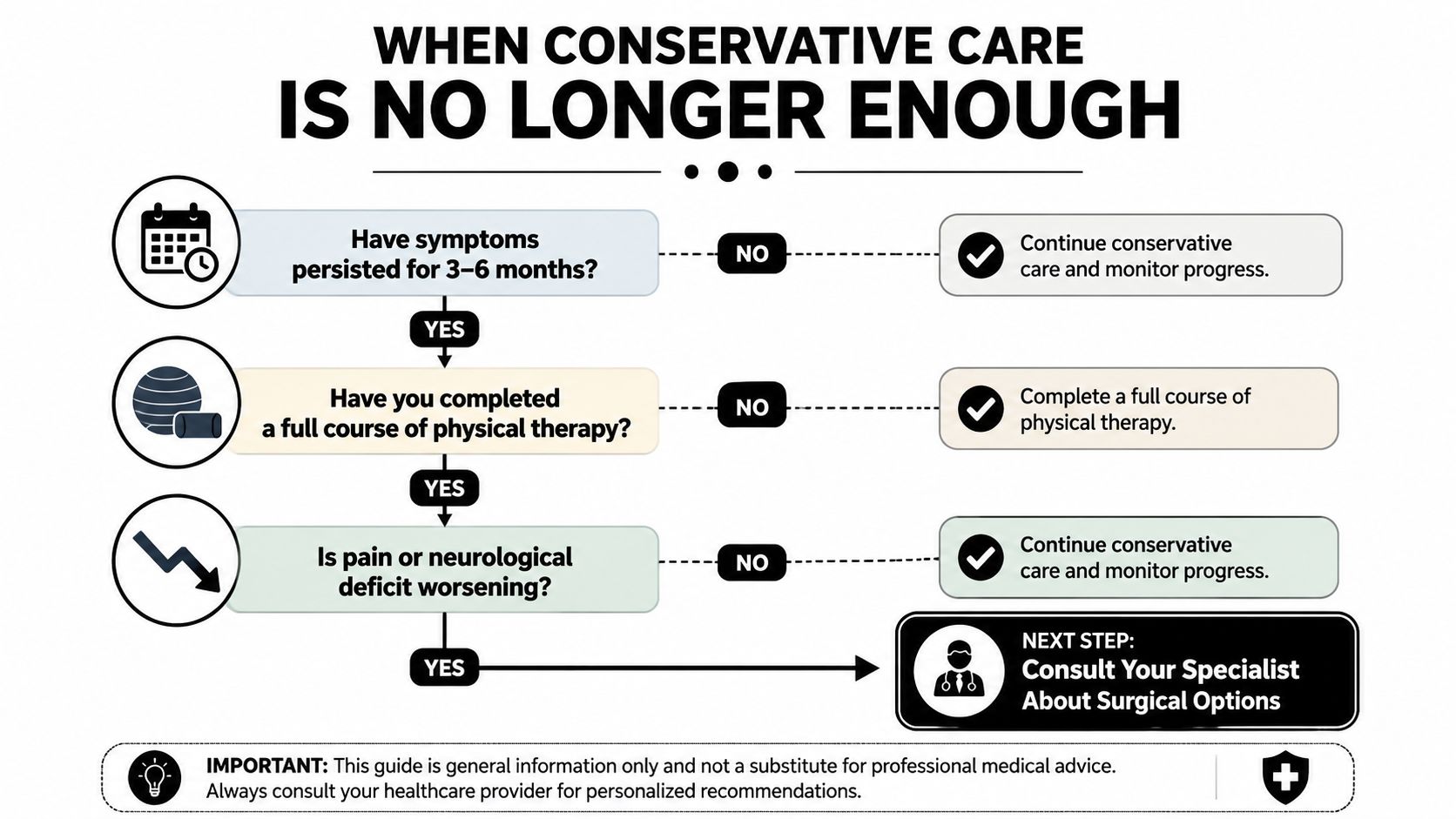
When Conservative Care Is No Longer Enough
The hardest question patients ask is also the most important one, when should conservative care stop being the plan? The answer depends less on the calendar alone and more on whether the neck is becoming neurologically dangerous.
Red flags that should prompt surgical evaluation
A surgical opinion becomes much more important when there are progressive neurologic deficits, worsening weakness, gait instability, or hand clumsiness. Imaging that shows severe cord compression or cord signal change also raises the stakes, especially if symptoms and scan findings line up (Emory Healthcare on cervical stenosis myelopathy). If bowel or bladder control is affected, that's not a watch-and-wait situation.
Here's a practical checklist patients can use before the next visit:
- Worsening strength: notice if lifting, gripping, or reaching is getting harder.
- Balance changes: pay attention to stumbling, wide-based walking, or feeling unsteady.
- Hand function loss: watch for dropping objects, slower buttoning, or clumsier writing.
- Persistent symptoms despite a full trial: if structured care hasn't improved the pattern after an adequate period, escalation belongs on the table.
- New cord-type symptoms: bowel, bladder, or coordination changes need prompt review.
Serial neurologic exams every 6 months help catch early myelopathy before it gets missed (PM&R KnowledgeNow on cervical stenosis). That surveillance is not busywork, it's how subtle decline gets recognized before it becomes harder to reverse.
How to talk about escalation
Patients do better when they ask direct questions. “Is my weakness stable?” “Do my symptoms fit radiculopathy or myelopathy?” “Have I had a full enough trial of conservative treatment?” Those questions help separate pain control from neurologic risk.
If the answer keeps drifting toward worsening function, the right move is a surgical consult, not another round of guesswork. The job is to avoid missing the window when decompression matters most.
Surgical Options for Severe Cervical Stenosis
Severe cervical stenosis is not the point for trial-and-error care. Once myelopathy is established or neurologic problems keep getting worse, the discussion shifts to surgery because the goal becomes protecting the spinal cord or nerve roots before more damage sets in.
The main operations patients hear about
ACDF, or anterior cervical discectomy and fusion, uses a front-of-neck approach. The surgeon removes the disc or bone that is crowding the spinal cord or nerve roots, then often fuses the vertebrae to add stability. For patients with compression at the front of the canal, that approach is often the most direct way to address the problem.
Laminectomy removes part of the back of the vertebra to open more space. Laminoplasty also creates more room from the back, but it preserves more of the posterior anatomy in selected cases. The choice depends on where the stenosis is, how many levels are involved, and whether the spine is stable enough to avoid fusion. That decision matters because a procedure that decompresses well but destabilizes the neck can create a different problem later.
Surgical planning is rarely about one MRI line item. It is about where the compression sits, whether symptoms match that level, and what trade-off offers the best chance of protecting function.
What decompression does and doesn't do
Decompression can relieve pressure on the cord or nerves, but it does not restore normality overnight. Recovery depends on the extent of compression, the operation performed, and how long symptoms have been present. Pain after surgery still needs a deliberate plan, and that is where perioperative pain management becomes part of the pathway rather than an afterthought.
In practice, that often means opioid-sparing protocols, scheduled non-opioid medications when appropriate, ice, activity pacing, and close follow-up so pain is treated without drifting into unnecessary medication exposure. Patients usually want to know how the first few weeks feel, and the honest answer is that soreness, stiffness, and limited neck motion are common early on. The job is to control that pain enough to let walking, hygiene, sleep, and rehab move forward.
Most patients also need a realistic recovery frame. Some are up and walking the same day, but return to heavier activity takes longer, especially after fusion. The post-op plan should spell out lifting limits, wound care, and when physical therapy or home exercises begin, because the safest recovery is the one that is specific instead of vague.
Surgery is not a failure of conservative care. It is the correct treatment when the anatomy and neurologic findings show that waiting carries more risk than acting.
Columbia Doctors notes that when symptoms are severe, weakness progresses, or imaging shows tight compression of the spinal cord or nerves, decompressive surgery is typically recommended (Columbia Doctors on cervical spinal stenosis). That is the threshold that matters.
Your Cervical Stenosis Treatment Plan at Midwest Pain and Wellness
At a Chicago Ridge pain and wellness clinic, the plan starts with a real conversation about symptoms, function, and neurologic risk, then moves into assess, recommend, treat. That matters for people in Oak Lawn, Palos Hills, Palos Heights, Worth, Bridgeview, Hickory Hills, Alsip, Burbank, Evergreen Park, and Orland Park, because the right next step isn't the same for everyone, even when the MRI looks similar.
Dr. Yaw Donkoh, a double board-certified interventional pain specialist, uses a multimodal, opioid-sparing model that can include image-guided injections, targeted blocks, radiofrequency procedures, and coordination with outside surgeons or rehab clinicians when the case calls for it. The clinical goal is durable function, not short-lived medication dependence.
The process is straightforward:
- Assess, with symptom review, exam, and imaging context.
- Recommend, with a plan that matches the pain generator and the neurologic risk.
- Treat, using the least invasive option that still makes sense.
Midwest Pain & Wellness also supports workers' compensation and personal injury cases, and it keeps weekday access convenient for working adults. If a patient needs surgical review, the clinic can coordinate that handoff instead of leaving the person to piece together care alone.
The best outcomes usually come from matching the treatment to the stage of the disease. Mild to moderate stenosis may stay non-surgical. Pain that lingers can be bridged with procedures. Progressive weakness or myelopathy needs escalation.
If you're dealing with cervical stenosis pain, arm symptoms, or questions about whether conservative care is still enough, Midwest Pain & Wellness can help you sort out the next step with a clear, opioid-sparing plan. Visit Midwest Pain & Wellness to get started and discuss whether your symptoms call for injections, coordinated conservative care, or a surgical referral.