You're sitting in an exam room because the headaches aren't just “bad lately” anymore. They've become the kind that change your schedule, your workday, and the way you plan around light, noise, and neck tightness. When patients ask about botox for migraine injection points, they usually want one simple answer: what gets injected and where. The most helpful answer is that the treatment is built around a standardized map that's been studied, repeated, and refined in real migraine care.
The key thing to know is that migraine Botox isn't a single shot in one painful spot. The FDA-approved chronic migraine protocol uses 155 Units of onabotulinumtoxinA across 31 fixed injection sites in seven head and neck muscle areas, repeated about every 12 weeks (FDA label). That structure is why people talk about injection points rather than one injection. It's also why the treatment room feels more methodical than dramatic.
Table of Contents
- What Happens During a Botox Migraine Treatment
- The Seven Muscle Groups That Make Up the Map
- How Dosing and Scheduling Work
- Why These Specific Points and Not Others
- Your Appointment From Start to Finish
- Who Is a Candidate and What Are the Risks
- Standard Protocol vs Individualized Approaches
- Next Steps for Patients in the Chicago Ridge Area
What Happens During a Botox Migraine Treatment
A patient often sits down expecting something intense, then realizes the whole process is more organized than scary. The clinician does not improvise from scratch, because the chronic migraine pattern follows a fixed map, 155 Units delivered across 31 sites in seven head and neck muscle areas (FDA label). That predictability matters. It turns a vague fear of “shots in my head” into a repeatable medical plan.
The room feels procedural, not cosmetic
Patients are often surprised by how quickly the injections move once they start. The pattern is built around muscle groups that commonly contribute to migraine burden, so the clinician works through the forehead, temples, back of the head, neck, and shoulders in a set sequence. The treatment is brief, but it is not casual. It follows a protocol, and the dose, spacing, and site distribution are integral to the therapy.
Practical rule: if a migraine treatment is working as intended, the patient should feel like they are following a clear medical plan, not getting a random series of shots.
That distinction matters because many people expect a pain-focused injection to chase the worst tender spot of the day. Migraine Botox does not work that way. The standard map spreads the medication across multiple regions so the effect is not dependent on one “hot” point, and that is a big reason the term botox for migraine injection points is so useful. It describes a structured pattern, not a single target.
What the patient experiences
The appointment is usually short enough that patients can return to the rest of the day without special downtime. The injections themselves are small and quick, and the sequence is repetitive in a reassuring way once you know what to expect. People often tense up more before the first visit than during it.
The important mindset shift is simple. You are not signing up for a one-time rescue. You are starting a preventive plan that is repeated on a schedule, with the anatomy and dose staying consistent unless there is a defined reason to adjust later. That is what makes this treatment so different from a casual injection visit.
The Seven Muscle Groups That Make Up the Map
A migraine visit often feels more structured than patients expect. The map is built around seven muscle groups, and each one sits in a region people already associate with migraine symptoms, the brows, forehead, temples, back of the head, neck, and shoulders. That structure is why the standardized botox for migraine injection points approach makes sense in the treatment room. It is not chasing a single sore spot, it is treating the pattern that keeps showing up.
The reason the points are standardized is practical. Migraine pain shifts from day to day, but the treatment needs a repeatable plan that targets the same anatomic regions each cycle. The standardized map gives that consistency, while still leaving room for adjustment when a patient's symptoms justify a broader plan.
The front of the head and face
The corrugator is the small frown-line muscle between the brows. The procerus sits between the eyebrows at the bridge of the nose. The frontalis covers the forehead. These muscles matter because they sit in the same areas many patients describe as pressure, tightness, or a heavy feeling across the front of the head. They also explain why migraine treatment often begins at the brow and forehead instead of focusing only on the scalp.
That front-of-face pattern can surprise people. In the room, I often explain that the forehead injections are not about the surface skin, they are part of a fixed neurologic map that has to cover the same territory each time. A pain-guided approach alone would miss that consistency.
The sides, back, neck, and shoulders
The temporalis sits at the temples, where many patients feel migraine pain as a band or deep ache. The occipitalis sits at the back of the skull, a common area for headache referral. The cervical paraspinals run through the neck, and the trapezius connects into the shoulders and upper neck. Patients with mixed head and neck symptoms usually recognize this part of the protocol quickly.
Those injections are chosen because migraine-related symptoms often spread through these regions together. A patient may come in focused on one painful spot, but the exam usually shows a broader pattern involving the scalp, neck, and shoulder girdle. That is why the treatment map uses several muscle groups instead of trying to guess which spot hurts most on that particular day.
Learn how many units are typically used in migraine Botox treatment.
| PREEMPT Injection Point Distribution | |||
|---|---|---|---|
| Muscle Group | Injection Sites | Units per Site | Total Units |
| Corrugator | 2 | 5 | 10 |
| Procerus | 1 | 5 | 5 |
| Frontalis | 4 | 5 | 20 |
| Temporalis | 8 | 5 | 40 |
| Occipitalis | 6 | 5 | 30 |
| Cervical Paraspinals | 4 | 5 | 20 |
| Trapezius | 6 | 5 | 30 |
The map works best when the clinician thinks in regions, not just in one tender spot. That is the logic behind PREEMPT.
How Dosing and Scheduling Work
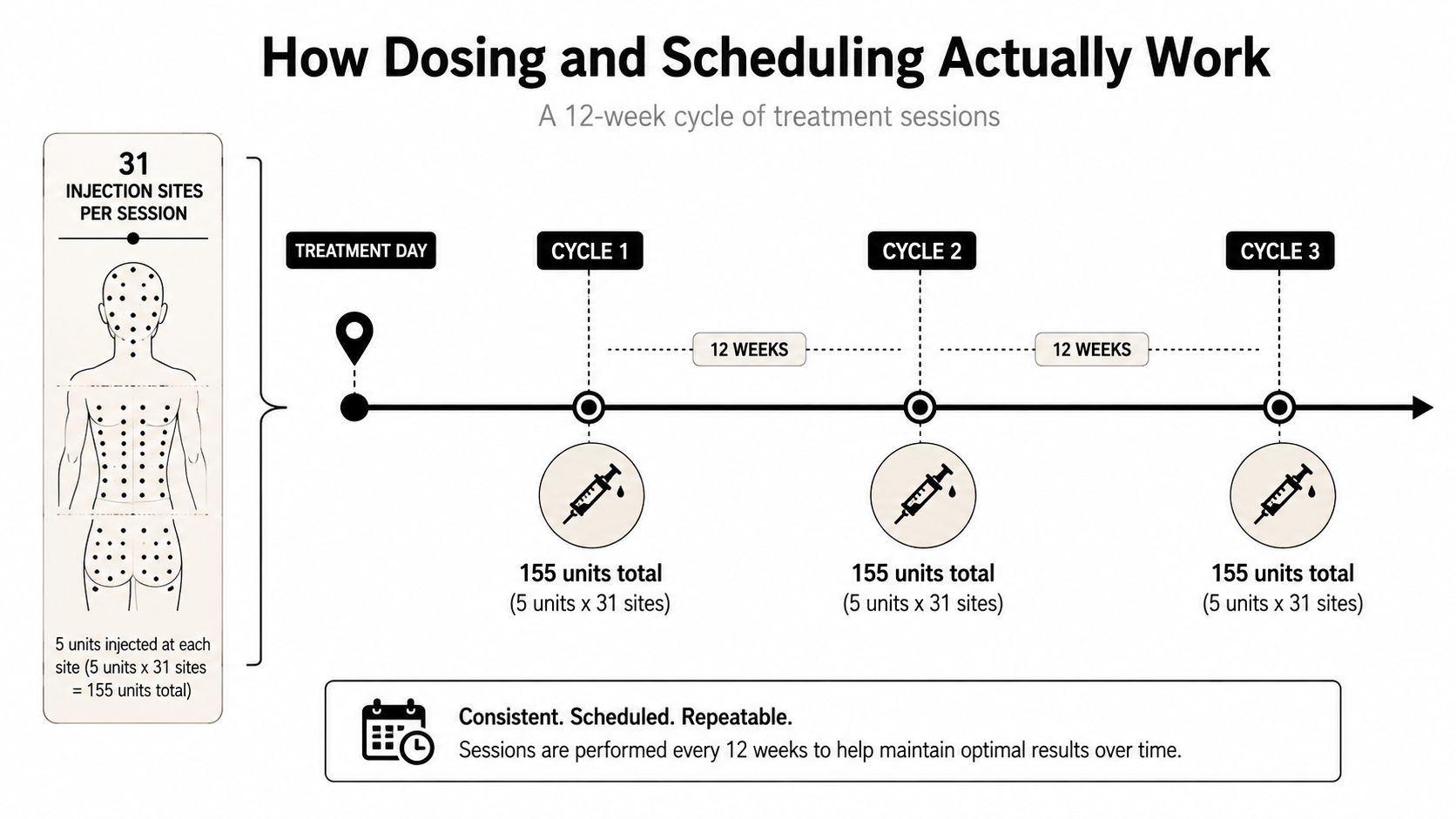
The standard plan uses a fixed dose pattern. Each of the 31 sites gets 5 Units, which brings the total to 155 Units in the core protocol. That structure matters because it keeps treatment consistent from one visit to the next and from one trained clinician to another.
Why the schedule repeats every 12 weeks
The injections are repeated about every 12 weeks because the benefit fades over time, and the protocol is built around that window. Patients should not expect a same-day turnaround. Relief is often noticed within 2 to 4 weeks, and the response may build over 2 to 3 treatment cycles. That is part of the trade-off with migraine Botox, the pattern is steady and repeatable, but it is not instant.
Where the optional expansion fits
Clinical literature also describes a limited “follow the pain” approach, with up to 8 additional injections in the temporalis, occipital, and trapezius regions. That can bring the total dose into a range of 155 to 195 Units (PMC review). The expansion is not open-ended. It is a defined adjustment used when symptoms cluster in certain regions or when the base map leaves meaningful tenderness behind.
If you want a practical overview of how the unit count is discussed in clinic, see Midwest Pain & Wellness's guide to how many Botox units are used.
What the dosing logic means in real life
Patients often feel reassured once they see that the plan follows a pattern. The treatment is not improvised from visit to visit. The core map stays standardized, the optional extension stays limited, and the follow-up schedule stays consistent. That makes it easier to compare visits, judge whether the injections are helping, and decide whether the next session should stay with the base protocol or use the added regions when symptoms justify it.
Why These Specific Points and Not Others
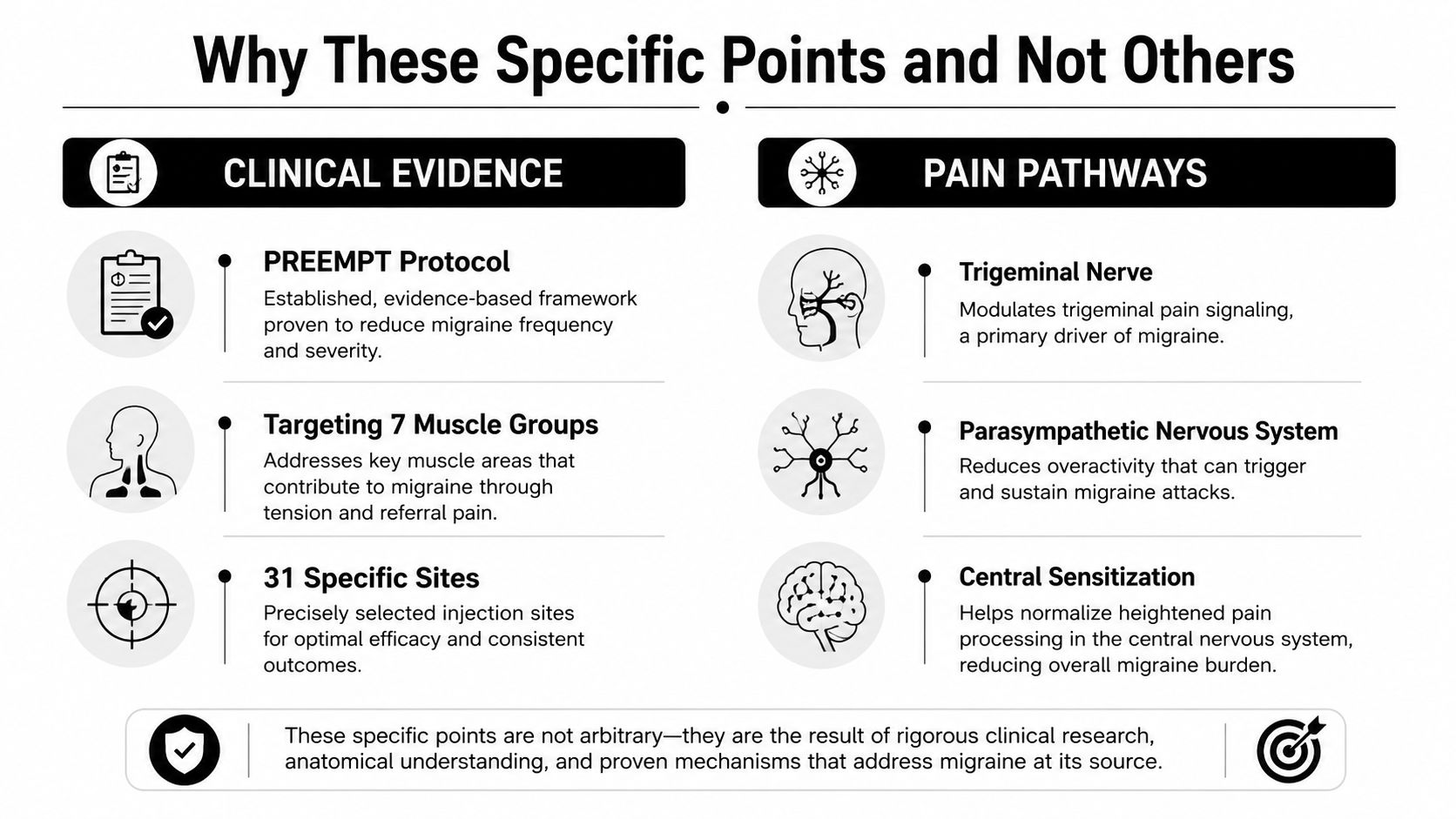
Patients often ask the question that most articles skip. Why not just inject the spot that hurts that day? In the treatment room, the answer is practical. The standardized map tracks with measurable migraine outcomes, while the pain a patient feels in one flare does not always match the biology driving the attacks.
The evidence points to a repeatable pattern
Pooled analyses found that people receiving botulinum toxin had 1.6 fewer migraine attacks per month than placebo at 3 months (clinical outcomes summary). Real-world synthesis later showed average reductions of 10.64 headache days per month at about 24 weeks and 10.32 days per month at about 52 weeks in that same evidence summary. Those results matter because they explain why the pattern became part of chronic migraine care. The protocol is anchored to outcomes, and that is what gives the map its value.
The map is also tied to localization work
Targeted diagnostic Botox injections showed a positive predictive value of 89.5%, with sensitivity of 56.7% and specificity of 80.0% for identifying migraine trigger sites (clinical outcomes summary). That does not mean every tender spot deserves a shot. It does mean clinicians have evidence for using the medication to test and treat likely trigger regions instead of chasing pain blindly.
For a deeper clinical explanation of the mechanism, patients can read how Botox helps migraines.
Standout point: the standardized map is the strongest starting point because it has the cleanest evidence behind it, and the pattern can still be adjusted when symptoms justify it.
The trade-off is real. Pain-guided injections may feel intuitive, especially for patients with prominent neck or occipital symptoms, but the best-supported chronic migraine approach still begins with the fixed PREEMPT framework. Once that base is in place, experienced clinicians decide whether the optional expansion fits the headache pattern and the exam findings.
Your Appointment From Start to Finish
Your visit usually starts with a short check-in, a review of your current headache pattern, and a quick look at what has changed since the last treatment. If this is your first injection visit, the clinician often spends a few extra minutes explaining the sequence so the appointment feels predictable before anything begins. You usually do not need fasting, special preparation, or a long recovery plan.
What the injections feel like
The needle is small, and most patients describe the sensation as brief pinching or pressure. In the neck, a 1-inch needle may be needed for patients with thick neck muscles. That does not mean the treatment is harsher, it means the injector should match the needle choice to the anatomy in front of them instead of using the same setup for every neck.
The injection phase itself is usually fast. The practical reality is that there is less ceremony than many patients expect once the treatment starts.
What happens after you leave
No one should expect instant relief on the way out. A more realistic expectation is that benefit may begin within 2 to 4 weeks, and the response can build over 2 to 3 treatment cycles. That timeline matters because the first visit is too early to judge the full effect.
Do not grade the treatment the same day. Grade it over the next few weeks, then again after the next cycle.
If you want to arrive prepared, a practical checklist can help. The clinic's guide on how to prepare for Botox injections is a useful place to start, especially if you track headaches, medication use, or neck pain patterns before treatment.
Who Is a Candidate and What Are the Risks
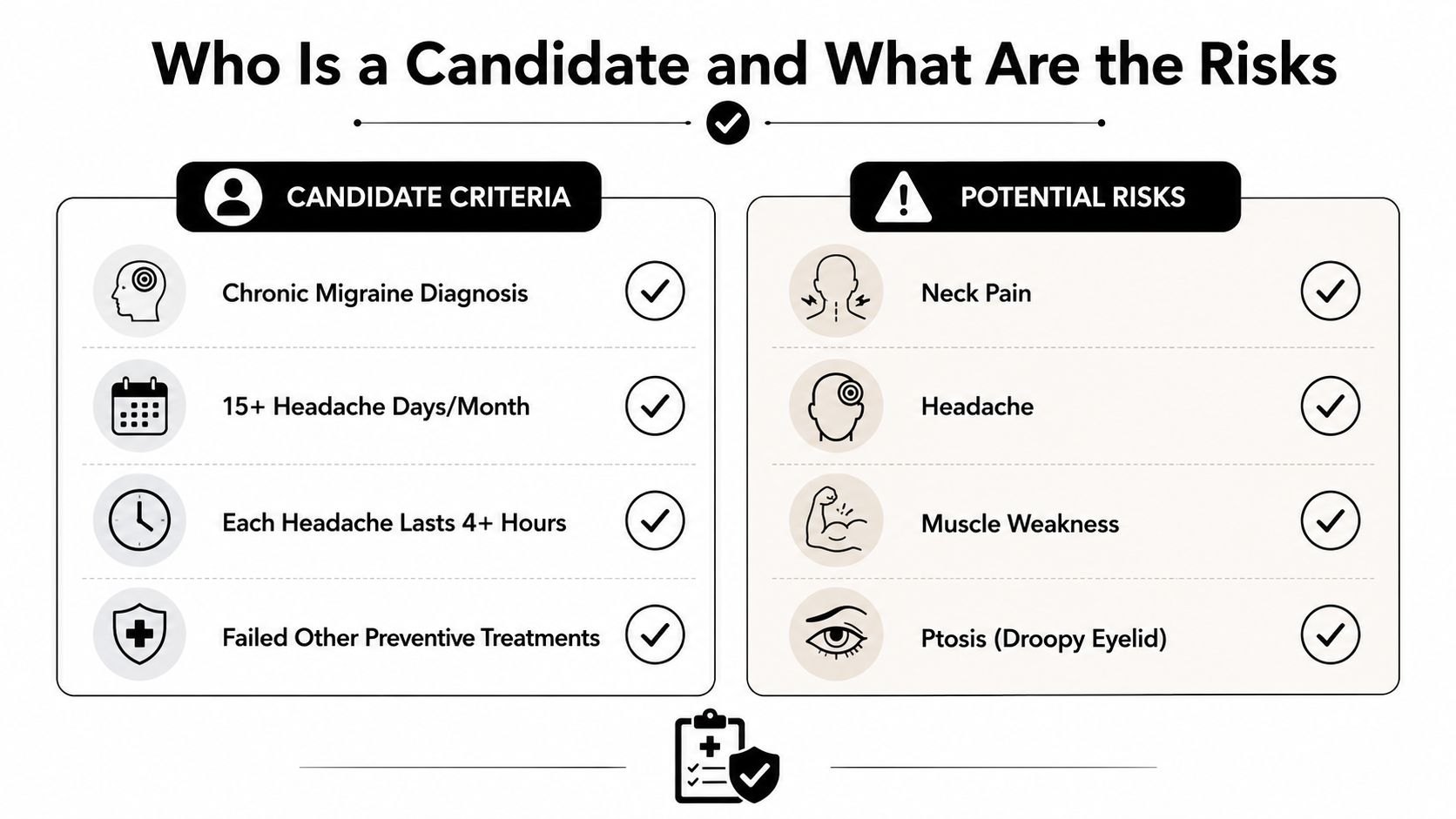
A patient usually comes to this conversation after headaches have started taking over the calendar. For chronic migraine prevention, the clearest FDA-backed threshold is 15 or more headache days per month, with headache lasting 4 hours a day or longer. That pattern is what separates chronic migraine from less frequent headache problems in this treatment setting. If the headaches do not match that pattern, the discussion may still be worthwhile, but the chronic migraine protocol is not the same as occasional headache care.
What patients should weigh before treatment
The FDA review lists the most common treatment-related effects as neck pain (9%), eyelid ptosis (4%), muscular weakness (4%), and injection-site pain (3%). Those effects are usually temporary, but they matter more if someone already lives with neck fatigue or shoulder strain. A careful exam before the first injection helps separate a reasonable risk from a poor fit.
A practical candidacy checklist often looks like this:
- Chronic migraine pattern: The headaches are frequent enough to fit the preventive indication.
- Functional burden: The attacks interfere with work, sleep, or daily planning.
- Prior prevention history: The patient has already tried other approaches or needs a preventive option that can be repeated consistently.
- Anatomy and symptom pattern: Neck and shoulder involvement may shape how the clinician thinks about the injection map.
When caution matters
Patients with an allergy to botulinum toxin, or infection at a proposed injection site, should not be treated until the issue is addressed. Pregnancy and breastfeeding call for a slower conversation, because the choice often depends on the individual risk-benefit picture rather than a blanket answer. The medication is preventive, not an acute rescue, so the decision should match the long-term burden of the migraine pattern.
The point is not to make treatment sound dangerous. The point is to be honest that benefit has to outweigh the trade-offs, especially if symptoms are already close to the threshold where even mild neck weakness would matter.
Standard Protocol vs Individualized Approaches
The fixed PREEMPT map is still the standard starting point, but patients rarely present with symptoms that feel perfectly uniform. One person may describe pain that sits in the temporalis area. Another feels it most in the neck and upper trapezius. Some patients are especially sensitive to weakness and prefer to avoid extra posterior neck injections unless there is a clear reason to add them.
Where individualization fits
Clinical literature places the PREEMPT injections in the frontalis, corrugator, procerus, temporalis, occipitalis, cervical paraspinals, and trapezius, while separate studies describe modified, anatomy-guided, and trigger-site approaches rather than a single universally accepted set of points (Practical Neurology review). This is how it works in practice. The standard map gives the baseline plan, then the injection pattern gets adjusted only when the symptom pattern justifies it.
A clinician may put more emphasis on individualized adjustments when pain is concentrated in the temporalis, occipital, cervical paraspinal, or trapezius regions. That matters most when the goal is not only migraine prevention, but also some relief of a mixed migraine-plus-neck pain pattern. A patient who is prone to neck weakness may do better staying close to the fixed protocol instead of adding more work in the posterior neck.
Why the debate stays practical
Treatment becomes a judgment call, not a theory exercise. The discussion centers on whether the patient's symptom pattern justifies any modification and whether the added benefit is worth the side-effect risk. The more mixed the presentation, the more carefully the injector has to balance those trade-offs.
Next Steps for Patients in the Chicago Ridge Area
If you live in Chicago Ridge, Palos Heights, Palos Hills, Evergreen Park, or Hickory Hills, the best first step is to bring the information a pain specialist needs to sort out whether your headaches fit chronic migraine care. A headache diary is the most useful thing to bring, along with prior treatment records and any imaging or neurology notes you already have. Those details help the clinician separate migraine burden from other pain generators that can overlap with it.
What a pain and wellness visit should feel like
This should be a medical evaluation, not a cosmetic appointment. In a pain and wellness clinic, the discussion should cover headache frequency, neck symptoms, prior preventive failures, and whether Botox fits into a broader opioid-sparing plan that may also include image-guided injections, nerve blocks, or referral-based rehabilitation. Midwest Pain & Wellness in Chicago Ridge uses that kind of interventional pain framework for migraine care when the clinical picture supports it.
What to ask at the first consult
A good first consult should leave you with a clear plan, not vague reassurance.
- Diagnosis fit: Ask whether your headache pattern meets chronic migraine criteria.
- Injection plan: Ask how the standard PREEMPT map would be used in your case.
- Follow-up timing: Ask when the response should be reviewed and whether a second cycle is expected before judging success.
- Coordination: Ask how migraine treatment fits with the rest of your pain plan, especially if you also have neck pain or spine issues.
If you're ready to move from research to a real plan, schedule an evaluation with Midwest Pain & Wellness. A focused consult can help you decide whether the standard migraine Botox protocol, a modified approach, or a different preventive strategy makes the most sense for your symptoms.
If chronic migraine is taking over your week, Midwest Pain & Wellness can evaluate whether Botox belongs in your treatment plan and map the injections to the standard PREEMPT protocol when appropriate. Their Chicago Ridge pain and wellness team treats headache conditions within a broader interventional, opioid-sparing approach, so you're not left piecing the plan together on your own. Visit Midwest Pain & Wellness to request an appointment and start a migraine evaluation that's built around real anatomy, real evidence, and your actual symptom pattern.