Illinois self-pay kyphoplasty prices range from roughly $9,600 to $26,400, while a patient with Original Medicare typically faces 20% coinsurance after the applicable deductible. That spread exists because the bill depends on the facility, professional services, imaging, implants, anesthesia, treatment setting, insurance plan, and number of vertebral levels treated.
A Chicago Ridge-area patient usually isn't asking for a national average. They're looking at a recent compression fracture, trying to sleep, walk, or return to normal activities, and wondering whether the procedure will create a manageable bill or an unpleasant surprise. The useful question is not, "What does kyphoplasty cost?" It's, "What amount will my specific facility, physician, insurer, and treatment plan produce?"
For an older adult in Chicago Ridge, the answer starts with medical necessity and ends with a written estimate. A published price may describe hospital costs, a Medicare-approved amount, or a self-pay package, but those figures aren't interchangeable. The Chicago Ridge vertebral compression fracture pain resource can help explain why the clinical diagnosis must be established before comparing treatment prices.
Table of Contents
- What Your Kyphoplasty Bill in Chicago Ridge Depends On
- What Actually Makes Up the Bill
- How Medicare Prices the Procedure Step by Step
- Insurance Coverage and What It Means for Your Bill
- Your Pre-Procedure Billing Checklist
- Kyphoplasty Versus Alternatives
- Workers' Compensation and Personal Injury Considerations
- Planning Your Next Step Near Chicago Ridge
What Your Kyphoplasty Bill in Chicago Ridge Depends On
A Chicago Ridge patient develops severe back pain after a minor fall. Imaging identifies a painful vertebral compression fracture, while medication and bracing have not restored normal movement. The family searches for a price, but the first figures they find may describe different parts of the episode.
One Illinois self-pay comparison lists kyphoplasty prices from roughly $9,600 to $26,400 across Chicago facilities, a $16,800 spread between the lowest and highest listed prices (Chicago Illinois kyphoplasty pricing data). Treat those figures as benchmarks, not a guaranteed quote. The final bill may include separate physician services, facility charges, anesthesia, imaging, and implants.
Medicare adds another layer. A published procedure price may separate professional and facility components, while the patient's responsibility depends on the approved amount, deductible status, coverage type, network rules, and site of service. Under Original Medicare, 80% is paid after the applicable Part B deductible and the beneficiary usually owes 20% coinsurance. That coinsurance applies to the Medicare-approved amount, not automatically to an advertised cash price.
Practical rule: Compare the expected total episode cost, not only the procedural fee.
For patients in Chicago Ridge, Palos Heights, Palos Hills, Evergreen Park, and Hickory Hills, request the exact procedure code, facility, number of levels, and payer assumptions in writing. Confirm whether the estimate includes the physician, facility, anesthesia, imaging, and implants. A clinical resource on vertebral compression fracture pain can also clarify why the diagnosis and medical necessity should be established before comparing treatment prices.
A single “average kyphoplasty cost” cannot show what your specific bill will be.
What Actually Makes Up the Bill
Kyphoplasty billing usually contains several separate building blocks. Understanding them makes an estimate easier to challenge, verify, and compare.
Facility charges
The facility fee covers the setting where the procedure occurs and the resources needed to operate it. Depending on the location, that can include the procedure room, sterile processing, nursing, recovery, supplies, and administrative overhead. Hospital outpatient departments and ambulatory settings can price the same clinical work differently because their payment structures and included resources differ.
Inpatient treatment may add room and hospitalization services that don't appear in an outpatient estimate. That doesn't mean inpatient care is always inappropriate, but it does mean the estimate should state whether the procedure is planned as outpatient or inpatient.
Physician services
The physician fee pays for professional work, including evaluation, procedural performance, image interpretation connected to the procedure, and medical decision-making. The amount can vary with the exact CPT code and the number of vertebral levels treated.
A quote that says “kyphoplasty” without identifying the code isn't detailed enough. Ask whether the estimate covers one level or multiple levels, and whether consultation or follow-up services are separate.
Imaging and anesthesia
Kyphoplasty relies on imaging guidance. Fluoroscopy or other imaging services may appear as distinct billing lines, depending on the facility and payer arrangement. Anesthesia or sedation can also be billed separately from the physician and facility components.
These charges aren't minor details to assume away. Ask who bills for anesthesia, whether the anesthesia professional is in-network, and whether imaging is included in the facility package.
Implants and balloon devices
The balloon system, cement, access instruments, and related procedural supplies can appear as implant or device charges. The number of treated levels may affect the supplies used and the professional and facility work involved. A written estimate should state whether these materials are included or billed separately.
For a broader explanation of how medical expenses can be divided among labor, materials, overhead, taxes, and profit, Life Senior Placement's cost breakdown offers a useful general framework, although the specific kyphoplasty categories come from the procedure's billing structure.
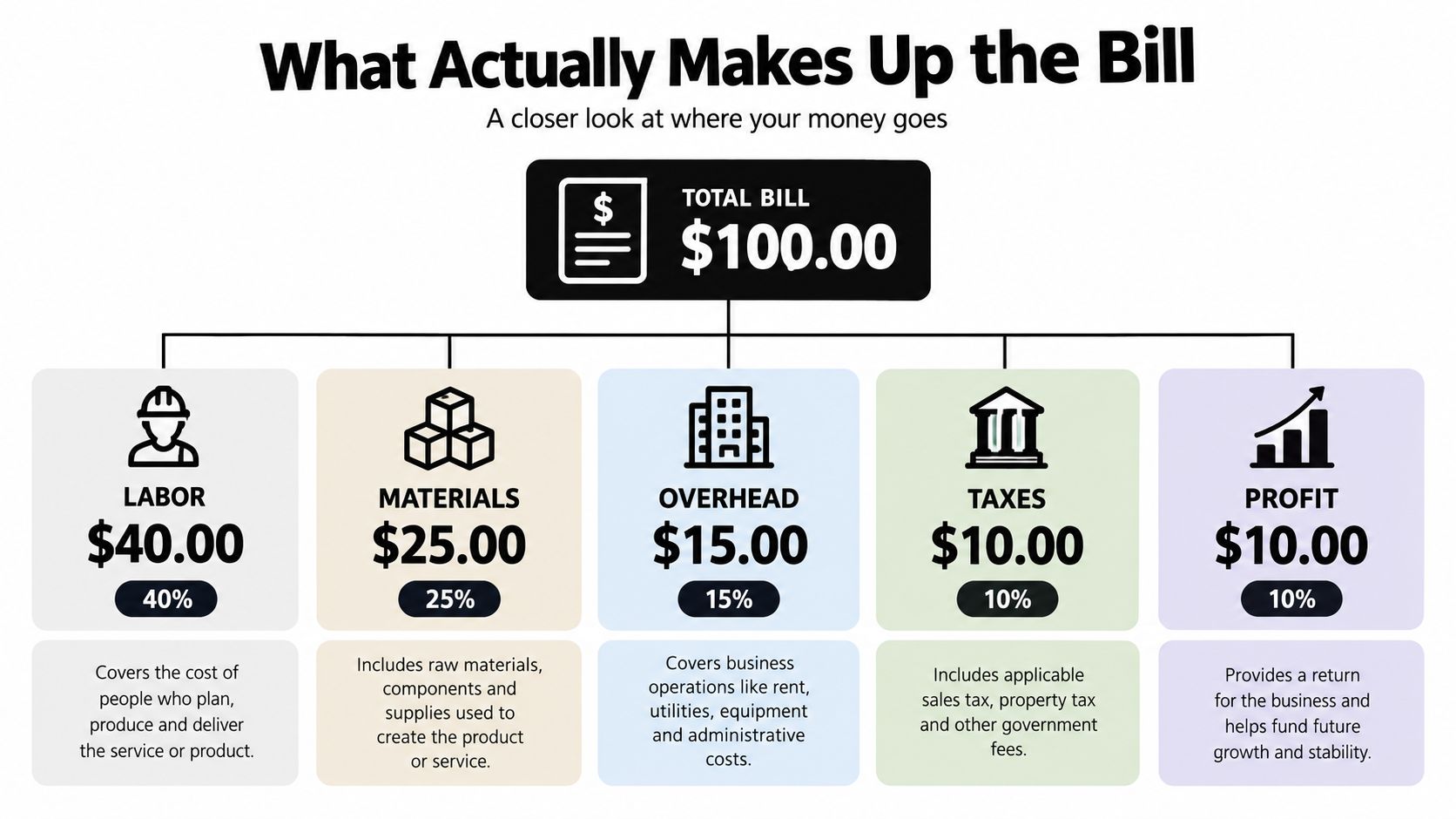
The practical test is simple: if the estimate combines everything into one unexplained number, ask for an itemized version. You need to know which amounts are professional, facility, imaging, anesthesia, and device charges before comparing facilities.
How Medicare Prices the Procedure Step by Step
Medicare doesn't use one universal kyphoplasty price. It assigns payment through procedure codes and separates professional work from facility-based resources. The exact code matters because related vertebral augmentation codes can have different approved amounts.
One Medicare benchmark lists a physician fee of $424 and an ambulatory facility fee of $3,695, producing an approved amount of approximately $4,119. Another setting lists the same $424 physician fee with a $7,413 facility fee, producing an amount of approximately $7,837 (Medicare procedure-price information for CPT 22514). Those figures are approved payment benchmarks, not guaranteed bills or cash prices.
Why site of service changes the approved amount
The physician component reflects professional work, practice expense, and malpractice expense through Medicare's relative-value-unit methodology. Facility payments account for resources billed through the hospital or ambulatory setting. Because those settings carry different operating and recovery costs, the facility portion can change substantially even when the physician work appears similar.
A Chicago-area beneficiary should therefore ask two questions before scheduling: “What is the exact CPT code?” and “What is the site of service?” Without both answers, an estimate may be impossible to interpret.

Original Medicare generally leaves the beneficiary with 20% of the Medicare-approved amount after the applicable deductible, but supplemental insurance may reduce that exposure. Medicare Advantage plans use their own cost-sharing and network rules. Patients who want a more detailed explanation of possible physician billing above the Medicare-approved amount can review how Medicare Part B excess charges work.
The central distinction is approved amount versus patient bill. The approved amount is the basis for Medicare payment. Your actual responsibility depends on deductible status, coinsurance, supplemental coverage, admission status, network participation, and separate charges.
Insurance Coverage and What It Means for Your Bill
A Chicago Ridge patient can have a confirmed vertebral compression fracture and still face a coverage review. Medicare coverage for vertebral augmentation in Illinois follows a medical-necessity framework that requires documentation of a painful fracture confirmed by imaging, an acute or not-healed fracture, a clinical match between the affected level and the patient's findings, and persistent pain despite appropriate conservative treatment. The applicable policy is summarized in Illinois Medicare coverage policy for vertebral augmentation.
Original Medicare
Original Medicare generally pays 80% of the Medicare-approved amount after the applicable Part B deductible, leaving 20% coinsurance. That approved amount, rather than the facility's advertised charge, is the starting point for estimating what Medicare pays. Your bill can still include separately submitted professional, facility, anesthesia, imaging, or supply charges.
The record must explain why kyphoplasty is medically appropriate. Imaging, examination findings, fracture-healing status, pain severity, loss of function, and prior treatment attempts may affect the claim review. A diagnosis alone does not establish payment.
Medicare Advantage
Medicare Advantage plans set their own authorization, network, and cost-sharing rules. The same procedure may have different member costs at a hospital outpatient department and an ambulatory facility, even when the clinical service is similar. A plan can cover kyphoplasty while requiring approval before the appointment is scheduled.
Ask the plan to confirm the authorization requirement, approved facility, participating physician, anesthesia coverage, and estimated member responsibility. Request confirmation for the specific procedure, treated levels, and location. A general statement that kyphoplasty is “covered” does not establish what you will owe.
Commercial and supplemental coverage
Commercial plans apply their own medical policies, deductibles, coinsurance, and network requirements. Employer and individual coverage can therefore produce very different bills. Supplemental insurance may reduce eligible remaining costs, but it does not remove the need to verify the underlying approved amount and claim requirements.
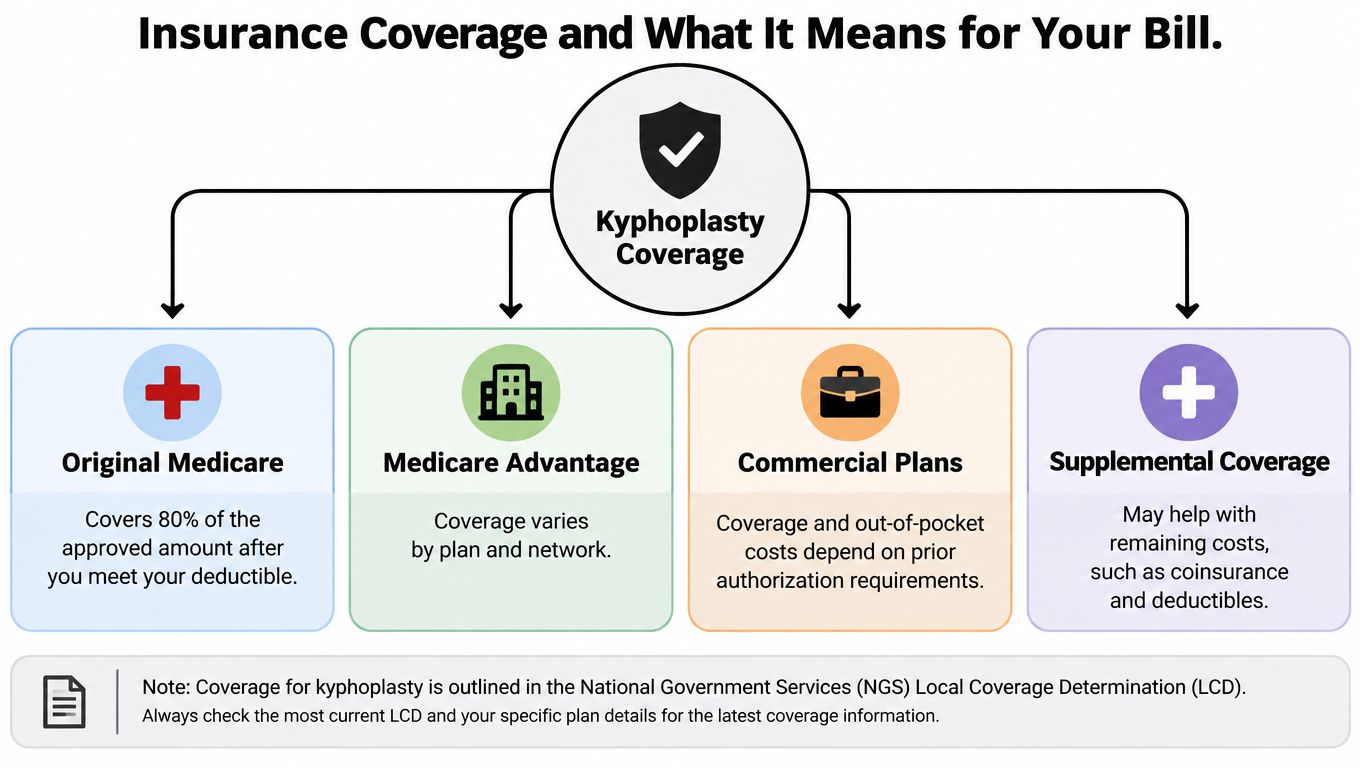
The most important administrative step is prior authorization when your plan requires it. Approval should match the diagnosis, code, number of levels, facility, and treating clinician.
Coverage remains conditional. If the record does not show an active painful fracture or prior conservative treatment that failed to provide adequate relief, the payer may question medical necessity. For a Chicago Ridge patient, the practical target is a written estimate tied to the approved amount, coverage rules, and every separately billed service.
Your Pre-Procedure Billing Checklist
Take this checklist to the physician's office, facility billing department, and insurer. The goal is to make every assumption visible before the procedure date.
- Confirm the exact CPT code: Ask for the code being submitted and whether it covers one vertebral level or more than one.
- Identify the treatment setting: Confirm whether the procedure is outpatient, hospital outpatient, ambulatory, or inpatient.
- Verify every network relationship: Check the facility, physician, anesthesia professional, and any separately billing imaging provider.
- Check your deductible status: Ask how much of the applicable deductible remains and how coinsurance will be calculated.
- Ask about anesthesia billing: Determine whether sedation or anesthesia is included in the facility estimate or billed independently.
- Confirm prior authorization: Get the authorization number, approved code, approved levels, facility, and expiration details when applicable.
- Request an itemized estimate: Ask for facility, professional, imaging, anesthesia, supplies, and implant charges in writing.
- Request a good-faith estimate: If you're self-pay or not using insurance, ask the facility for a written estimate and the assumptions behind it.
- Review the explanation of benefits: After billing, compare the EOB with the original estimate and question any unexplained difference.
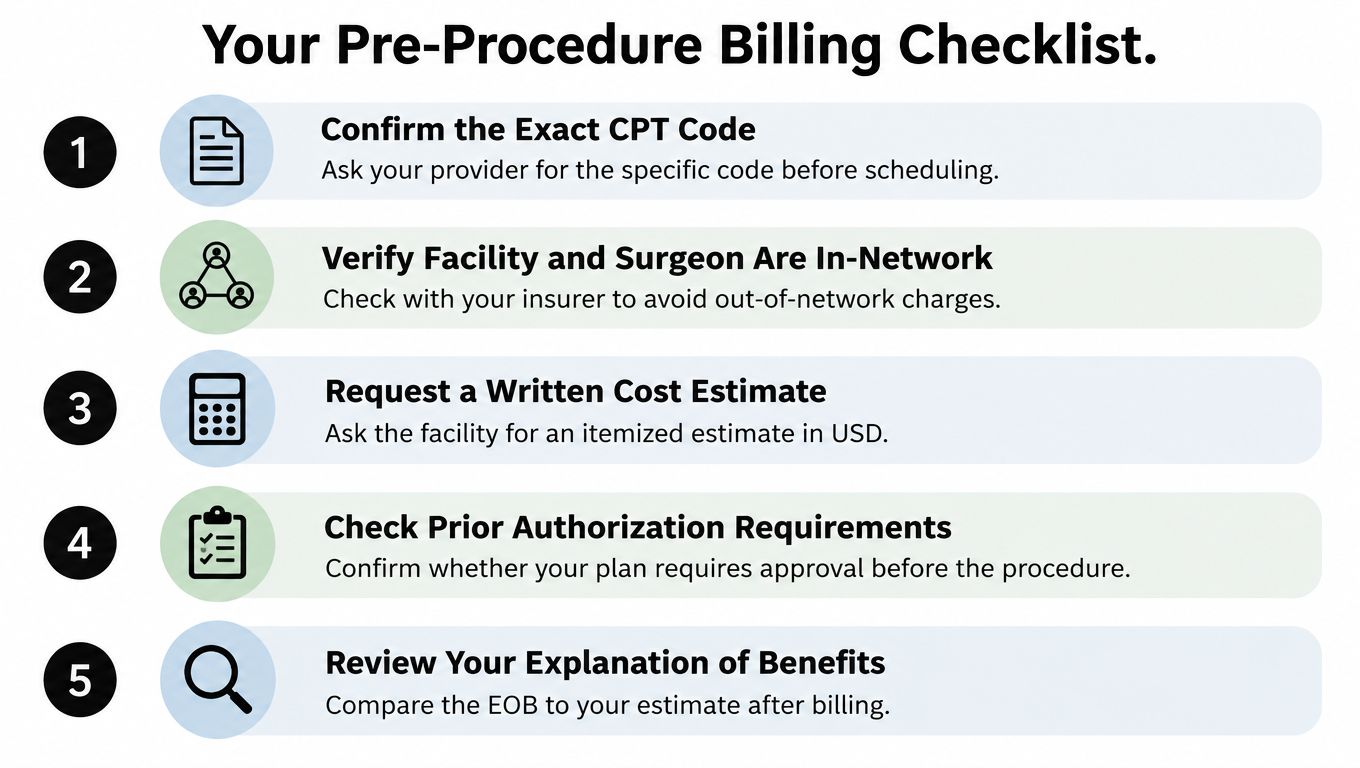
The phone calls don't need to be complicated. Ask each representative to document the date, name, reference number, and answer. If the facility, insurer, and physician's office give different information, pause scheduling long enough to reconcile the discrepancy.
Kyphoplasty Versus Alternatives
Kyphoplasty can carry a higher initial procedural price than vertebroplasty or conservative treatment, but the cheapest procedure isn't automatically the cheapest episode of care. The right comparison includes pain, mobility, rehabilitation, hospitalization, caregiving, and the likelihood that treatment will resolve the fracture-related problem.
Older hospital-economics data found adjusted mean costs of about $16,182 for inpatient kyphoplasty versus $11,386 for inpatient vertebroplasty, and $7,010 for outpatient kyphoplasty versus $2,997 for outpatient vertebroplasty. Those figures are historical economic comparisons, not current Illinois quotes.
| Treatment option | Typical Illinois price | Medicare setting effect | Two-year episode cost |
|---|---|---|---|
| Kyphoplasty | Roughly $9,600 to $26,400 for listed Chicago self-pay prices | Facility and professional components vary by site of service | Population-level studies show that the initial price may not represent total follow-up spending |
| Vertebroplasty | No single Illinois price applies | Facility setting, code, levels, and coverage still change the approved amount | Older Medicare analyses found different longer-term spending patterns than the initial procedure price suggests |
| Conservative management | No single procedure price | Costs arise through visits, medication, imaging, rehabilitation, and possible hospitalization | Total spending depends on pain duration, mobility, complications, and response to care |
A Medicare analysis followed 1,609 vertebroplasty patients and 2,878 kyphoplasty patients for two years. Adjusted average costs were $15,117 and $41,339 for kyphoplasty across the reported follow-up periods, compared with $14,585 and $44,496 for vertebroplasty; after the first nine months, kyphoplasty was associated with 6.8% to 7.9% lower adjusted treatment costs through two years (Medicare follow-up cost analysis). These are population estimates, not a personal bill.
When the higher initial cost may make sense
Kyphoplasty may be considered when imaging confirms a painful acute or non-healed fracture, pain substantially limits function, and appropriate conservative care hasn't worked. The value may come from stabilizing the fracture and helping the patient move sooner, but candidacy still depends on the clinical findings, fracture characteristics, underlying osteoporosis or cancer, and payer requirements.
Vertebroplasty or structured nonsurgical care may be more economical in other cases. The comparison shouldn't assume that one augmentation technique is universally superior. It should ask which option fits the fracture, the patient's health, expected recovery, and the total financial consequences of remaining immobile.
Workers' Compensation and Personal Injury Considerations
Workers' compensation and personal injury cases follow different administrative paths from ordinary Medicare or commercial insurance. The procedure itself doesn't change, but the person responsible for authorizing and paying for care does.
In an Illinois workers' compensation case, the carrier may require treatment authorization, utilization review, medical records, and sometimes an independent medical examination. Delays often arise when the records don't clearly connect the fracture, symptoms, imaging, and proposed procedure to the work incident. A case manager or attorney may need the exact CPT code, facility estimate, imaging report, and clinical rationale.
Personal injury cases can involve liability disputes, health-insurance subrogation, attorney arrangements, and provider liens. A patient may receive care before the claim resolves, but that doesn't mean the patient has no financial responsibility. Ask how charges will be handled, which documents must be signed, and whether the practice expects insurance billing, a lien, or another arrangement.
For general information about responding when a workers' compensation claim is denied, AskLegally's appeal advice for injured workers may help you prepare questions for your attorney or case manager. It isn't a substitute for case-specific legal advice.
Payer type changes the workflow more than it changes the procedure. Clear records and early communication reduce avoidable billing delays.
Patients with crash-related symptoms can also review information about car accident pain management. The key financial step is to identify who has authority to approve treatment before scheduling and to keep every authorization, estimate, and correspondence.
Planning Your Next Step Near Chicago Ridge
A clear billing plan starts with the fracture and the proposed treatment. Confirm that imaging supports a painful acute or non-healed compression fracture. Ask which vertebral level is involved and whether conservative care was appropriate and unsuccessful.
Before scheduling, request:
- The exact CPT code and number of levels.
- The planned site of service.
- Separate, itemized facility and physician estimates.
- Confirmation of anesthesia, imaging, implants, and network status.
- Prior-authorization requirements and deductible responsibility.
- The payer category, whether Original Medicare, Medicare Advantage, commercial insurance, workers' compensation, or a personal injury arrangement.
Ask who will bill each service. A facility estimate may not include the physician, anesthesia, imaging, or implant charges. That distinction helps separate the Medicare-approved amount or negotiated rate from the amount you may owe.
Chicago Ridge, Palos Heights, Palos Hills, Evergreen Park, and Hickory Hills provide a practical local service area. A pain and wellness clinic may offer kyphoplasty among other interventional options, but imaging, symptoms, medical history, and coverage should guide the decision. Review this guide to kyphoplasty procedure recovery before discussing restrictions and follow-up.
Listed Chicago facility prices vary widely, so one advertised self-pay figure is not a reliable estimate of your bill. Confirm what each quote includes and obtain the exclusions in writing.
Midwest Pain & Wellness evaluates vertebral compression fractures, reviews imaging, and discusses treatment and billing questions. Visit Midwest Pain & Wellness to request a consultation near Chicago Ridge.