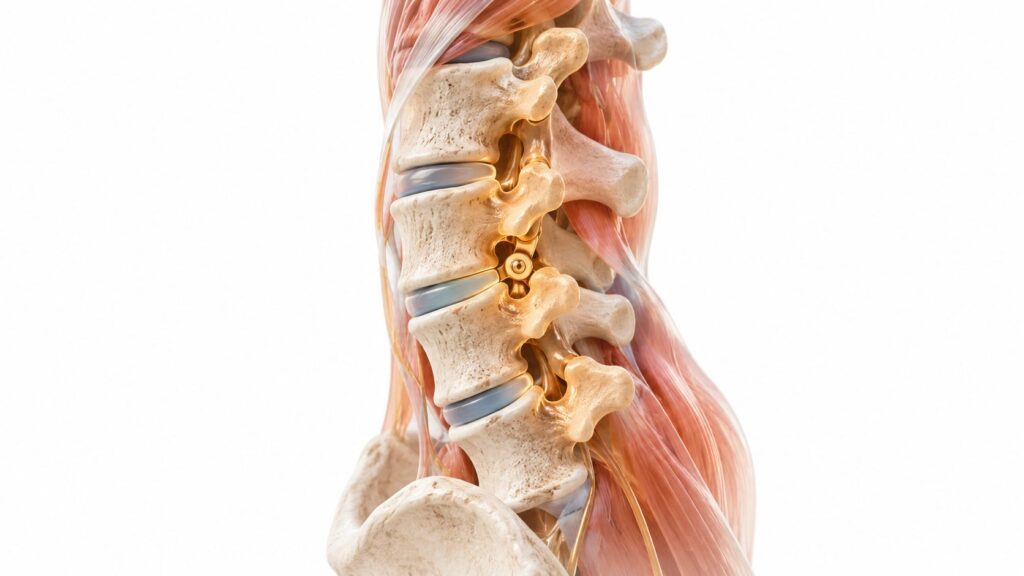
You may be considering an epidural steroid injection because pain from your back or neck travels into an arm or leg, and other care hasn't brought enough relief. It's natural to want to know what the procedure involves, what could go wrong, and whether the way it's done changes the risk.
There isn't one risk estimate that applies to everyone. The location of the injection, the route, the medication, your health history, and the safeguards used all matter. A useful conversation with your pain specialist should address those details, not just whether injections are “safe” or “dangerous.”
Table of Contents
- What Epidural Steroid Injections Are
- How Epidural Steroid Injections Work
- What the Complication Rates Actually Show
- How Technique and Steroid Choice Affect Risk
- How Clinicians Minimize Injection Risks
- Alternatives to Epidural Steroid Injections
- Questions to Ask Your Pain Specialist
What Epidural Steroid Injections Are
Suppose a person has lower back pain that shoots down the leg. A clinician may suspect an irritated spinal nerve and discuss an epidural steroid injection as one possible way to reduce inflammation near that nerve. The injection isn't the same as a shot into a muscle or a joint. It places corticosteroid medication in the epidural space, the area around the coverings of the spinal nerves.
These injections are generally considered for pain linked to irritated or compressed nerve roots, such as pain associated with a herniated disc, sciatica, or spinal stenosis. They don't repair a disc or remove pressure from a nerve. The aim is to reduce inflammation and, if it works, make everyday movement or rehabilitation more manageable.
An injection may be one part of a broader pain-management plan, rather than a stand-alone solution. Whether it's a reasonable option depends on the suspected cause of symptoms, examination findings, imaging when appropriate, medical history, and what treatments have already been tried. Pain that doesn't follow a nerve pattern may call for a different approach.
What the injection can and can't do
A clinician should explain what the procedure is intended to help with and what it won't address. Relief may be limited or temporary, and some people don't experience meaningful improvement. If pain improves, the next step may be to use that window to work on function and other parts of the treatment plan.
A useful expectation: An injection may calm inflammation around a nerve, but it doesn't necessarily correct the underlying structural cause of pain.
The term “steroid” can also create confusion. In this procedure, it refers to a corticosteroid medicine intended to reduce inflammation, not an anabolic steroid used to build muscle. The treatment is targeted, but the medication can still have effects beyond the injection site, especially when exposure is repeated or higher-dose.
Patients in Chicago Ridge, Palos Heights, Palos Hills, Evergreen Park, and Hickory Hills, Illinois, can ask a pain and wellness clinician to explain why the injection is being considered for their specific symptoms. A clear recommendation should connect the diagnosis, the intended benefit, and the risks that matter for that patient.
How Epidural Steroid Injections Work
The spinal canal contains nerves, and the epidural space lies around the protective coverings of those nerves. When a nerve root becomes inflamed, it can send pain into the back, neck, arm, or leg. The injected corticosteroid is intended to reduce inflammation near the affected area. Think of it as applying a fire suppressant close to a small source of irritation, not rebuilding the structure around it.
The clinician chooses an approach based on the spinal level and the target. The main approaches are interlaminar, transforaminal, and caudal. Each uses a different path to reach the epidural space.
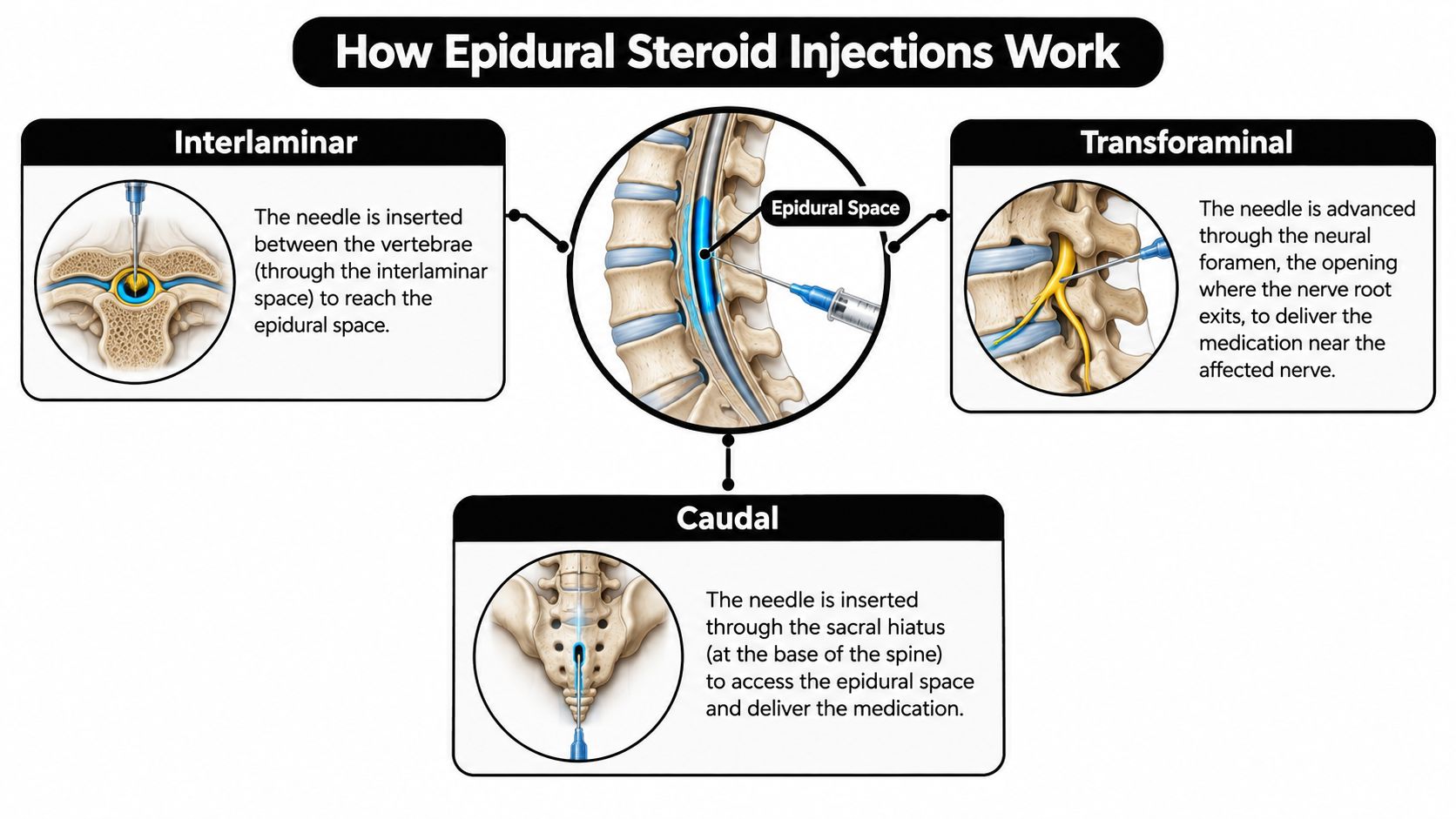
Three routes to the epidural space
- Interlaminar: The needle enters between parts of the vertebrae to reach the epidural space. A clinician may consider this route when medication needs to spread around an area rather than target one nerve root from the side.
- Transforaminal: The needle approaches through the opening where a spinal nerve exits. This can direct medication closer to a specific nerve root, but the needle is also near blood vessels, so precise placement and attention to vascular anatomy matter.
- Caudal: The needle enters through an opening near the base of the spine and advances into the lower epidural space. The route approaches the lower spine from below.
The route isn't chosen because one technique is universally safer or more effective. A clinician weighs the location of symptoms, the suspected nerve, anatomy, and the purpose of the injection. Ask which route is proposed and why it fits your condition.
Clinicians may use fluoroscopy, a form of X-ray guidance, to help position the needle. Guidance helps show where the needle is, but it can't eliminate every risk. In 2014, the U.S. Food and Drug Administration required injectable corticosteroid labels to warn about serious neurological events after epidural administration. The action followed reports of 90 serious, sometimes fatal neurological events between 1997 and 2014. Those reports included spinal-cord infarction, paraplegia, quadriplegia, cortical blindness, and stroke. The count is not an incidence rate: adverse-event reports lack a reliable denominator, may miss cases, and can't establish an individual patient's probability. The warning also noted that events had occurred both with and without fluoroscopic guidance, and that safety and effectiveness for epidural administration hadn't been established. Epidural use is generally considered off-label for corticosteroid products. The FDA safety history and warning are important context, but they don't mean every route or patient carries the same risk.
What the Complication Rates Actually Show
Suppose you search online and find a study reporting complications in 16.8% of epidural injections. That figure would unsettle anyone, and it deserves a second look before it settles anything. A systematic review summarized complication rates across studies at approximately 2.4% to 16.8%, a wide spread explained by differences in technique, spinal level, patient selection, and how each study defined a complication. In one retrospective review, complications followed 2.4% of 4,265 injections performed in 1,857 patients over seven years. The systematic review and its discussion of complications show why definitions matter.
Counting complications works like counting traffic accidents. One report may include every scraped bumper, while another records only collisions that caused injury. A study that counts brief soreness the same way it counts nerve damage will always produce a bigger number.
These figures describe groups of patients across different studies. They are not a personal forecast.
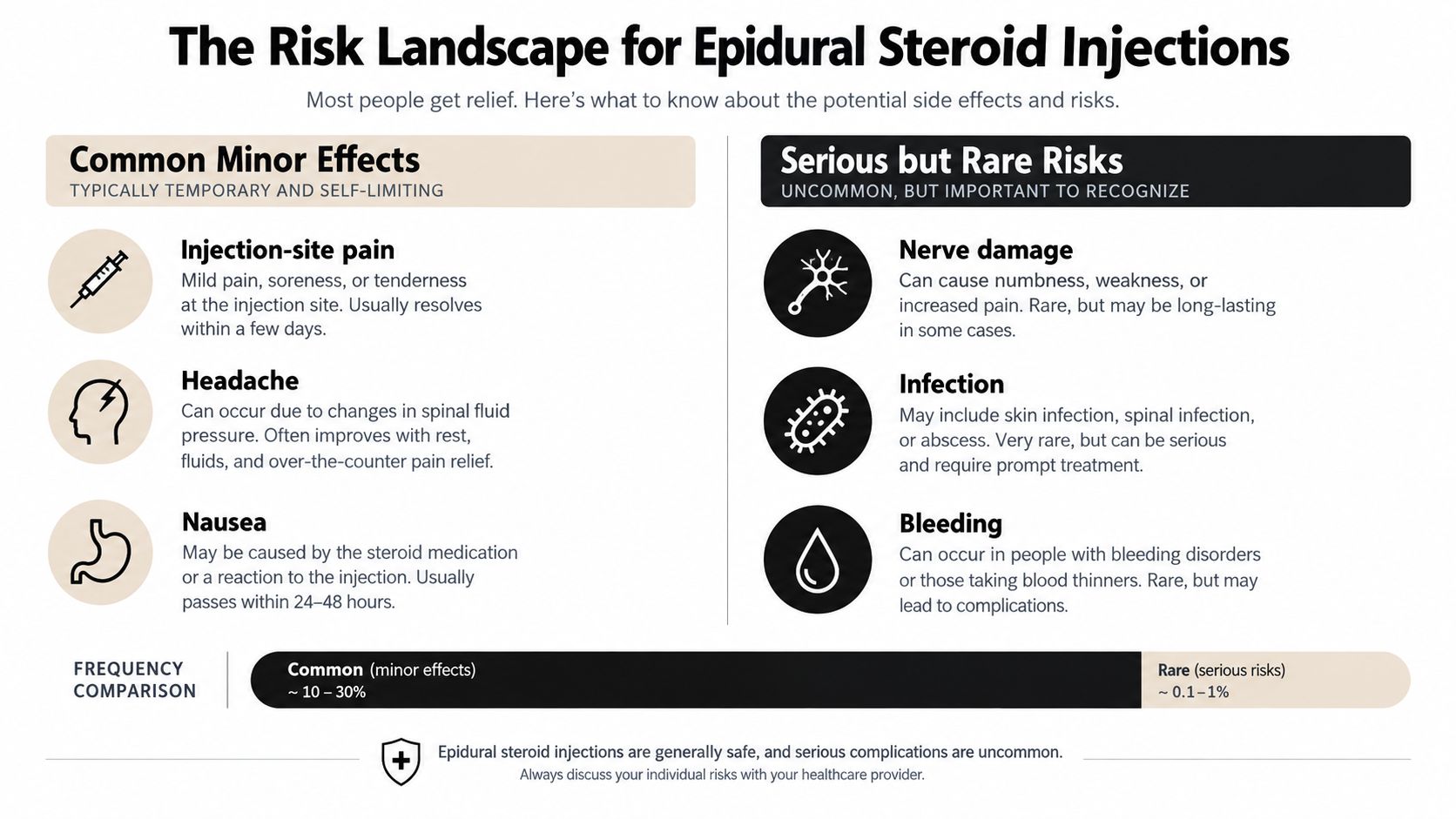
Temporary effects and procedural complications
A systematic review and meta-analysis of epidural injections for sciatica reported headache in 14.2% of procedures, local injection-site pain in 15.6%, tinnitus in 5.5%, and nausea in 8.2%. It also reported dural puncture in 1.5%, intravascular infiltration in 4.1%, and nerve-root irritation in 1.5%. The review of reported periprocedural events gives useful context for distinguishing an unpleasant day from a genuine problem.
A dural puncture can let cerebrospinal fluid leak, producing a headache that worsens when you sit or stand and eases when you lie down. Most temporary effects resolve on their own. Rarer events carry more weight: epidural hematoma has been estimated at 1 in 70,000 to 1 in 190,000 injections. The same review notes reported events such as hematoma, infection, paralysis, spinal-cord injury, and death.
Why averages don't predict your outcome
Population rates blend many different procedures into a single number. Your personal risk depends on the spinal level being treated, the injection route, the medication used, and your own health, including blood thinners, diabetes, or a weakened immune system.
That is where a focused conversation with your clinician does the most good. Ask which complication rate applies to the specific injection being proposed, not to epidural injections in general. Ask how often the clinician performs that procedure, which technique reduces the main risks in your case, and which symptoms afterward should trigger a call.
After the injection, certain symptoms need prompt medical assessment: a severe headache that persists or worsens when upright, fever, progressive weakness in a limb, loss of bowel or bladder control, or intense back pain. These can signal bleeding or infection rather than ordinary soreness, and waiting them out is the wrong move.
How Technique and Steroid Choice Affect Risk
The route and medication can change the risk discussion. One concern is particulate corticosteroid: its particles can clump. If the medication accidentally enters an artery supplying the spinal cord or brain, particles may obstruct small vessels and cause ischemia. The consequences can include permanent paralysis, stroke, blindness, or death. This mechanism is most strongly associated with transforaminal injections, particularly in the cervical and thoracic regions, where the needle is near segmental arteries.
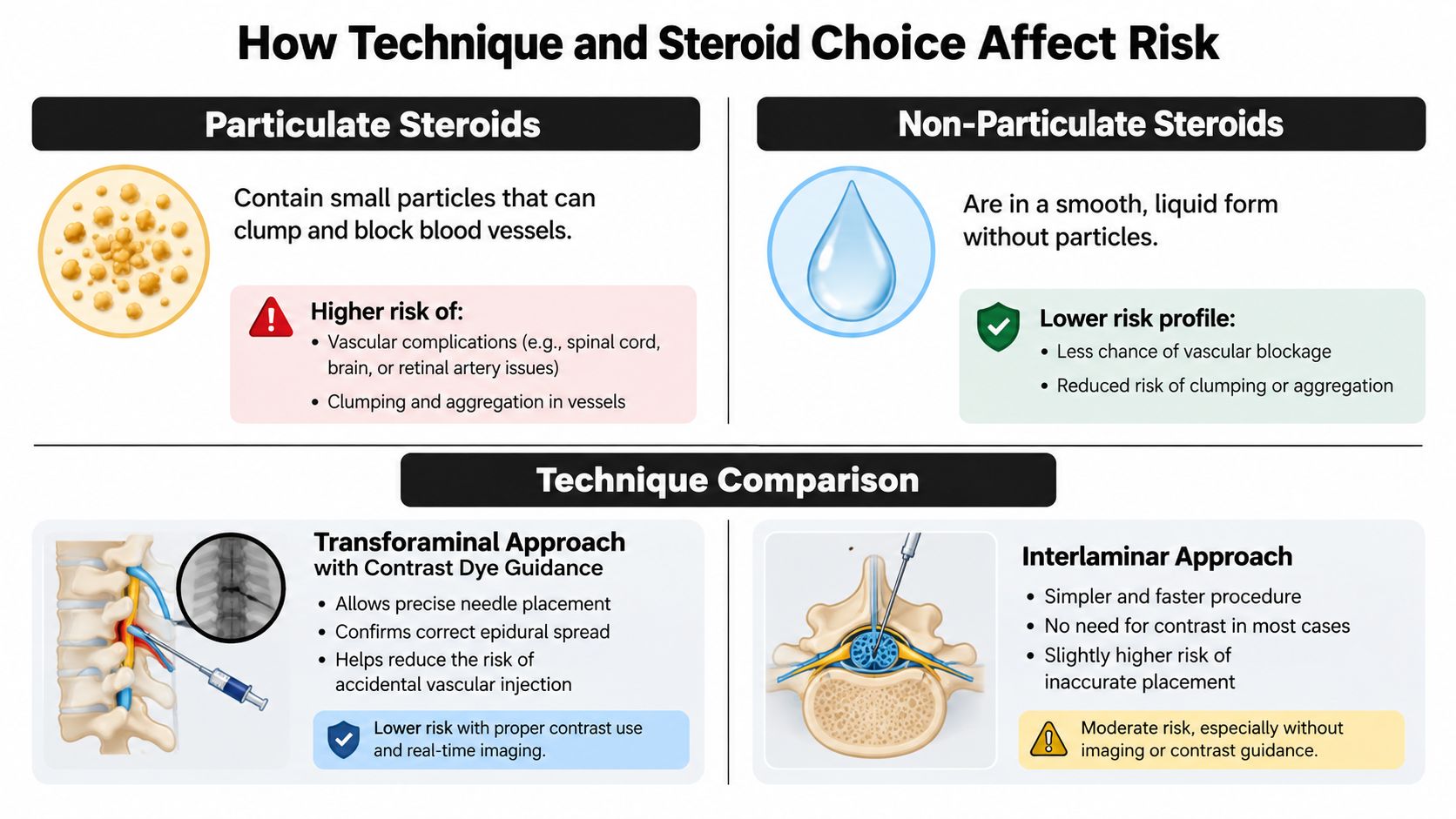
Particulate and non-particulate options
Non-particulate dexamethasone doesn't form the same embolizing particles. Reviews and recommendations generally favor it for cervical procedures and lumbar transforaminal injections when safety is a priority, though it doesn't make the procedure risk-free. Comparative evidence hasn't consistently shown that particulate products provide better pain or functional outcomes, so medication choice deserves a direct conversation rather than an assumption that one formulation is always preferable.
A transforaminal route may put medication near a specific nerve root, but it also brings the needle closer to blood vessels. An interlaminar route uses a different path and has its own considerations. Neither label alone tells you how safe a proposed injection is. Ask the clinician to explain the route, the target, and how the plan accounts for nearby blood vessels.
Questions about safeguards
Image guidance, contrast injection to identify possible vascular uptake, and careful needle positioning are practical precautions. They can help clinicians recognize or reduce certain hazards, but no technique eliminates risk. The FDA-approved labeling warns of serious neurological events, including spinal-cord infarction, paralysis, cortical blindness, and stroke, and notes that epidural administration isn't an FDA-approved indication because safety and effectiveness for that route haven't been established. The corticosteroid product labeling describes these warnings.
Ask what formulation is planned and why. If you're weighing the timing or frequency of another injection, this guide to how many steroid injections may be appropriate can help frame questions about reassessment and cumulative exposure with your clinician.
How Clinicians Minimize Injection Risks
Risk reduction starts before the needle is placed. The clinician should review the diagnosis, planned spinal level and route, medications, allergies, and health conditions that could affect the procedure or recovery. Tell the care team about blood thinners, diabetes, immune suppression, active infection, prior reactions to steroids, and any relevant medical history. Don't stop an anticoagulant on your own; the prescriber and procedural clinician should agree on a plan for your situation.

During the procedure and afterward
Clinicians may use imaging to help guide needle placement and contrast to check for unintended vascular uptake. They also consider the route, nearby anatomy, and medication formulation. Fluoroscopy can support accurate placement, but it doesn't guarantee that complications won't occur. You can ask what imaging will be used and what the clinician will do if the needle or contrast behaves unexpectedly. This overview of fluoroscopy-guided injections provides additional background on imaging guidance.
Afterward, follow the care team's instructions and ask which temporary effects are expected. A short-lived increase in soreness isn't the same as a new neurological problem. The FDA advises immediate medical attention for unusual vision changes, sudden weakness or numbness in the face, arms, or legs, severe headache, dizziness, or seizures. The FDA's warning about serious neurological symptoms after epidural corticosteroid injections applies broadly, including to patients in Chicago Ridge, Palos Heights, Palos Hills, Evergreen Park, and Hickory Hills. Don't assume new neurological symptoms are ordinary post-procedure effects.
For people comparing injection procedures, a Haven Medical joint injection guide can help clarify how a joint injection differs from a procedure that targets the epidural space. The location and purpose of the injection matter when you're interpreting benefits, risks, and aftercare.
Alternatives to Epidural Steroid Injections
An epidural injection is one option, not an automatic next step. The best alternative depends on the pain source, how it affects function, previous treatment, and whether there are warning signs that call for a different evaluation. A clinician can help match the treatment to the problem rather than treating every kind of back or leg pain as the same condition.
Match the option to the problem
Physical therapy and guided activity may be appropriate when movement, strength, and function are central goals. A clinician or rehabilitation professional can tailor activity to the person's symptoms and medical needs. For readers looking for general ideas about strengthening, this guide to back strength exercises with dumbbells offers a starting point to discuss with a qualified professional, particularly if movement currently worsens pain.
Oral medications may be considered when a medicine is appropriate for the patient's health history and symptoms. They can have their own side effects and aren't suitable for everyone, so ask about interactions and precautions rather than assuming a pill is automatically lower risk.
Nerve blocks may help a clinician evaluate or treat pain involving a particular nerve. Radiofrequency ablation may be considered for selected pain sources when its target is appropriate. These procedures aren't interchangeable with epidural injections: they use different methods and are intended for different pain patterns.
An injection may be considered when symptoms suggest an irritated spinal nerve and the clinician believes reducing inflammation could help. Another approach may make more sense when the pain comes from a different structure, when the risks outweigh the likely benefit, or when the plan should focus on another diagnosis or treatment. Shared decision-making means discussing the alternatives, not just accepting or rejecting an injection without understanding why it's proposed.
Questions to Ask Your Pain Specialist
A focused appointment can help turn a general worry into a practical discussion about your own circumstances. You don't need to memorize medical terminology. Ask the clinician to explain the plan in everyday language and to clarify which risks matter most for you.
Take these questions to your appointment
- What is the suspected cause of my pain? Ask how your symptoms, examination, and any imaging support the proposed treatment.
- Which route are you recommending, and why? Ask whether it's interlaminar, transforaminal, or caudal, and how the route fits the spinal level and target.
- Which steroid will you use? Ask whether it's particulate or non-particulate and why that formulation is appropriate for the proposed approach.
- What guidance and safeguards will you use? Ask about imaging, contrast, needle positioning, and how the team checks for vascular uptake.
- How should I manage my medications and health conditions? Mention anticoagulants, diabetes, osteoporosis, infection risk, adrenal disease, pregnancy-related concerns, upcoming surgery, and prior steroid reactions. Confirm medication changes with the care team.
- What symptoms require urgent help? Ask whom to contact and where to go if you develop new neurological symptoms or other concerning changes.
Repeated or higher-dose injections also deserve a deliberate review. A dose-comparison review found that higher lumbar epidural steroid doses didn't produce significantly better pain or functional outcomes than lower doses, but were associated with more adverse effects, particularly hyperglycemia and suppression of the hypothalamic-pituitary-adrenal axis. The review on lumbar epidural steroid dose and effects supports asking whether a proposed repeat is based on meaningful benefit, rather than scheduling it automatically. The evidence on repeated treatment remains unclear, and concerns include cumulative steroid effects such as epidural lipomatosis.
Before agreeing to another injection, ask what changed after the last one: Did pain or function improve enough to matter, and does that benefit justify repeating the treatment?
For a broader appointment checklist, you can also review these questions to ask a pain management doctor. If you're exploring non-injection ways to manage discomfort alongside care, this overview of infrared sleeves and chronic pain management can inform a conversation about supportive options, without replacing an assessment of the underlying condition.
If you're considering an epidural steroid injection, Midwest Pain & Wellness offers personalized pain evaluation and image-guided treatment options at its Chicago Ridge clinic. Visit Midwest Pain & Wellness to discuss your symptoms, the proposed technique, and whether an injection or another approach fits your care plan.