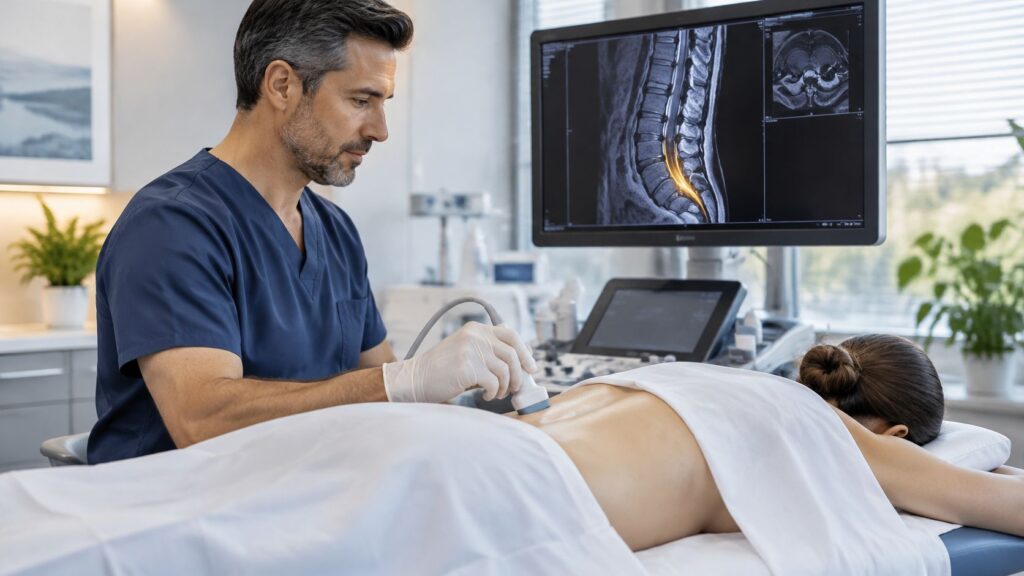
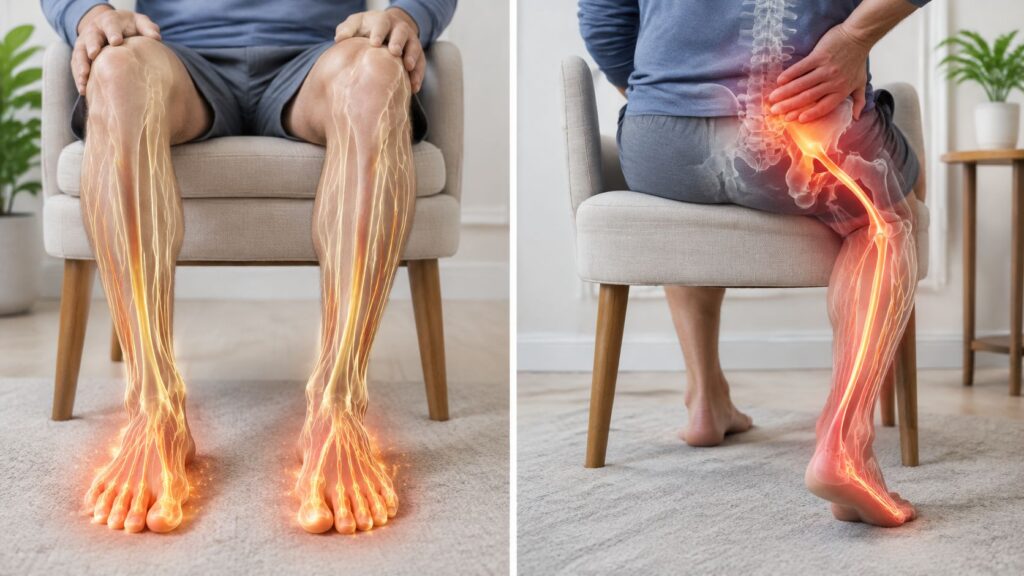
You wake up with a stiff neck, or you spend the workday shifting in your chair because your lower back keeps grabbing. You try rest, over-the-counter pain relievers, and a few stretches, but the pain keeps coming back, and now it's starting to travel into an arm or leg, interrupt sleep, or make simple tasks feel harder than they should. That's usually the point where a back and neck pain specialist stops being a distant idea and becomes a practical next step.
For many people in Chicago Ridge, Palos Heights, Palos Hills, Evergreen Park, and Hickory Hills, the question isn't whether the pain is “bad enough,” it's who should see it first and whether waiting is still reasonable. Back and neck pain are common worldwide and in the U.S. In one large global analysis, low back pain caused 181.6 million new cases and 428.5 million prevalent cases in 2021, while neck pain caused 32.56 million new cases and 159 million prevalent cases; the same analysis reported 48.84 million years lived with disability from low back pain and 15.91 million from neck pain in 2021, with only slight long-term changes in age-standardized trends since 1990 (Frontiers in Public Health). In the U.S., about 26% of adults have low back pain at any given time and about 14% have neck pain, and back pain accounts for 2% to 3% of all physician visits (StatPearls via NCBI).
Table of Contents
- When Back and Neck Pain Stops Being Just an Ache
- What a Back and Neck Pain Specialist Actually Does
- Common Causes and Red Flags You Should Never Ignore
- Evidence-Based Treatments Without Relying on Opioids
- How to Choose the Right Specialist Near Chicago Ridge
- What to Expect at Your First Visit
- Insurance, Workers' Comp, and Personal Injury in Illinois
- Common Questions From Chicago-Area Patients
When Back and Neck Pain Stops Being Just an Ache
A patient from the southwest suburbs often tells a very familiar story. The pain started after a long drive, a bad night of sleep, or a lift that felt ordinary at the time. A few weeks later, the pain hasn't settled down, and now it's not just sore, it's shooting down the arm, wrapping into the shoulder blade, or radiating into the leg.
That's the moment where self-care starts to lose its value. Rest, ice or heat, gentle movement, and over-the-counter medication can be reasonable early steps, but they don't answer the bigger question, what is irritating the nerve, joint, or disc? If pain keeps interfering with work, sleep, driving, or family life, the next move usually isn't more guessing. It's a focused evaluation.
Why the closest clinic isn't always the right clinic
People often search for the nearest place that treats pain, then hope the right person is there. Distance matters, but match matters more. A pain pattern with arm numbness, leg weakness, or pain after surgery doesn't need the same entry point as simple muscle strain.
Practical rule: if pain is spreading, lingering, or changing the way you move, the right specialist is the one who can sort out the source before you get pushed into a treatment that doesn't fit.
That's why the decision point matters. A general visit can be enough for uncomplicated soreness, but persistent radicular pain, chronic nerve pain, or pain that follows surgery usually needs someone who can connect the dots between history, exam, imaging, and treatment options. In the Chicago Ridge area, that often means a pain and wellness clinic that coordinates diagnosis and treatment under one roof rather than sending you from office to office.
The Cleveland-style problem-solving approach doesn't help much if the pain pattern is complex. A person can do everything “right” for a few weeks and still have a disc, joint, or nerve problem that needs a different plan. If that sounds like your situation, the next step is not to panic. It's to understand what kind of specialist fits the job.
What a Back and Neck Pain Specialist Actually Does
A lot of people use “spine doctor” as a catch-all, but the roles aren't the same. The right entry point depends on whether the problem looks mechanical, nerve-related, structural, or post-surgical. A back and neck pain specialist is usually the person who helps sort that out first, then matches the treatment to the pattern.
The three specialists patients mix up most often
An interventional pain physician focuses on diagnosing pain generators and treating them with image-guided procedures, medication strategy, and non-opioid care. A physiatrist, also called a physical medicine and rehabilitation doctor, often acts like the diagnostic quarterback for complicated spine cases, especially when symptoms involve strength, tingling, or function. A spine surgeon comes in when there's a structural problem that needs an operation or when red flags make surgery or urgent evaluation necessary.
The difference matters because not every painful spine needs a procedure, and not every nerve symptom needs surgery. In many cases, the first useful step is a careful nonoperative workup with a plan that can be adjusted based on response. Evidence-based neck pain guidance supports a stepped approach with reassurance, education, exercise therapy, manual therapy, and oral or topical analgesics first, with psychological or multidisciplinary care for selected subgroups (guideline review).
A clinic that handles pain, function, and procedures together can shorten the path from “I'm still hurting” to “I know what this is.”
That's where a pain and wellness clinic differs from a physical therapy office. Physical therapy helps with rehabilitation, but it doesn't diagnose every pain generator or perform image-guided procedures. A pain and wellness setting can review imaging, examine the nerve pattern, consider medication options, and decide whether an injection, block, or another intervention fits the case. For southwest suburban patients, Midwest Pain & Wellness in Chicago Ridge fits that integrated role.
Common Causes and Red Flags You Should Never Ignore
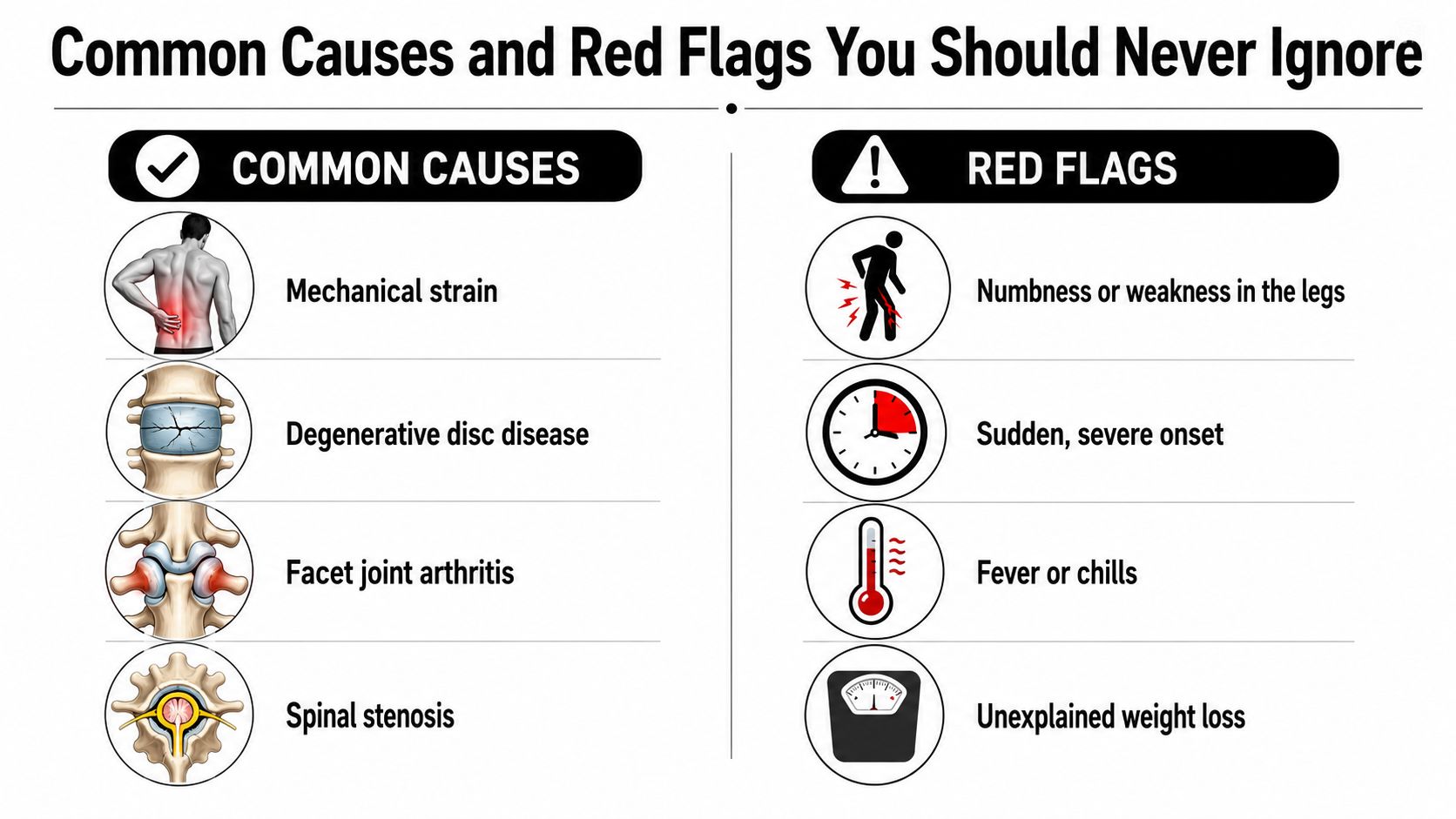
Back and neck pain aren't one diagnosis. They're a set of patterns, and the specialist's job is to figure out which pattern you're showing. Mechanical strain often feels localized and movement-related. Degenerative disc disease can create aching pain with flares. Facet arthritis tends to hurt with certain positions and twisting. Spinal stenosis can bring on heaviness, walking limits, or relief when bending forward.
Patterns that point toward nerve involvement
When pain starts traveling into an arm or leg, or when numbness, tingling, or weakness show up, the problem may be more than simple strain. Herniated discs with radiculopathy can irritate a nerve root. Sacroiliac joint dysfunction can mimic low back pain that sits low and off to one side. Whiplash may follow a crash or sudden motion and involve neck stiffness, headaches, and shoulder discomfort. Post-surgical pain and chronic nerve pain can linger after the tissue has healed, which is why the story matters as much as the scan.
The right specialist listens for what the pain does, not just where it lives. Does it worsen with sitting, standing, walking, coughing, or turning the head? Does it wake you from sleep? Does it move below the knee or into the hand? Those details help separate joint pain from nerve pain and make the exam more useful.
When the situation needs urgent attention
Some symptoms don't wait for a routine appointment. Progressive weakness, bowel or bladder changes, saddle anesthesia, unexplained weight loss, fever, night pain, or a history of cancer call for same-day medical evaluation. That's not the time to keep trying stretches or wait for the weekend to pass.
For uncomplicated mechanical pain, a conservative window is usually reasonable before escalation. In spinal pain guidance, a single epidural or nerve-root injection may be considered when severe neck or back pain with radiculopathy doesn't improve after 6 weeks of documented conservative therapy, or sooner if there's progressive objective neurologic deficit (BSW ICB spinal pain guidance). Repeat injections are generally judged by meaningful response, not just brief fluctuation, with 70% pain improvement lasting 6 months used as a benchmark in that guidance.
Evidence-Based Treatments Without Relying on Opioids
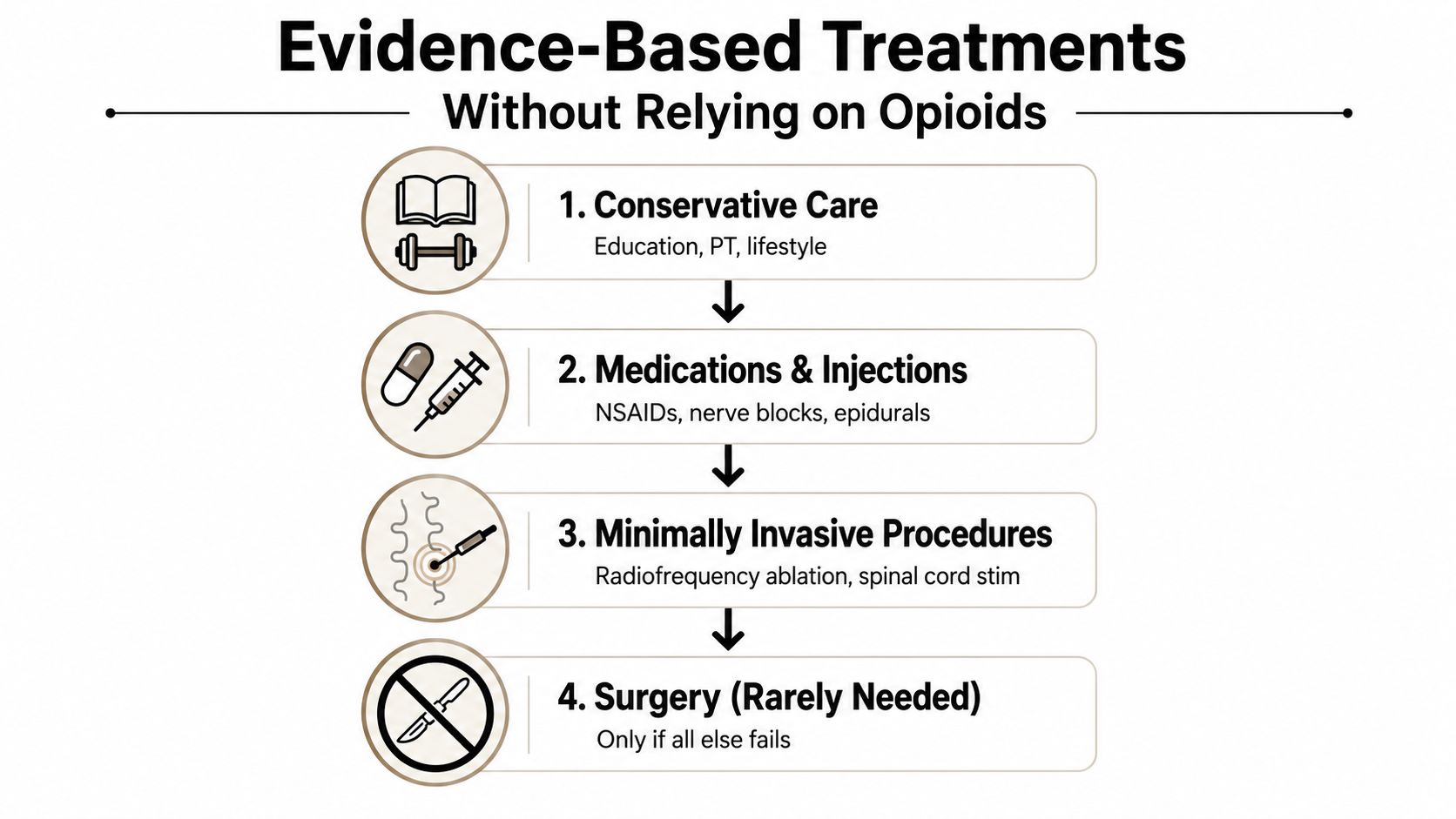
The cleanest treatment plan starts with the least invasive option that still fits the diagnosis. For many patients, that means education, activity changes, and a targeted rehab plan first. For nerve pain, it may also include non-opioid medication choices that calm nerve signaling rather than masking pain.
The treatment ladder in plain English
A good plan often begins with conservative care. That can include movement-based rehab, posture and lifting coaching, and medications that fit the pain type. For nerve-type pain, clinicians may use anticonvulsants or antidepressants in a pain-modulation role, not for psychiatric reasons, because those medicines can reduce nerve irritation in some patients. This is one reason a specialist visit matters, the right drug for muscle pain is not always the right drug for nerve pain.
If that's not enough, the next step may be an image-guided injection. Epidural steroid injections are used when a nerve root is inflamed or compressed. Medial branch blocks and facet interventions help identify or calm pain from the small joints in the spine. Sacroiliac joint injections target a different pain source altogether. If facet pain keeps returning, radiofrequency ablation may provide longer-lasting relief by interrupting the tiny pain-carrying nerves.
Rule of thumb: if a procedure is being offered, ask what pain generator it is trying to confirm or treat. If nobody can explain that clearly, the plan is too vague.
For refractory cases, the toolbox gets broader. Peripheral nerve stimulation and spinal cord stimulation can help some people with persistent nerve pain or post-surgical pain. Minimally invasive lumbar decompression (MILD) and Vertiflex Superion are options for some patients with lumbar stenosis. Kyphoplasty may help selected vertebral compression fractures. PRP and other regenerative options may be used for select joint or tendon problems. For headache-related or movement-related conditions, Botox can be part of care in the right diagnosis, and bioidentical hormone replacement may be discussed when appropriate in a broader wellness plan.
If you want to see how that kind of stepped care is organized, the clinic's advanced pain management approach outlines the broader model.
Why the non-opioid approach matters
A pain clinic that emphasizes function, not just symptom suppression, usually tries to match the intensity of treatment to the intensity of the problem. That's important because more invasive is not automatically better. Some patients do better with a coordinated rehab plan than with another procedure, especially when pain is chronic and the pattern is mixed.
How to Choose the Right Specialist Near Chicago Ridge
For patients in Chicago Ridge, Palos Heights, Palos Hills, Evergreen Park, and Hickory Hills, the best choice usually comes down to symptom pattern and urgency. If the pain is simple, early, and clearly improving, a primary care visit may still make sense first. If there's radiating pain, weakness, persistent numbness, or pain that's outlasting conservative care, an interventional pain specialist is often the right next call.
A simple decision rule
Use this order of thinking. Primary care first when the pain is new, non-radiating, and improving with time. Pain specialist first when the pain is persistent, nerve-like, post-surgical, or function-limiting. Spine surgeon first when there are red flags, progressive neurologic deficits, or a structural problem that already looks surgical.
Local fit matters too. Look for double board certification, on-site image guidance, and a multimodal, opioid-sparing philosophy. Ask whether the clinic coordinates with surgeons, chiropractors, and rehab providers when needed, because complicated spine pain usually needs that kind of handoff. For work-related injuries and crash-related cases, support for workers' compensation and personal injury documentation can save time later.
A Chicago Ridge clinic that combines diagnosis, image-guided procedures, and rehabilitation coordination can reduce the ping-pong effect of being sent from one office to another. That's especially helpful when symptoms are changing and you need a plan that can move from evaluation to treatment without losing momentum.
| Symptom Pattern | First Specialist to See | When to Escalate |
|---|---|---|
| Local back or neck ache that improves with rest and movement | Primary care or conservative care | Escalate if it persists or starts radiating |
| Pain shooting into arm or leg, numbness, tingling, or weakness | Interventional pain specialist or physiatrist | Escalate sooner if weakness progresses |
| Pain after surgery | Interventional pain specialist | Escalate if imaging or exam suggests a structural problem |
| Red flags, bowel or bladder changes, fever, cancer history, major weakness | Urgent medical evaluation, then spine specialist as needed | Same-day care |
The goal isn't to over-medicalize every sore neck. It's to avoid under-treating pain that's already crossed the line from nuisance to disability.
What to Expect at Your First Visit
The first visit is usually more detailed than people expect, but that's a good thing. A specialist can't make a smart plan from a single sentence like “my back hurts.” They need the timeline, the pattern, the prior treatments, and the images if you already have them.
The visit usually follows a sequence
First comes the history. Expect questions about when the pain started, where it goes, what makes it worse, what helps, and what you've already tried. The clinician will ask about prior imaging, prior injections, surgeries, accidents, and medication use. If you've had MRI or X-ray studies elsewhere, bring the reports and, if possible, the actual imaging files.
Next comes a focused physical and neurologic exam. That usually includes strength, sensation, reflexes, range of motion, and movement tests that help distinguish joint pain from nerve irritation. If the pattern suggests a specific source, the specialist may recommend a treatment plan right away or discuss a diagnostic injection when that would clarify the diagnosis.
Bring your ID, insurance card, imaging CDs or portal access, medication list, and prior notes. Those details save time and reduce guesswork.
Most patients should also come prepared to describe pain in functional terms, not just with one number. Can you sleep? Can you sit through a commute? Can you lift groceries? Can you walk the dog? A practical pain history helps the clinician choose between conservative care, a block, an injection, or something more advanced. If you want a simple framework for describing symptoms clearly, see how to describe pain to your doctor.
The day one commitment is usually a plan, not a promise of instant relief. Some patients get a clear next step immediately. Others need imaging review, record gathering, or a short conservative trial before the right procedure makes sense. Follow-up is typically built around response, because a good pain plan changes when your symptoms change.
Insurance, Workers' Comp, and Personal Injury in Illinois
Administrative details can feel annoying, but they matter because pain care often depends on authorization. For common commercial insurance plans, it's smart to verify that interventional pain care is covered before you arrive. Procedures like radiofrequency ablation, spinal cord stimulation, and some injections may need prior authorization, and the approval process can take time.
What to gather before the appointment
For workers' compensation, bring the claim number, adjuster contact, and any referral information your employer or insurer has requested. For personal injury cases, keep records of bills, imaging, treatment notes, and attorney contact details so the clinic can coordinate documentation correctly. In either case, the clinic may need a medical records release before it can move records where they need to go.
Patients sometimes assume that pain care works like a basic therapy visit. It usually doesn't. A pain and wellness clinic handles more involved diagnostics and procedures, so the paperwork and authorization steps are often different. If your pain started after a crash, the clinic's car accident pain management process is the kind of documentation-focused pathway that often comes into play.
The practical takeaway is simple. Call early, verify benefits, and ask what the office needs before the first visit. That keeps a treatable problem from stalling on paperwork.
Common Questions From Chicago-Area Patients
People ask the same practical questions once they realize they may need a specialist. The first is usually timing. If your pain is acute and severe, or if you have weakness or bowel or bladder changes, don't wait. If it's persistent but stable, a prompt outpatient visit is usually the right next step.
Many patients also ask whether they need a referral. Some plans require one, some don't, and the office can often help you figure that out before the visit. Another common question is whether a pain and wellness clinic will work with your existing surgeon or chiropractor. The answer should be yes, because coordinated care is often better than isolated care.
Second opinions are reasonable when you've been told the only options are injections or surgery and you're not sure the diagnosis fits. Follow-up after a procedure depends on the treatment and your response, but the goal is always to check whether function is improving, not just whether the pain score moved for a day or two.
For return to work or sports, the honest answer is that it depends on the diagnosis, the procedure, and how your body responds. Some people resume limited activity quickly, while others need a staged plan with restrictions and reassessment. The right clinic should tell you that clearly instead of guessing.
If you're in the southwest suburbs and pain is keeping you from working, sleeping, or moving normally, schedule a visit with Midwest Pain & Wellness to get a clear diagnosis and a treatment plan built around your symptoms, your goals, and your case.