You wake up and turn your head, only to feel a sharp, electric pain run from your neck into your shoulder blade and down your arm. Perhaps your fingers are tingling, your grip feels unreliable, or the pain keeps you awake even after you change position. These cervical radiculopathy symptoms can feel alarming, but understanding the pattern helps you decide what needs prompt attention and what can be evaluated routinely.
Cervical radiculopathy occurs when a nerve root leaving the cervical spine becomes irritated or compressed. The symptoms may involve pain, altered sensation, weakness, or reflex changes, and they don't always appear as textbook neck pain. This guide explains how to recognize classic and subtle symptoms, how clinicians evaluate them, which treatments may help, and which changes mean you should contact a provider promptly.
Table of Contents
- When Neck Pain Travels Down Your Arm
- How a Pinched Nerve Root Actually Works
- Classic Cervical Radiculopathy Symptoms to Recognize
- Overlooked Symptoms That Change the Picture
- What Happens During Diagnosis and Imaging
- Treatment Pathways From Conservative to Interventional
- Red Flags That Mean Call Your Provider Today
- Taking the Next Step at Midwest Pain & Wellness
When Neck Pain Travels Down Your Arm
A neck ache becomes more concerning when it starts behaving like an electrical signal. You may feel burning, shooting, stabbing, or shock-like pain moving into the shoulder, shoulder blade, arm, or hand. Turning your head, looking upward, or reaching overhead can intensify it because these positions may further irritate the nerve root. The clinical description of cervical radiculopathy describes the relationship between neck movement and radiating neurologic symptoms.
The familiar term pinched nerve can refer to several processes. A disc may bulge or herniate, a bone spur may reduce the available space, or nearby tissues may become inflamed. The result is an irritated nerve that sends abnormal pain signals and may carry sensation or muscle-control messages less reliably.
The symptom pattern matters
Pain intensity alone does not identify the problem. The route, quality, and change over time provide useful clues. Numbness or tingling may follow part of the forearm or hand. Weakness may appear as trouble lifting the arm, straightening the elbow, opening a jar, or keeping hold of an object.
Symptoms can also extend beyond the usual arm pattern. Scapular pain, pain in the front of the chest, and headache have been reported with cervical radiculopathy. A review of the presentation describes arm pain, sensory changes, reflex changes, neck pain, and motor deficits as common findings, while also showing why the examination must cover more than the neck. The review of cervical radiculopathy presentation
The trend matters as much as the starting point. Stable discomfort without weakness may allow time for a routine assessment. Pain paired with a weakening grip, increasing hand clumsiness, or new balance trouble deserves faster attention. These changes can indicate that the problem is affecting function, not only causing pain, so an Illinois pain and wellness clinic such as Midwest Pain & Wellness will want to hear when they began and whether they are progressing.
How a Pinched Nerve Root Actually Works
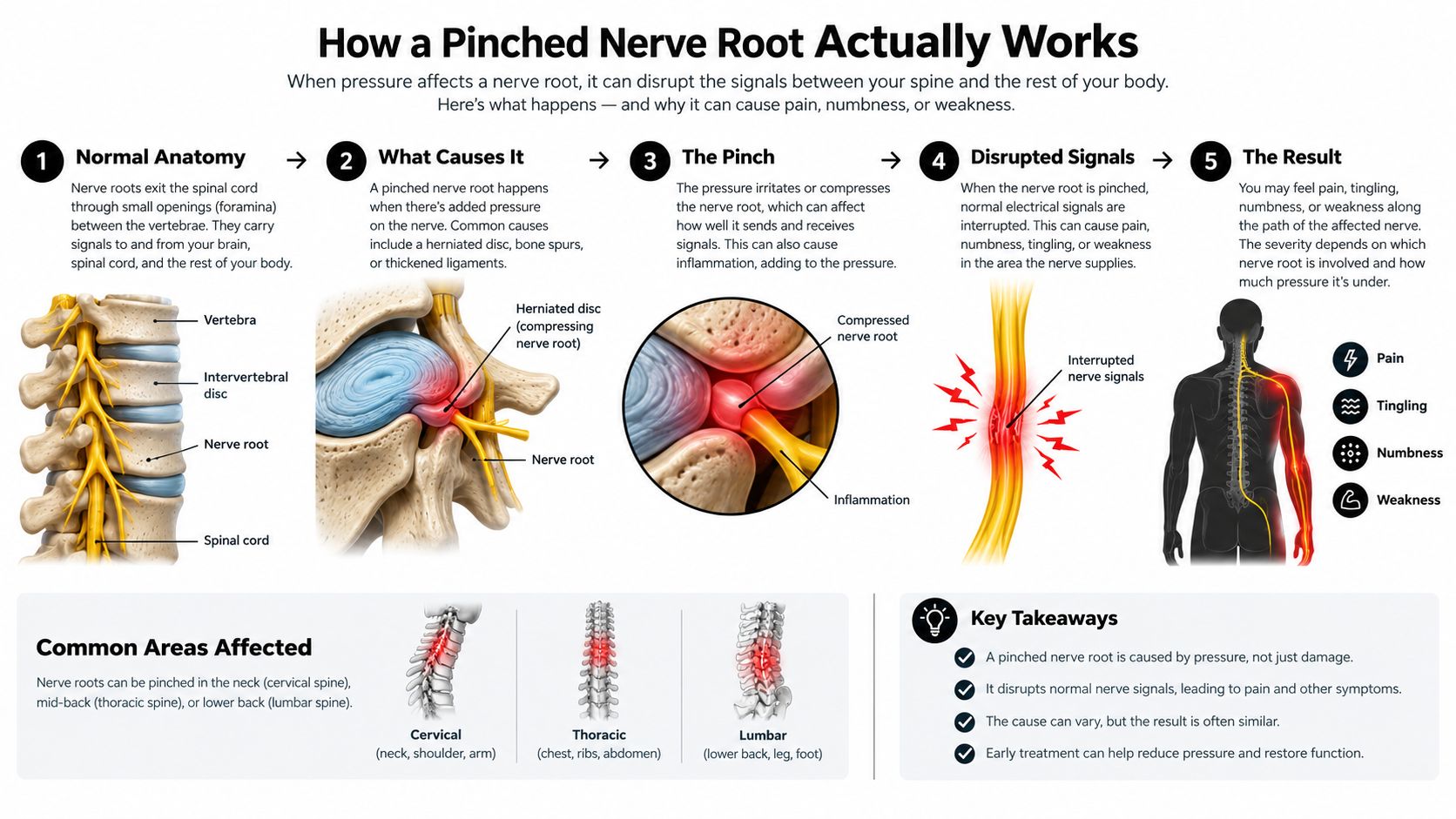
A neck movement can narrow the passage where a nerve leaves the spine, and the resulting irritation may send symptoms into the shoulder, arm, or hand. The spinal cord runs through the central canal. Individual nerve roots branch outward through openings called foramina between neighboring vertebrae, carrying sensory and movement signals to specific body regions.
A disc herniation, bone spur, or thickened ligament can crowd one of these openings. Pressure may irritate the nerve mechanically, while inflammation can make it more sensitive. Symptoms may therefore change with posture even when the underlying narrowing has not changed.
Why pain follows a route
Each nerve root supplies predictable areas of skin and muscle. Irritation can therefore create a band-like or track-like pattern called a dermatomal pattern, rather than causing discomfort throughout the entire arm.
The borders overlap, so symptoms rarely form a perfect map. Still, the distribution gives a clinician a working hypothesis:
- C5 involvement may affect the shoulder area and deltoid function.
- C6 involvement may extend along the outer arm toward the thumb or index finger and affect biceps or wrist-extension strength.
- C7 involvement may travel along the back of the arm toward the middle finger and affect triceps function.
These patterns guide the examination, but they cannot confirm one nerve root by themselves. Imaging findings also do not always match the symptoms a person feels. For a plain-language comparison, see this guide to disc conditions.
The nerve carries both sensory and motor signals. Sensory irritation may cause pain, tingling, or numbness. Motor involvement may make an ordinary task unexpectedly difficult, such as lifting, pushing, or gripping. A symptom pattern that is spreading or paired with increasing weakness deserves a more timely assessment at an Illinois pain and wellness clinic such as Midwest Pain & Wellness.
Classic Cervical Radiculopathy Symptoms to Recognize
A person may notice the problem while reaching for a cup, carrying a bag, or turning the head. Pain can begin in the neck or shoulder blade and then follow the arm. Common descriptions include burning, pins and needles, crawling, buzzing, or a sudden electric jolt.
Arm pain is often more prominent than neck pain. That distinction matters because meaningful nerve-root irritation can occur even when neck discomfort is mild or absent. The clinical review of symptom frequencies cited earlier supports examining the full arm and neurologic system, rather than focusing only on the neck.
Sensory and motor clues
Numbness and tingling are related, but they do not feel the same. Numbness dulls normal sensation. Tingling may feel like prickling, static, or tiny electrical pulses. Some people notice altered temperature sensation or discomfort when clothing brushes the skin.
Weakness may appear first as a change in performance. You might drop an object, struggle to lift a bag, have difficulty pushing a door open, or lose control during a familiar movement. Reflexes provide another piece of the examination. A clinician may compare the biceps, brachioradialis, and triceps reflexes on both sides.
| Nerve root | Pain pattern | Sensory changes | Weakness | Reflex change |
|---|---|---|---|---|
| C5 | Neck or shoulder into the upper arm | Shoulder-region altered sensation | Deltoid or shoulder elevation difficulty | Biceps may be reduced |
| C6 | Lateral arm toward the thumb or index-finger region | Lateral forearm or thumb-side tingling | Biceps or wrist-extension weakness | Brachioradialis or biceps may be reduced |
| C7 | Posterior arm toward the middle-finger region | Middle-finger or central-hand tingling | Triceps or pushing weakness | Triceps may be reduced |
These levels offer a working map, not a fixed diagnosis. Neighboring nerve territories overlap, and the same nerve root can produce different symptoms in different patients. Pain is often the main complaint, with altered sensation also common. Weakness may be less obvious, which is why a careful strength examination matters even when pain dominates the visit. The primary-care discussion of cervical radiculopathy describes this examination-based approach.
A symptom trend deserves particular attention: weakness that is spreading or becoming harder to compensate for should lead to a more timely assessment. In Illinois, Midwest Pain & Wellness can evaluate the pattern, examine nerve function, and help determine the appropriate next step.
Overlooked Symptoms That Change the Picture
A patient may report hand clumsiness rather than severe pain. Dropping keys, fumbling buttons, or struggling with handwriting can reflect impaired motor control. Intrinsic-hand weakness may also resemble a problem farther down the arm, so the clinician checks neck movement, reflexes, sensation, and strength instead of assuming the wrist is responsible.
The pattern becomes more concerning when function is changing. Stable symptoms that gradually improve may allow time for a measured evaluation. Symptoms that spread, weaken the hand, or interfere with walking require faster attention.
Function can reveal a higher level of concern
Balance changes deserve particular care. Gait imbalance, leg heaviness, or unexpected falls may suggest that the spinal cord is affected rather than a single nerve root. Urinary urgency can also occur with cervical cord involvement. These findings do not establish a diagnosis, but they change the workup and should not be dismissed as routine muscle tension.
Persistent night pain is another reason to arrange an assessment, especially when it repeatedly wakes you and no longer improves with a change in position. Neck stiffness without arm pain can still matter when strength, dexterity, or mobility is worsening.
A practical way to judge urgency is to track what your body can no longer do. Can you grip a cup, button clothing, write, climb stairs, and walk without new unsteadiness? Loss of ability is more informative than a single difficult morning. Pain may fluctuate, while declining coordination or strength can signal a problem that needs timely examination.
At Midwest Pain & Wellness in Illinois, an evaluation can compare these changes with the neurologic examination and help determine the appropriate next step. Seek prompt medical guidance when weakness is progressing, balance is deteriorating, or bladder symptoms appear. The review of less typical cervical radiculopathy presentations also describes why nerve-related cervical problems may appear outside a simple textbook pattern.
What Happens During Diagnosis and Imaging
Diagnosis begins with a conversation, not a scan. The clinician asks where the pain starts, where it travels, whether sensation has changed, which movements worsen it, and whether strength or coordination has shifted. Your description helps map symptoms to likely nerve roots, while also identifying patterns that may point elsewhere.
The examination then tests the map. A provider may use Spurling's test, upper-limb tension signs, manual strength testing of the deltoid, biceps, triceps, and intrinsic hand muscles, and reflex testing at the biceps, brachioradialis, and triceps. The goal isn't to provoke pain for its own sake. It is to compare sides and determine whether the symptoms have an objective neurologic pattern.
Imaging follows the clinical question
Plain radiographs can help screen for alignment, vertebral changes, or disc-space loss. They don't show nerve tissue as clearly as magnetic resonance imaging, so MRI is generally preferred when soft-tissue or nerve-root compression needs evaluation. CT myelography may have a limited role when MRI isn't sufficient or can't be used, while electrodiagnostic studies can help when imaging is equivocal or symptoms persist despite treatment.
| Diagnostic step | What it checks | When it is used |
|---|---|---|
| History | Pain route, sensation, weakness, triggers, and progression | At the first visit |
| Neurologic examination | Strength, sensation, reflexes, coordination, and provocative signs | At the first visit and follow-up |
| Plain radiographs | Alignment and bony or disc-space changes | When structural screening is appropriate |
| MRI | Discs, nerve roots, spinal cord, and other soft tissues | When findings may change treatment |
| Electrodiagnostic testing | Nerve and muscle function | When the diagnosis remains uncertain or symptoms persist |
You may leave the first appointment with a working diagnosis and a plan rather than an immediate procedure. At follow-up, the provider reviews your response, examines any change in function, and decides whether imaging or additional testing will alter care. This overview of diagnosing nerve pain explains why the history and examination remain central even when imaging is available.
Treatment Pathways From Conservative to Interventional
Treatment should match the symptom pattern, the examination, and the direction symptoms are taking. A typical starting point may include activity modification, targeted physical therapy, anti-inflammatory medication when medically appropriate, and a short trial of a neuropathic medication such as a gabapentinoid or duloxetine. A structured conservative trial commonly takes four to six weeks, provided strength and neurologic function remain stable.
The objective isn't to make you rest. It is to reduce aggravating positions, maintain useful movement, improve strength and control, and give irritated tissues time to settle. Medication choices depend on kidney function, stomach health, other prescriptions, sleep, mood, and individual risk factors.
Matching an intervention to the problem
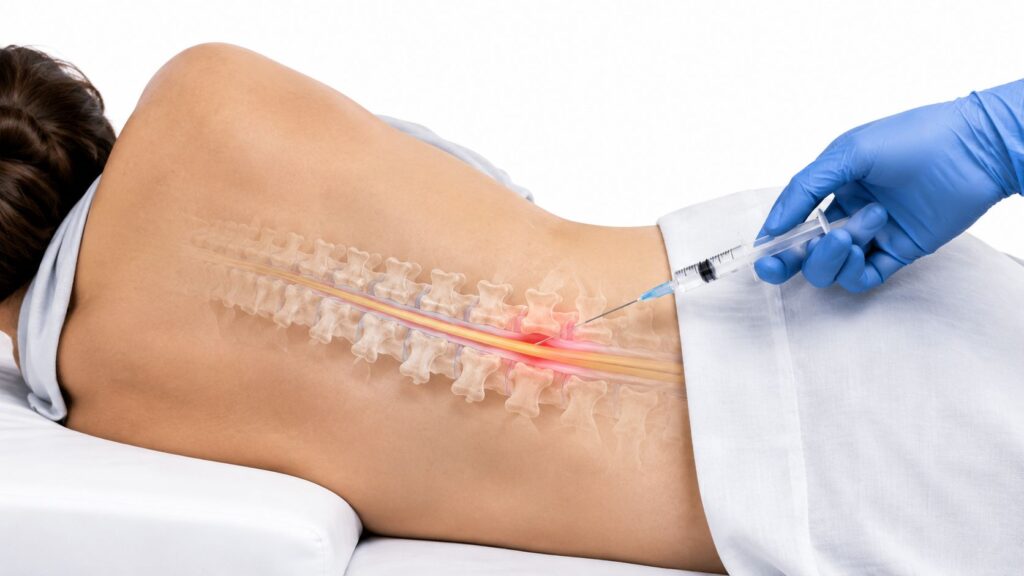
When radiating symptoms continue, an image-guided cervical epidural steroid injection may deliver anti-inflammatory medication near the irritated region. A selective nerve-root block can help target a suspected root and may provide diagnostic information as well as relief. These procedures don't repair every structural cause, but they can reduce the inflammation and pain that restrict rehabilitation.
Facet-mediated neck pain is a different pattern. When examination and diagnostic blocks point toward the facet joints, medial-branch blocks or radiofrequency ablation may be considered. These treatments address pain signals from facet joints rather than treating a compressed nerve root as though every neck problem were the same.
| Pathway | Main purpose | When it may fit |
|---|---|---|
| Activity modification and rehabilitation | Reduce aggravation while preserving function | Stable symptoms without concerning progression |
| Medication | Calm inflammation or reduce nerve-related pain | Short-term symptom control when medically appropriate |
| Epidural or selective nerve-root injection | Target inflammation near a symptomatic root | Persistent radicular pain after evaluation |
| Medial-branch treatment or ablation | Address facet-mediated pain | Confirmed facet contribution |
| Surgical consultation | Consider decompression or stabilization | Progressive motor deficit or refractory pain after structured care |
| Neuromodulation | Modulate persistent pain signals | Select persistent cases after appropriate evaluation |
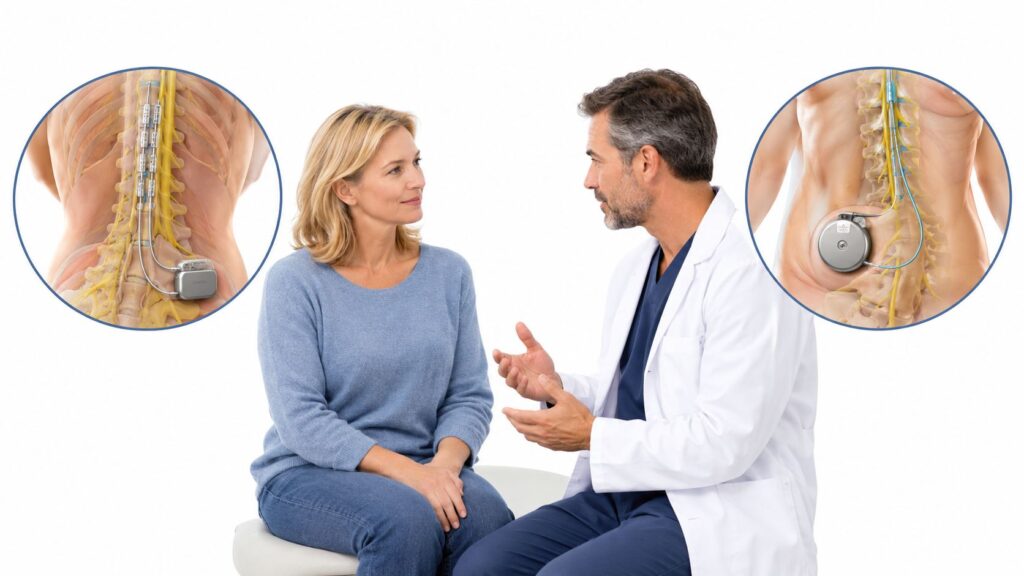
Progressive weakness needs a different conversation from pain alone. Surgical referral may become appropriate when motor function is declining or radicular pain remains disabling despite structured conservative care. In selected persistent cases, spinal cord stimulation may be discussed as part of a broader plan, not as a first response to a new symptom.
Patients considering surgery may find it useful to find anterior cervical discectomy relief and review the questions they want to bring to a surgical consultation. Midwest Pain & Wellness can coordinate an opioid-sparing, multimodal plan that may include rehabilitation, image-guided injections, nerve blocks, radiofrequency procedures, or stimulation when those options fit the clinical findings. Recovery information for an epidural procedure is available in this guide to epidural steroid injection recovery.
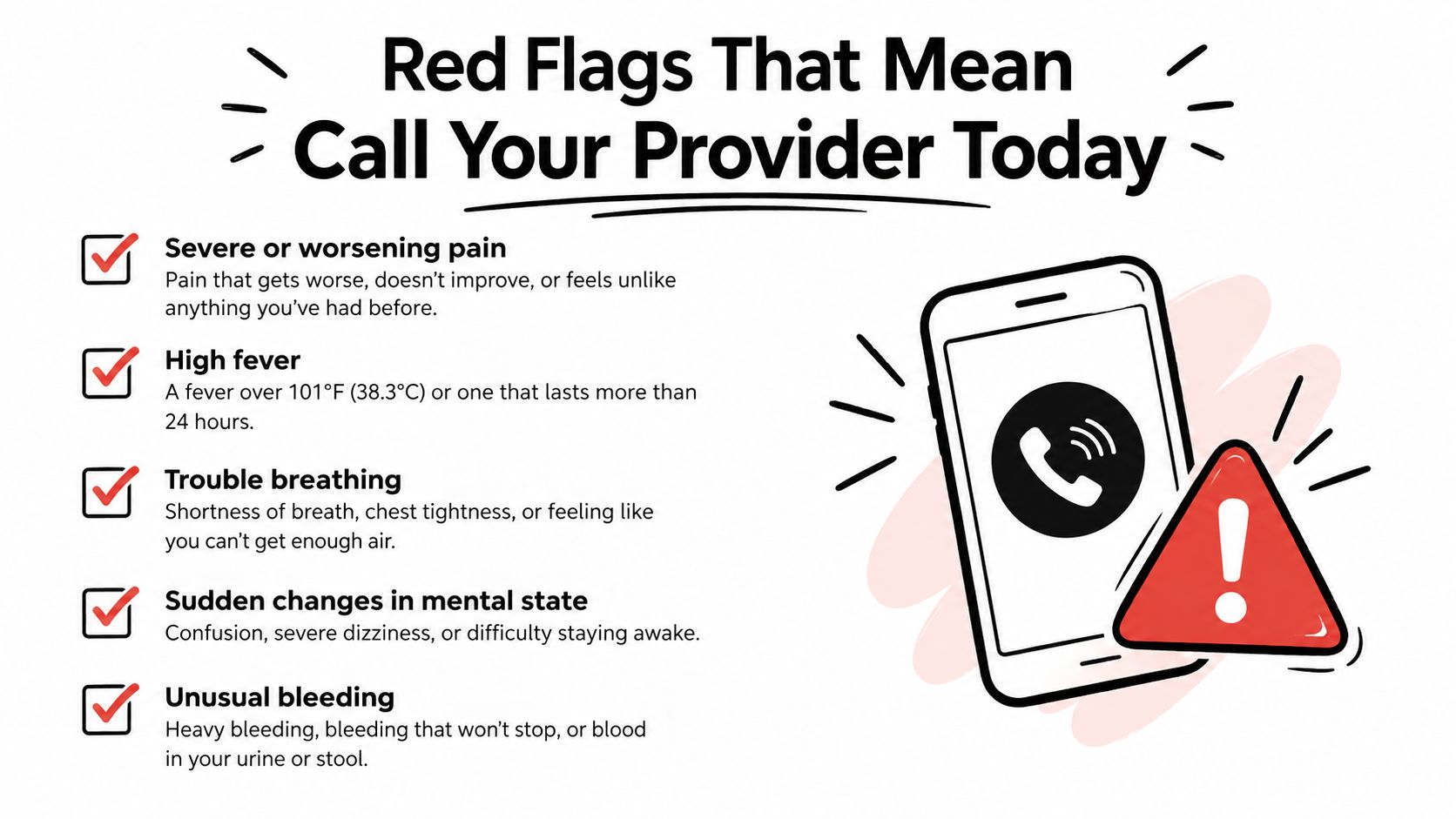
Red Flags That Mean Call Your Provider Today
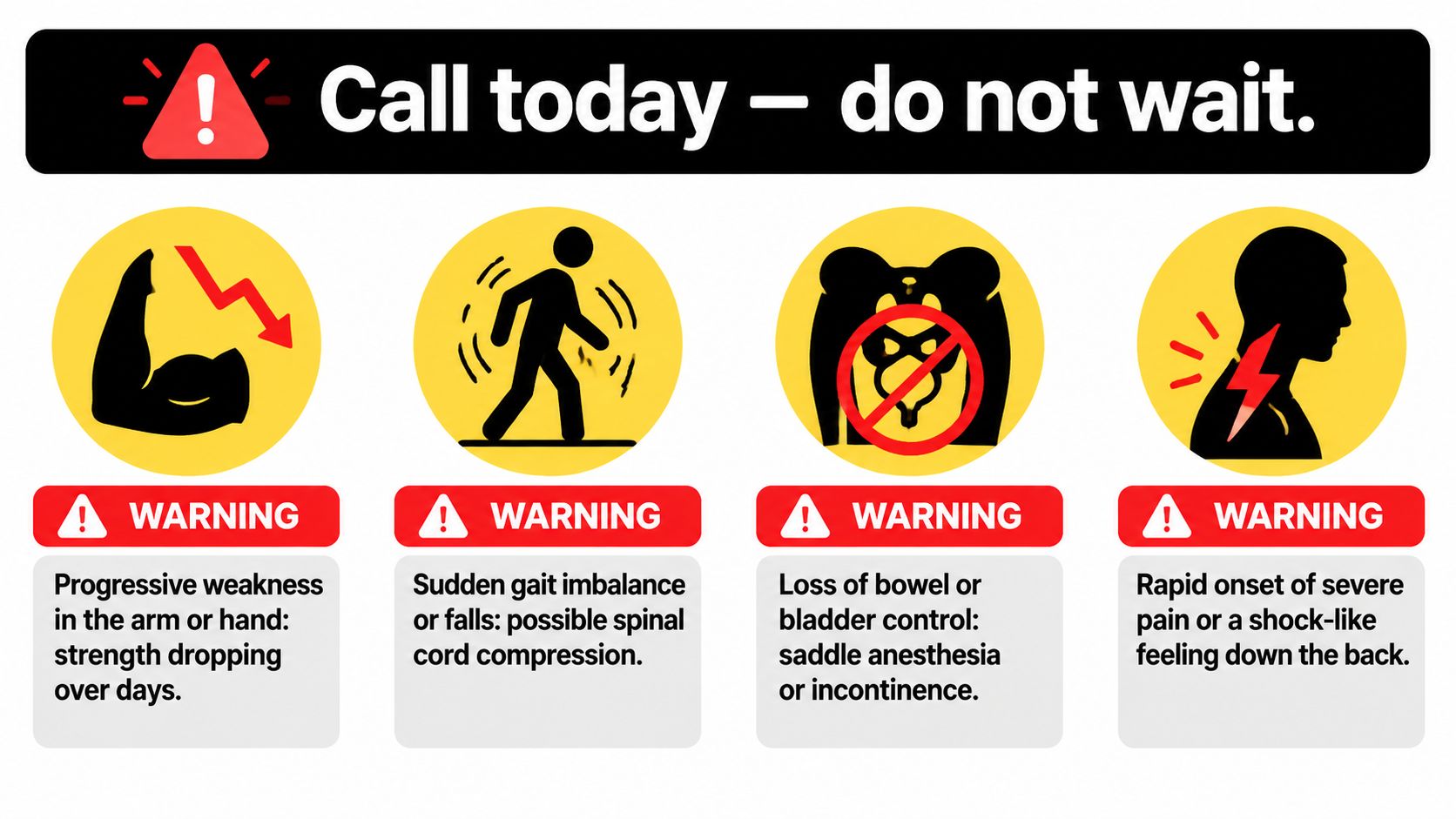
Most neck-to-arm pain doesn't require panic, but certain changes shouldn't wait for a routine appointment weeks away. The most important warning sign is progressive neurologic loss, meaning the arm or hand is becoming weaker, less coordinated, or less useful over time.
Call the Chicago Ridge clinic and explain the change in function clearly. Say where the weakness or numbness is located, when it began, whether it is worsening, and whether you have balance, bowel, or bladder symptoms. That information helps triage staff understand that the concern involves neurologic function rather than ordinary soreness.
Use this short checklist
- Arm or hand weakness: Strength is dropping over days, or you can't perform tasks you could previously do.
- Gait imbalance or falls: Walking feels unsteady, your legs feel heavy, or you have started falling.
- Bowel or bladder changes: You lose control or develop a new inability to control these functions.
- Saddle-area numbness: Sensation changes in the pelvic or inner-thigh region require urgent guidance.
- Rapidly worsening night pain: Severe pain escalates quickly and no longer improves with a position change.
- Shock-like symptoms: A sudden electrical sensation travels down the spine or into the limbs, especially with new coordination problems.
These findings can suggest spinal cord involvement or another urgent neurologic problem. Guidance for 2026 emphasizes progressive deficits and possible myelopathy as reasons for prompt referral, because declining function matters more than how tolerable the pain feels at a particular moment.
Stable tingling, mild radiating pain, or symptoms that are gradually improving still deserve an appointment, but they may be appropriate for routine evaluation. If you're also dealing with leg pain during pregnancy, keep that as a separate concern and review safe pregnancy leg pain self-care advice with an appropriate clinician.
Taking the Next Step at Midwest Pain & Wellness
If you're in Chicago Ridge, Palos Heights, Palos Hills, Evergreen Park, Hickory Hills, or nearby Illinois communities, start by contacting Midwest Pain & Wellness by phone or through its online request process. Ask about the evaluation of radiating neck and arm pain, numbness, tingling, weakness, or changing function.
At the first visit, expect a focused history, a neurologic examination, and a review of any outside imaging. Bring prior imaging CDs or reports, a current medication list, and operative notes if you've had spine surgery. It also helps to write down when symptoms began, what movements worsen them, and whether your strength, balance, or hand coordination has changed.
Ask the scheduling team about insurance participation, referral requirements, appointment availability, and language-access needs. These practical questions can prevent delays for patients throughout the Southwest suburbs of Illinois.
An interventional pain specialist can also provide a second opinion before surgery is considered. The purpose is to clarify whether your symptoms fit a nerve-root pattern, whether further studies would change management, and which treatment matches your goals.
Midwest Pain & Wellness evaluates cervical radiculopathy symptoms with focused neurologic examinations and individualized, opioid-sparing treatment plans that may include rehabilitation, image-guided injections, nerve blocks, or other interventional options. If radiating neck and arm pain is affecting your strength, sleep, or daily function, visit Midwest Pain & Wellness to request an evaluation in the Chicago Ridge area.