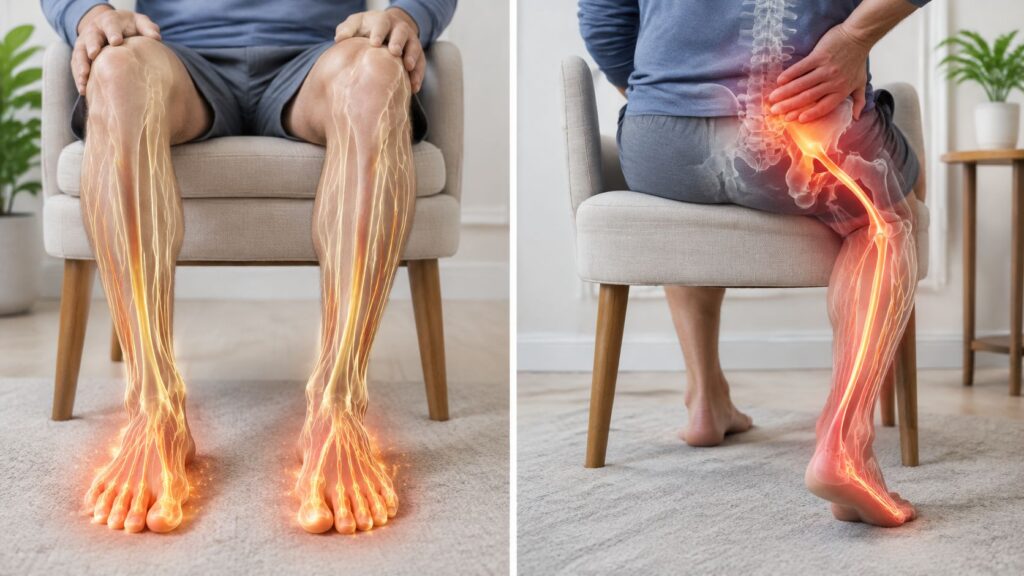
You wake up with a burning line of pain down the leg, or a patch of numbness in the foot that wasn't there last month. Maybe your back scan showed “mild changes,” but that doesn't explain the electric jolt in your calf. Maybe someone already told you the test was normal, so you're left wondering whether the pain is being missed.
That situation is common in pain clinics across Illinois, including Chicago Ridge and nearby communities like Oak Lawn, Palos Hills, Palos Heights, Worth, Bridgeview, Hickory Hills, Alsip, Burbank, Evergreen Park, and Orland Park. Diagnosing nerve pain isn't about chasing one magic test. It's about matching your symptoms, exam findings, and targeted studies to the anatomy that could be generating your pain.
A careful diagnosis matters because nerve pain behaves differently from a muscle strain, arthritis flare, or tendon injury. It also responds differently. If the diagnosis is off, treatment often misses the mark. If the diagnosis is precise, the path to opioid-sparing relief becomes much clearer.
Understanding Your Nerve Pain Symptoms
A lot of patients describe the same early frustration. The pain doesn't feel like soreness. It feels strange. Burning. Tingling. Sharp. Sometimes cold. Sometimes like a live wire under the skin. It may come with numbness, sensitivity to touch, or pain from clothing, bedsheets, or light pressure that shouldn't hurt.

That pattern is different from nociceptive pain, which comes from irritated tissues like joints, muscles, or ligaments. Nociceptive pain is often described as aching, throbbing, or sore. Neuropathic pain comes from nerve injury or dysfunction, and it often feels electrical, burning, stabbing, or pins-and-needles in nature.
What nerve pain often feels like
Some symptom patterns raise suspicion right away:
- Burning pain that tracks down an arm, leg, hand, or foot
- Electric shock sensations with certain movements
- Tingling or pins-and-needles that don't go away
- Numbness mixed with pain
- Allodynia, where light touch hurts
- Temperature sensitivity, especially burning or cold discomfort
Your words matter. “Burning,” “zapping,” and “tingling” aren't casual descriptions. They are diagnostic clues.
Nerve pain is also common enough that you shouldn't dismiss it as unusual. It affects roughly 1 in 10 adults, and an estimated 20 million Americans suffer from peripheral nerve damage, a major cause of these symptoms according to this review on neuropathic pain prevalence.
Why the first label you get may be incomplete
Patients are often told they have “sciatica,” “a pinched nerve,” or “neuropathy.” Sometimes that's accurate. Sometimes it's only a placeholder until the underlying source is mapped. Pain in the leg could come from a spinal nerve root, a peripheral nerve, a small-fiber process, or a non-nerve condition mimicking nerve pain.
If you're trying to understand whether a radiating symptom pattern fits a nerve injury, this overview of spinal nerve injury symptoms can help you frame the discussion before your visit. For readers looking outside Illinois for a broader conservative care perspective, this resource on non-surgical pinched nerve care in Kansas City also gives useful context on how persistent nerve-related symptoms can be approached without jumping straight to surgery.
The First Step A Focused Clinical Evaluation
Before any scan, injection, or procedure, the strongest diagnostic tool is still the office visit. A good nerve pain evaluation starts with your history and a hands-on examination. That's not old-fashioned medicine. It's the foundation.
The most accurate diagnostic formula for peripheral nerve issues is a 50-50 combination of a detailed patient history and a thorough physical examination according to this discussion of peripheral nerve diagnosis. That means the conversation is not a prelude to the essential work. It is the essential work.

What your history tells the specialist
The details matter more than commonly realized. A specialist listens for the pattern, not just the pain level.
- When it started helps separate sudden compression, gradual degeneration, post-surgical irritation, and metabolic causes.
- Where it travels helps map the pain to a spinal root, peripheral nerve, or more diffuse process.
- What it feels like helps distinguish nerve pain from joint or muscle pain.
- What makes it worse can reveal compression, motion sensitivity, or inflammatory triggers.
- What else came with it matters too, including weakness, balance change, skin color change, or numbness.
Diabetes often enters this conversation because it's a common driver of peripheral neuropathy. If blood sugar evaluation is part of your workup, a patient-friendly explainer on understanding diabetes test results can make those lab discussions easier to follow.
What the physical exam is actually checking
A focused exam is not a generic routine. It is a map. The clinician is checking whether your symptoms line up with actual nerve anatomy.
That usually includes:
- Strength testing to look for muscle weakness linked to a specific nerve or spinal level
- Reflex testing to identify changes that support root or nerve involvement
- Pinprick and light touch testing to map altered sensation
- Cold perception testing because some nerve problems show up there first
- Skin and tissue inspection for color change, swelling, hair change, or trophic changes
- Provocative maneuvers that may reproduce symptoms when a nerve is under tension or compressed
Practical rule: If the story and the exam don't fit the imaging, the diagnosis isn't finished.
Why this matters in real practice
A patient in Palos Hills or Bridgeview may arrive with an MRI report that sounds serious but doesn't match the painful area. Another may have mild imaging findings but a very convincing sensory deficit and weakness pattern. The specialist's job is to decide which findings matter and which are incidental.
No single test confirms every case of nerve pain. The diagnosis becomes stronger when your symptom description, neurologic exam, and anatomy all point in the same direction.
Navigating Advanced Diagnostic Tests
Once the clinical evaluation suggests nerve involvement, the next step is choosing the right test for the right question. Many patients stumble at this point. A “normal” test may mean the wrong structure was tested, not that nothing is wrong.
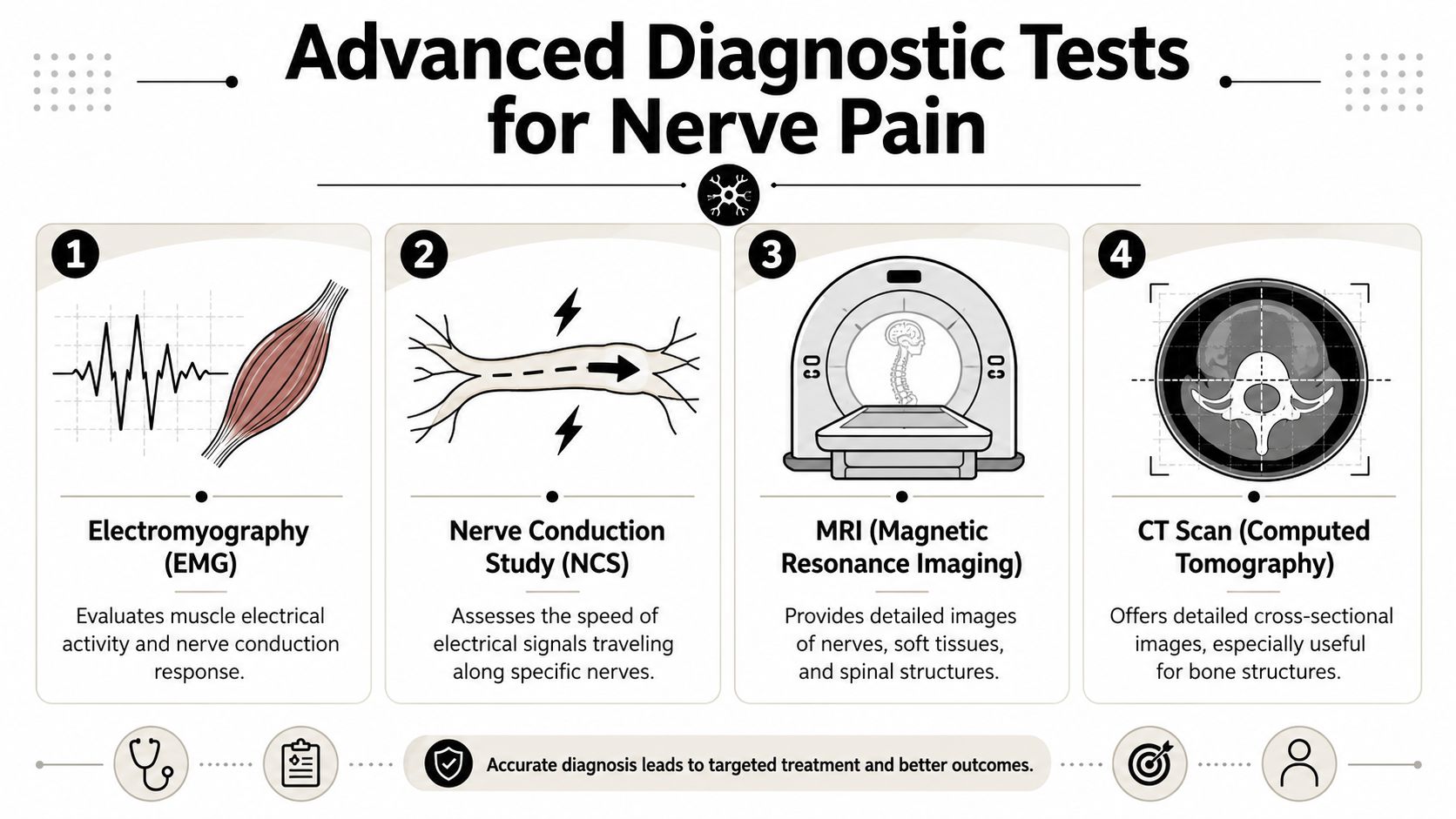
What the common tests actually do
Some tests measure function. Others show structure. Those are not the same thing.
| Test | What It Measures | Best For Detecting | Limitation |
|---|---|---|---|
| EMG | Muscle electrical activity | Nerve-related muscle dysfunction, radiculopathy patterns, motor nerve involvement | Doesn't directly evaluate small pain fibers |
| NCS | Speed and strength of electrical signals in nerves | Large-fiber peripheral nerve problems | Can miss small-fiber neuropathy |
| MRI | Structural detail of spine and soft tissues | Disc issues, stenosis, nerve compression, masses | May show abnormalities that aren't causing pain |
| CT scan | Cross-sectional structural imaging, especially bone detail | Bony narrowing or anatomy when bone detail matters | Less helpful for many soft tissue pain questions |
A clinician may also use ultrasound in selected situations, particularly when evaluating a peripheral nerve dynamically or planning a targeted procedure. If you want to understand how image guidance improves precision, this explanation of ultrasound guidance for nerve blocks is useful background.
The problem with normal EMG results
One of the biggest myths in pain medicine is that a normal EMG means there's no nerve pain. That isn't true.
A major pitfall is that EMG and nerve conduction studies measure large nerve fibers and can miss small-fiber neuropathy. Nearly 50% of patients with small-fiber neuropathy are initially misdiagnosed because their EMG results are normal according to this discussion of the small-fiber diagnostic gap.
That matters because small-fiber neuropathy often causes the very symptoms patients are trying to explain: burning pain, temperature sensitivity, and skin hypersensitivity.
A normal test can be informative, but it should never be used as proof that your pain isn't real.
When a specialist looks beyond standard electrodiagnostics
If someone in Alsip or Hickory Hills reports burning feet, severe touch sensitivity, or heat-related worsening, yet the EMG is unrevealing, the next question isn't “Are you sure this is nerve pain?” The next question is whether the pain involves fibers the EMG cannot detect.
In those cases, specialists may consider tools such as:
- Validated symptom questionnaires that support a neuropathic pain pattern
- Quantitative sensory testing, which can assess sensory thresholds
- Skin biopsy, the gold standard for confirming small-fiber neuropathy
- Targeted imaging, when anatomy still needs clarification
- Electrophysiologic testing, when large-fiber or root involvement remains in question
Another practical point is that imaging can mislead in the opposite direction. An MRI may show narrowing, disc bulges, or degenerative change that looks impressive on paper but doesn't match the pain pattern on exam. Structural findings only matter when they line up with the patient in front of you.
Pinpointing the Pain Generator with Diagnostic Injections
After the history, exam, and testing narrow the possibilities, there may still be one final question. Which structure is producing the pain right now?
That's where diagnostic injections become especially valuable. These are not just treatment shots. In the right setting, they are confirmation tools. A specialist places numbing medication around a specific nerve, joint, or spinal target under imaging guidance and then watches what happens to your usual pain.
Why this step can change the whole plan
If the correct structure is numbed and your familiar pain temporarily shuts off, that response helps identify the pain generator. If nothing changes, the diagnosis may need revision. That feedback is far more useful than guessing based on symptoms alone.
The precision of diagnosis affects treatment success. Diagnostic nerve blocks that identify the specific pain generator can increase the accuracy of matching a patient to the right long-term treatment by 2.3 times and improve relief rates by 40% according to this review of diagnostic injection strategy.
What diagnostic injections can answer
A targeted block may help sort out questions such as:
- Is the pain coming from a spinal nerve root or from a peripheral nerve?
- Is the painful structure the sacroiliac joint, facet joint, or a compressed nerve?
- Is the MRI finding relevant, or just present?
- Would a more durable procedure make sense if the temporary block works?
For example, a patient in Worth or Burbank may have leg pain with mixed imaging findings. One study suggests several possible culprits. A carefully chosen block can clarify which site matters most clinically.
Diagnostic injections are most useful when the diagnosis is close, but not fully proven.
What patients should expect
These procedures are typically brief and image-guided. The key is not whether you feel numbness alone. The key is whether your usual pain changes in the expected area and time window.
Patients who want a plain-language overview of the procedure itself can review what a nerve block injection is. The larger point is that a good pain specialist doesn't use injections randomly. The injection is chosen to answer a specific diagnostic question.
What to Expect at a Specialist Pain Clinic
A specialist pain clinic looks at nerve pain differently from a general urgent care visit or a rushed one-problem appointment. The goal is to assemble the whole picture, not to react to one isolated finding.
The first major distinction
A specialist must decide whether the pain is central or peripheral. That changes everything that comes after it.
An accurate diagnosis must differentiate between central nerve pain, such as pain related to stroke or spinal cord injury, and peripheral nerve pain, such as pain linked to diabetes, trauma, or vitamin deficiencies, because the underlying cause dictates treatment strategy as outlined in this overview of central versus peripheral nerve pain.
How the data gets integrated
At a specialist visit, the diagnosis usually comes from combining several layers of information rather than elevating one test above all else:
- Symptom pattern including burning, numbness, spread, and triggers
- Neurologic examination showing whether strength, reflexes, or sensation support a specific pathway
- Prior studies such as MRI, EMG, or lab work
- Diagnostic procedures when the anatomy still needs confirmation
- Medical context including diabetes, prior surgery, trauma, or nutritional issues
Patients from Evergreen Park or Orland Park often feel a shift in care. Instead of hearing, “Your scan isn't too bad,” they hear a more useful explanation: “Your symptoms and exam suggest this nerve pathway. These findings fit. These don't.”
When the diagnosis is accurate, treatment stops being a trial-and-error cycle and starts becoming a strategy.
What treatment planning looks like after diagnosis
A specialist pain clinic focused on opioid-sparing care usually aims for targeted treatment. That may include image-guided procedures, nerve-focused interventions, neuromodulation strategies, rehabilitation coordination, or minimally invasive options when appropriate.
The right plan depends on what was diagnosed. Burning foot pain from small-fiber neuropathy is not managed the same way as lumbar radicular pain. Central pain is not treated the same way as a peripheral entrapment. Precision matters more than speed.
Take Control of Your Nerve Pain Diagnosis
If you're trying to figure out how to diagnose nerve pain, the most important thing to know is this. The process is investigative. It rarely comes down to one lab, one scan, or one office test.
A strong diagnosis starts with your story. It becomes more precise with a focused neurologic exam. It gets refined by choosing tests that match the suspected problem. And when needed, it gets confirmed by targeted diagnostic injections that reveal the true pain generator.
What works and what usually fails
The patients who make progress usually avoid two common traps.
- Trap one is assuming imaging alone has the answer. MRI can help, but only if it matches the symptoms and exam.
- Trap two is assuming a normal electrodiagnostic test ends the search. It doesn't, especially when small-fiber symptoms are present.
- What works is correlation. Symptoms, anatomy, and test findings must make sense together.
- What also works is specialist-level pattern recognition. Nerve pain often has a logic to it, but someone has to trace that logic carefully.
Questions worth asking at your appointment
Bring direct questions. Good answers help expose whether the evaluation is thorough.
- What nerve or structure do you think is causing this pain?
- Do my symptoms fit a spinal nerve problem, a peripheral nerve problem, or something else?
- If my prior test was normal, what could it have missed?
- Would a diagnostic block help confirm the source?
- What opioid-sparing treatments make sense once the diagnosis is clear?
For patients in Chicago Ridge and neighboring Illinois communities such as Palos Heights, Oak Lawn, Worth, Bridgeview, Burbank, Alsip, Hickory Hills, Evergreen Park, Palos Hills, and Orland Park, that level of clarity is worth pursuing. Unexplained nerve pain can wear down sleep, movement, mood, and confidence. But vague answers are not the endpoint.
A careful diagnosis gives you something more useful than reassurance alone. It gives you a roadmap.
If you're dealing with burning, tingling, numbness, shooting pain, or “normal” test results that don't match how you feel, Midwest Pain & Wellness offers specialist evaluation for spine and nerve pain in Chicago Ridge, Illinois. Dr. Yaw Donkoh and the team focus on precise diagnosis, image-guided care, and personalized opioid-sparing treatment plans designed to restore function, not just mask symptoms.