Yes, Botox for chronic migraine is covered by most major insurance plans, including Medicare and commercial insurers, but approval depends on meeting specific clinical thresholds and completing prior authorization. If you're waking up to another migraine and staring at a stack of insurance forms, the answer is usually not “no,” it's “prove medical necessity with the right documentation.”
That distinction matters because chronic migraine treatment is not treated like a cosmetic Botox visit. It's a preventive therapy with a clear insurance pathway, but the pathway is picky. In practice, patients do better when the clinic knows how to document headache frequency, prior preventive failures, and specialist involvement before the insurer asks for it.
If you want a plain-language overview of the treatment itself, how Botox works for migraines is a useful place to start. For patients in Chicago Ridge, IL, and nearby Palos Heights, Palos Hills, Evergreen Park, and Hickory Hills, the key question is less about whether Botox can help and more about how to get the plan to pay for it without getting lost in paperwork.
Table of Contents
- Why Botox for Migraine Is Covered and What That Means for You
- Clinical Criteria Insurers Use to Approve Botox for Chronic Migraine
- Navigating Prior Authorization and Appeals for Botox Coverage
- Understanding Your Out-of-Pocket Costs With and Without Insurance
- When Botox Alone Is Not Enough and Combination Therapy Gets Denied
- Your Next Steps for Botox Coverage at Midwest Pain and Wellness
- Key Takeaways and Common Questions About Botox Insurance Coverage
Why Botox for Migraine Is Covered and What That Means for You
A patient sits in the exam room with a headache diary, two denied medications, and a plan that keeps sending the same message back, “not enough documentation.” That scene is common because Botox for chronic migraine is an FDA-approved preventive treatment, and insurers cover it when the chart shows the diagnosis and the treatment history they want to see.
Practical rule: coverage starts with the diagnosis, not the injection date. If the chart doesn't prove chronic migraine and prior preventive use, the insurer usually won't treat the request as complete.
Most major plans, including commercial insurance and Medicare, do cover Botox for chronic migraine when medical necessity is established. Medicare-oriented guidance notes that Part B can cover Botox when it's medically necessary, with beneficiaries typically paying 20% coinsurance after the deductible, and the cited guidance lists a commonly referenced annual Part B deductible of $257 (Medicare coverage summary). Manufacturer coverage information also shows that Botox for chronic migraine is broadly reimbursed in U.S. insurance markets, with about 100% of commercially insured treated patients and about 100% of Medicare-treated patients having coverage, while average patient out-of-pocket costs are about $352 per treatment for commercially insured patients and about $393 per treatment for Medicare patients (BOTOX cost and coverage).
That's the good news. The less convenient news is that approval is usually tied to the insurer's chronic migraine definition and prior authorization rules. In other words, coverage exists, but it's conditional.
For patients in Chicago Ridge, IL, and the surrounding Illinois suburbs, that usually means the first visit should focus on proof, not guesswork. A pain and wellness clinic that handles migraine documentation day to day can help turn a frustrating “maybe” into a workable coverage request, especially when the insurer wants a clean record of headache frequency, failed preventives, and specialist oversight.
Clinical Criteria Insurers Use to Approve Botox for Chronic Migraine
Insurance reviewers usually start with one question, does the chart show chronic migraine rather than episodic migraine? One commercial policy defines chronic migraine as headaches on 15 or more days per month for more than 3 months, with at least 8 migraine days per month (commercial policy criteria). That definition is the gatekeeper because Botox coverage is tied to chronic migraine, not occasional or less frequent attacks.
What the insurer wants to see in the chart
The headache count matters, but so does the treatment history. The same commercial policy requires documented failure or intolerance of at least 3 different prophylactic drug classes, each tried for at least 2 months (commercial policy criteria). That means a vague note like “tried meds before” is not enough. The insurer wants names, dates, duration, and why each preventive was stopped.
A headache diary is the cleanest way to support the diagnosis because it shows frequency over time. Medication lists help prove prior failure. Specialist notes help confirm that the treatment request comes from a clinician who understands chronic migraine, not a generic pain complaint.
If the chart shows 12 headache days a month, the request often stalls. If it shows 15 or more headache days with 8 migraine days, plus documented preventive failures, the case becomes far stronger.
Why patients get stuck here
Many patients have tried preventives, but they haven't kept records of side effects or the exact length of each trial. That creates a gap between what happened and what the insurer can verify. In coverage reviews, verification beats memory every time.
For patients in Palos Heights, Palos Hills, Evergreen Park, and Hickory Hills, self-checking against those criteria before submission can save weeks. If you're unsure whether your migraines are frequent enough or whether your prior meds are documented well enough, the safest move is to have the clinic review the timeline before the prior authorization goes out.
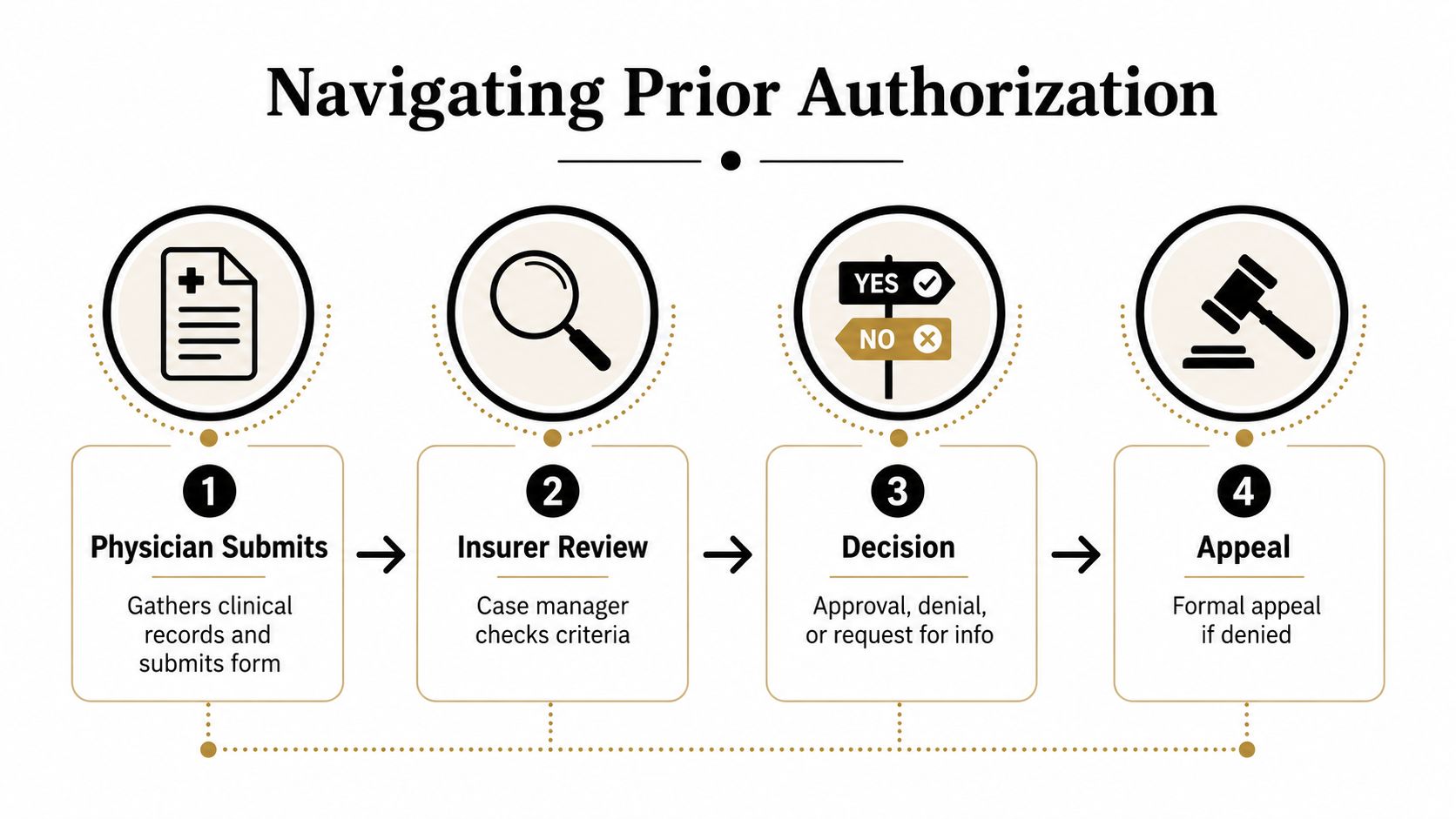
The prior authorization process for how does Botox help migraines? starts with this documentation, not with the injection itself. If the paperwork is thin, the insurer usually asks for more rather than making a quick approval.
Navigating Prior Authorization and Appeals for Botox Coverage
Prior authorization is the part where a good clinical case can still get delayed if the paperwork is sloppy. The provider submits the diagnosis, headache frequency, prior medication history, and the requested treatment plan, then the insurer reviews whether the request matches its policy. That review often turns on the details, not the diagnosis name alone.
What gets submitted and why it matters
The strongest packet usually includes a headache diary, prior preventive medication history, and specialist notes. A prior authorization reviewer wants to see that the patient meets the chronic migraine threshold, that earlier preventives were tried correctly, and that Botox is being requested as a medically necessary preventive rather than a convenience treatment.
A useful internal resource for clinics dealing with coverage friction is stop denials from costing revenue, because the same documentation discipline that protects clinic workflow also protects the patient's approval path. In migraine care, missing dates, incomplete medication lists, or an absent specialist note can be enough to trigger a denial.
Some policies also require the prescription to come from or be in consultation with a neurologist or headache specialist. In that setting, an interventional pain specialist who works within that referral structure can still support the case, as long as the chart reflects the required consult relationship and the insurer's provider criteria are met.
What to do if the insurer says no
A denial isn't the end of the process. It usually means the insurer wants a cleaner case, additional proof, or clarification of the diagnosis and treatment history. The appeal should respond point by point, with the missing evidence attached and the clinical rationale stated plainly.
The most persuasive appeals are boring in the best possible way. They restate the headache count, list the failed preventive classes, show the duration of each trial, and explain why Botox remains medically necessary. If the insurer objected to specialist involvement, the appeal should include the appropriate consultation note.
Practical rule: appeal the insurer's reason, not the denial letter in general. A targeted appeal has a much better chance than a generic “please reconsider” note.
For patients in Illinois suburbs such as Chicago Ridge, IL, the value of an experienced clinic is practical, not abstract. It's the difference between a packet that gets kicked back and one that keeps moving through review.
Understanding Your Out-of-Pocket Costs With and Without Insurance
Coverage matters because the price gap is large enough to change whether treatment is realistic. The FDA-recommended chronic migraine dose is commonly cited as 155 units, and the American Migraine Foundation reports that dose typically costs about $300 to $600 per treatment session after insurance coverage (cost and dosing summary). Without insurance, the same treatment can run roughly $1,200 to $2,500 per session according to the Medicare-focused summary, which is why approval changes the financial picture so dramatically (Medicare coverage summary).
Medicare coverage still leaves cost sharing. Beneficiaries typically pay 20% coinsurance after the deductible, and the cited guidance references a $257 annual Part B deductible (Medicare coverage summary). Manufacturer-reported averages place patient out-of-pocket costs at about $352 per treatment for commercially insured patients and about $393 per treatment for Medicare patients (BOTOX cost and coverage).
| Botox for Chronic Migraine Cost Comparison by Insurance Type | ||
|---|---|---|
| Insurance Type | Average Patient Cost Per Session | Key Cost Factors |
| Commercial insurance | About $352 | Coverage is common, but deductibles, copays, and plan rules still matter (BOTOX cost and coverage) |
| Medicare | About $393 | 20% coinsurance after deductible, with the cited annual deductible guidance listing $257 (Medicare coverage summary) |
| Uninsured | Roughly $1,200 to $2,500 | Full cash-pay exposure, no plan discount (Medicare coverage summary) |
If you're comparing options, how much does Botox cost? is worth reviewing before you start the authorization process. The main point is simple, insurance doesn't make Botox free, but it usually turns an unaffordable treatment into a manageable one.
That difference is why I tell patients to look at approval and cost together. A treatment that's clinically appropriate but financially impossible won't help anyone, and a clinic should be candid about that from the start.
When Botox Alone Is Not Enough and Combination Therapy Gets Denied
The harder question often comes after the first approval. A patient gets some relief from Botox, but not enough, and the next logical step is adding another preventive such as a CGRP-targeted antibody. That's where coverage gets messy, because many insurers still treat layered preventive therapy as redundant even when the patient is clearly still symptomatic.
Why the insurer resists combination treatment
A 2025 Migraine Canada explainer notes that many insurers currently do not cover Botox plus a CGRP antibody together, even though the combination may help some patients (combination coverage gap). From the insurer's point of view, the objection is usually duplication. From the patient's point of view, it's unfinished treatment.
That gap matters because chronic migraine is often treatment-resistant. Many people arrive at Botox only after several preventives have already failed, and the clinical goal is sometimes layered control, not single-agent perfection. Static policy language often lags behind that reality.

How patients can frame the request
The strongest argument for combination therapy is medical necessity tied to documented incomplete response. The chart should show what Botox improved, what symptoms remain, and why the second preventive is being added. That's much stronger than saying the first treatment “didn't work.”
Coverage fights usually happen when the request looks like convenience therapy. They ease when the request reads like a stepwise pain plan with a clear clinical target.
Step therapy can feel out of sync with real migraine care. Insurers often prefer linear pathways, while migraine practice frequently becomes layered over time. Patients do best when their documentation reflects that nuance, especially if the plan later questions whether another preventive is “too much.”
For a pain and wellness clinic, the practical job is to preserve the medical reasoning in the chart so the patient doesn't have to rebuild it after a denial. That's the piece most coverage guides leave out.
Your Next Steps for Botox Coverage at Midwest Pain and Wellness
If you're in Chicago Ridge, IL, or nearby Palos Heights, Palos Hills, Evergreen Park, or Hickory Hills, the best first move is to bring the evidence the insurer will eventually ask for anyway. That usually means a headache diary, prior medication list, insurance card, and any imaging or specialist records that already support the migraine diagnosis. The cleaner the intake, the faster the prior authorization packet can move.
What to bring and how the clinic uses it
At the first visit, the clinician reviews headache frequency, symptom pattern, and prior treatments. That history helps determine whether you meet chronic migraine criteria and whether Botox fits the treatment plan. It also helps decide whether the chart needs more documentation before submission.
A practical resource for preparing for treatment is how to prepare for Botox injections. Preparation matters because insurance approval and treatment readiness usually travel together, and missing details at the start can slow everything down later.
Midwest Pain & Wellness is one option for patients who want a clinic to handle the paperwork as part of care, including the prior authorization process when coverage is needed. The clinic's role is to assess candidacy, recommend a plan, and treat in a way that fits the insurer's documentation rules.
What treatment itself looks like
The commonly used chronic migraine protocol is 155 units distributed across 31 injection sites every 12 weeks. That schedule matters because it matches the standard coverage and treatment cycle, and it gives patients a realistic timeline for follow-up. Some people notice improvement sooner, but coverage decisions should never be based on hope alone.
Practical rule: keep the headache diary going after approval. Reauthorization often depends on showing that the treatment is still clinically useful.
The most efficient path is straightforward. Bring the records, let the clinic assess the history, submit the authorization cleanly, and be ready to appeal if the first answer is incomplete rather than final.
Key Takeaways and Common Questions About Botox Insurance Coverage
Botox for chronic migraine is widely covered, including by commercial insurance and Medicare, but coverage depends on meeting the insurer's chronic migraine criteria and completing prior authorization. The usual treatment interval is every 12 weeks, and the cited Cigna policy allows approval for 1 year when criteria are met (Cigna policy).
Patients often ask whether Medicaid covers Botox for migraine in Illinois. Coverage can vary by plan and program, so the safest answer is that you have to check the specific benefit rules rather than assume a yes or no. If your plan changes mid-treatment, the new payer may require fresh authorization even if the previous one was already approved.
The hardest part is rarely the injection itself. It's usually the step-therapy history, the prior authorization packet, and the need to keep proving medical necessity when the treatment is working only partially or needs adjustment. That's why a clinic that understands the paperwork can save time and frustration.
If you're dealing with chronic migraine in Chicago Ridge or the surrounding Illinois suburbs, don't wait for the next denial to force action. Contact Midwest Pain & Wellness to review your headache history, confirm whether you meet coverage criteria, and start the authorization process with a team that handles migraine Botox every day. Visit Midwest Pain & Wellness to take the next step.